Showing posts with label mint. Show all posts
Showing posts with label mint. Show all posts
Monday, June 18, 2012
RHUBARB AND APPLE CRISP WITH ORANGE AND MINT


The other day my friend Holly brought me some of her "Ruby" rhubarb-- it's so beautiful-- makes your desserts look nicely pinky-red instead of green. I rejected making a pie-- not much time and even my low-fat crust gives DH heartburn (don't tell I said that in public!). Since I had some apples that needed using up, I made a crisp combining the two, but I wanted to add a little "zing" to the dessert, so I added orange zest and juice, and some fresh mint.
For the oat topping, I used pecans instead of walnuts, but use whatever nuts you have around. I use whole wheat flour and oil instead of margarine/vegan butter in my crisp topping-- nobody has ever noticed the difference and it's more nutritious that way.

It turned out very well, and the mint and orange did indeed perk up this old-fashioned stand-by. A keeper, I'd say!

BRYANNA'S RHUBARB AND
APPLE CRISP WITH ORANGE AND MINT
Servings: 8
3 medium apples
(about 1 lb.), scrubbed, cored and cut into 1/4" slices (soft ones are actually recommended here!)
6 cups rhubarb
slices-- roughly 2 lbs. (washed and sliced about 1/4-inch thick)
2 Tbs unbleached
flour
1 cups light unbleached organic sugar
juice and grated
zest of one large orange
1/4 to 1/2 cup
chopped fresh mint
Topping:
1 cup rolled
oats
3/4 cup chopped
pecans
1/2 cup wholewheat
flour
1/2 cup brown
sugar
1/4 cup oil
1 tsp cinnamon
Preheat the oven to 375 degrees F. Combine the apples,
rhubarb, flour, sugar, orange juice and zest, and chopped mint gently in a
bowl. Scoop into a 10-inch round baking dish or 12-inch-long oval baking dish.

Rub the topping ingredients together in a small bowl with your fingertips until crumbly. Sprinkle over the fruit.

Bake for 40 minutes. Serve warm with your favorite nondairy vanilla frozen dessert, or vegan cream.


Rub the topping ingredients together in a small bowl with your fingertips until crumbly. Sprinkle over the fruit.

Bake for 40 minutes. Serve warm with your favorite nondairy vanilla frozen dessert, or vegan cream.

Nutrition Facts
Nutrition (per
serving): 411.5 calories; 32% calories from fat; 15.3g total fat; 0.0mg
cholesterol; 11.7mg sodium; 530.3mg potassium; 68.4g carbohydrates; 7.1g fiber;
45.2g sugar; 61.3g net carbs; 5.1g protein; 8.7 points.
Enjoy!

Enjoy!


Wednesday, June 13, 2012
TWO HEARTY VEGETABLE SALADS DEBUTED AT VEGAN DINNER PARTY

Our
vegan dinner group of 5 couples convened at our house last week for another
great vegan meal. (We were also celebrating 3 Gemini birthdays-- me,
DH Brian, and Rob.) It was a bit of a squish in our little house, but nobody
minded-- it has been a while since we got together and even longer since we hosted a dinner. On the menu, we had Fireweed's yummy vegan quiche with potatoes
and veggies in it; a delicious lemony cauliflower and potato curry on yellow
rice from Gordon and Sarah; Pelka's aromatic focaccia and wonderful green salad
with Sunshine Dressing; and Ellen's beautiful wild rice salad with black beans.
( My contributions were two vegetable salads and a Chocolate/Almond
Tiramisu for dessert.
I
changed my plans for what to make for the dinner at the last minute because I
thought we weren’t going to be enough vegetables on the menu. (It turned out that we had plenty of veggies in
the end, and it was all delicious.) Because we live on an island, I had to use what was in my freezer, fridge and pantry,
and inspiration was just not coming to me (probably due to the fact that I was
trying to get the house spiffed up at the same time). I turned to a book that I’d just borrowed
from the library, “Fine
Cooking in Season” (Tauton Press, 2011).
Two salad recipes jumped out at me because, not only did they sound
delicious, but I had most of the ingredients, and with a little substituting
here and there, I judged that I could make them- and make them vegan and lower
in fat at the same time.
One
recipe was a roasted corn salad with edamame (green soybeans), fresh mint and
cherry tomatoes, in a basil/yogurt dressing with honey and lemon. I had frozen sweet corn and frozen shelled
edamame in the freezer, fresh mint in the garden, frozen basil paste from last
year’s crop, and soy yogurt and agave nectar to use in the dressing.
The
other recipe consisted of quickly-braised kale or Swiss chard, escarole or frisée,
and spinach with roasted hazelnuts, in a dressing flavored plum preserves. I
had hazelnuts, kale and spinach on hand, and figured that the rapini in the
fridge could stand in for the escarole.
I had no plum preserves, but I did have some plum butter that I’d made
last year from the plums on the wild plum tree near our back deck, and I
figured that would do in a pinch. (Polish plum butter is available in some supermarkets, gourmet stores and online-- amazon carries it, too.)
In
both recipes, I could substitute some of my lowfat oil substitute for some of
the olive oil, in order to lower the fat content. (The plum dressing called for a whole cup of
oil!)

For
the celebratory dessert I made a Chocolate/Almond Tiramisu, adapted from the
tiramisu recipe in my book "World Vegan Feast", but, instead of the vegan sponge cake, I used the cake
layers from the Mocha Cafe Latte Cake in the same book. Besides the boozy vegan
mascarpone layer called for in that recipe, I added a layer of Italian
Chocolate Mousse (from my book "Nonna's
Italian Kitchen"), laced with ground roasted almonds. The whole thing
was topped with my Almond
Whipped Cream Topping, ground dark chocolate and slivered roasted almonds. (I
used Kahlua for the liqueur.)
There wasn’t much left at the end of the night,
of either the salads or the dessert! All
in all, another enjoyable evening with great conversation and company and
excellent vegan food! Here are my versions of the salad recipes (I also streamlined the methods a bit), just in case you's like to try them.

BRYANNA’S VERSION OF WARM
SALAD OF AUTUMN GREENS WITH PLUM VINAIGRETTE
Serves
8
Adapted
from a recipe in “Fine
Cooking in Season” (Tauton Press, 2011).
For the plum
vinaigrette:
5
Tbs. plum butter
1/4
cup apple cider or red wine vinegar
1
Tbs. Dijon-style mustard
1/4
cup extra-virgin olive oil
1
tsp. chopped garlic
Kosher
salt and freshly ground pepper
For the greens:
10
oz. baby spinach
1
bunch young kale
1
bunch rapini
2
Tbs. extra-virgin olive oil
3/4
cup (about 3 oz.) roasted, peeled hazelnuts, roughly chopped
Whisk
together the plum butter, vinegar, and mustard until smooth. Add
the olive oil, broth and salt and pepper to taste; mix again briefly. Refrigerate in a jar or bottle. This can be made a few days ahead of time. Shake before using.
the olive oil, broth and salt and pepper to taste; mix again briefly. Refrigerate in a jar or bottle. This can be made a few days ahead of time. Shake before using.
Stem
the kale and slice it into strips about 1/4-inch wide. Cut the tough bottoms
off the rapini stems and slice as for the kale. Mix all the greens, wash
thoroughly, and spin dry. (If you prepare the greens ahead of time—1 to 4
days--wrap them loosely in paper towels and store refrigerated in sealed zipper-lock
bags.)
In
a very large sauté pan, stir-fry pan or skillet heat the olive oil over medium-high heat and add
one-third of the greens, and a bit of salt and pepper. Sauté 1 to 2 minutes,
stirring all the time, until the leaves are slightly wilted. Repeat twice with
the remaining greens in two batches. Scoop the greens into a bowl and add the
roasted hazelnuts and the dressing to taste.
Toss well and spread on a large serving platter. Serve at room temperature.

BRYANNA’S VERSION OF TOASTED
CORN, CHERRY TOMATO, AND EDAMAME SALAD
Serves
8-12
Adapted
from a recipe in “Fine
Cooking in Season”, Tauton Press, 2011.
2
cup frozen shelled edamame
1
Tbs. extra-virgin olive oil
4
1/2 cups frozen sweet corn kernels, thawed, OR fresh corn kernels (from about 6
medium ears)
1/4
cup plain soy yogurt
1/4
cup fresh lemon juice
2
tsp. agave nectar
1
tsp. minced garlic
1
Tbs. extra-virgin olive oil
Kosher
salt
Freshly
ground black pepper
2
heaping cups quartered cherry tomatoes
1/2
cup very thinly sliced fresh mint
1/2
cup very thinly sliced fresh basil OR a cube of frozen basil paste, thawed
Boil
the edamame in water to cover by 2 inches for 4-5 minutes. Drain and set aside
to cool completely.
Mix
the corn kernels with 1 Tbs. of the oil on a large baking sheet. Spread the
corn out on the sheet. Place about 5
inches under the broiler of your oven and broil until the tops start to brown a
little (about 4-5 minutes—watch carefully).
Remove from the oven.
To make the Dressing: whisk together the yogurt, lemon
juice, agave, garlic, and 1/4 tsp. salt in a small mixing bowl. Slowly pour in
the remaining 1 Tbs. olive oil and the aquafaba or Fat-Free Oil Substitute for Salad Dressings, whisking constantly
until blended. Season to taste with salt and pepper.
In
a medium serving bowl, combine the edamame, corn kernels, tomatoes and herbs.
Toss gently. Add the dressing and toss gently. Add salt and pepper to taste.
Serve at room temperature.
Enjoy!

Thursday, May 3, 2012
A DELICIOUS AND UNUSUAL STEW-- PERSIAN-STYLE WITH RHUBARB AND MINT

The stew is pictured here with a vegan corn "spoonbread" because I was testing that recipe the same day and wanted to use it up. It should be served with rice-- though it was delicious with the "spoonbread", which I will blog about in a few days. UPDATE: Spoonbread recipes here.
I've been meaning to "veganize" this type of stew for a long time, but finally having our own rhubarb plant and cutting the first stalks got me fired up to go for it. In addition, I'm on the look-out for savory rhubarb recipes, to avoid all that sugar that's in most rhubarb recipes.
Rhubarb, which can be traced back to 2700 BC in China (where it was used for medicinal purposes) is used in this type of stew in Persian (Iranian/Iraqi) cooking, and is also used in a few interesting Indian lentil and chickpea curries. It was also a favorite medicinal with early Arab and Persian physicians. "As early as 114 B.C.,
caravans carried the dried rhizomes eastward over the high mountains to Bokhara
in central Asia, whence they found their way to Europe by way of the Black Sea.
Dioscorides and Pliny wrote of rhubarb in the first century A.D. In later centuries,
Arabs conducted a busy trade in rhubarb by way of Persia and other parts of the
Mideast." Source: http://www.herbs2000.com/herbs/herbs_rhubarb.htm
So far, I've only found this type of Persian stew using rhubarb-- if you know of any other Persian recipes using rhubarb, please share. I have found some Arabic sherbet recipes using rhubarb, and those shouldn't be too sweet.
This recipe is a simple version of what can be a complicated dish. It sounds odd, but the rhubarb lends a fresh, almost lemony flavor and also thickens the stew, and the mint, though plentiful, does not overwhelm, but complements the other flavors. We were very taken with this dish, so I hope you'll give it a try while rhubarb is abundant.
BRYANNA'S VEGAN PERSIAN-STYLE STEW WITH RHUBARB AND MINT
Servings:
4
Because the soy protein or seitan is so low
in calories and fat, you can get away with adding some olive oil and vegan
buttery spread for richness and still have a very low-calorie meal. NOTE: To reconstitute textured soy/vegetable protein chunks, simmer them for about 15 minutes in a tasty (rather strong) vegan broth, using about 2 cups broth per 1 cup chunks. Drain well.
1 tablespoon olive oil
5 cups
(loosely packed) reconstituted textured soy protein chunks (5.5 oz./156
g dry) (also called textured vegetable protein, TVP or TSP)
(Or
you can use seitan chunks instead, or Soy Curls)
2 large
onions, halved and sliced
4 cups
vegetarian broth (I prefer a rich broth, such as Better Than Bouillon No-Chicken Vegan Broth Base.)
2 teaspoons ground coriander
1/2 teaspoon turmeric
2 tablespoons vegan
buttery spread, divided (try my homemade palm-oil-free vegan buttery spread)
1 bunch
fresh mint, stripped from stalks and chopped
1 bunch
green onions (green only), chopped
5 medium stalks rhubarb, trimmed and cut into 3/4" lengths
2 tablespoons light agave nectar
freshly-ground black pepper
Note: Make sure that your textured soy
protein or seitan chunks are well drained.
Heat the olive oil in a large nonstick, cast iron or hard-anodized aluminum skillet, stir-fry pan or sauté pan over high heat. As soon as the oil is hot, swirl the pan to
coat the bottom and add the drained soy protein or seitan chunks. Turn the heat to medium-high and stir-fry
until the chunks have browned a bit. Remove them to a plate.
Add the onions to the same pan and
steam-fry until softened. (To steam-fry,
stir-cook over high to medium-high heat, adding a squirt of water as needed to
keep the onions from sticking.) An alternative method is to place the
onions in a microwave-safe casserole or pie plate sprayed with oil from a
pump-sprayer and sprinkle with salt.
Cover and microwave at full power for about 10 minutes. Set aside.
Melt 1 tablespoon of the vegan buttery
spread in a medium nonstick, cast iron or hard-anodized aluminum skillet, stir-fry pan or sauté pan over
medium-high heat. Add the chopped mint
and green onions and stir-fry for about 5 minutes, or until they have softened. Clean out the pan.
Combine the broth, browned soy protein or
seitan chunks, softened onions and sautéed mint and green onion in a heavy pot. Add the coriander and
turmeric. Bring to a boil, then turn
down to a high simmer and cook, uncovered, for about 30 minutes, checking often
to make sure it doesn’t stick.
While the stew simmers, melt the 2nd
tablespoon of buttery spread over medium-high heat in the same pan that you
used for the mint. Add the rhubarb and sauté for a few minutes, just until it
softens, but don’t let it get mushy.
After 30 minutes, the broth will have
cooked down somewhat. Stir the rhubarb into the stew, along with the agave nectar and
freshly-ground pepper to taste.
Serve the stew with steamed basmati rice.
Nutrition Facts
Nutrition
(per serving): 259.4 calories; 29%
calories from fat; 9.0g total fat; 0.0mg cholesterol; 744.8mg sodium; 1247.8mg
potassium; 30.7g carbohydrates; 5.8g fiber; 8.7g sugar; 24.9g net carbs; 23.6g
protein; 5.1 points. Enjoy!

Saturday, May 30, 2009
BULGUR WHEAT, AN ANCIENT, HEALTHFUL FAST FOOD!
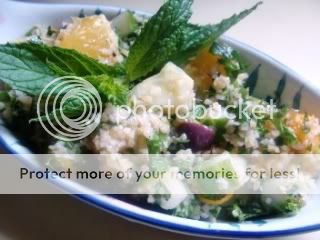
"Fruity Tabouli" from my book "World Vegan Feast".
This post was updated on May 31, 2018.
BULGUR WHEAT IS A LOW-GLYCEMIC WHOLE GRAIN:
Articles on the nutrition of bulgur wheat:
https://www.livestrong.com/article/256333-what-are-the-benefits-of-bulgur-wheat/
https://www.livestrong.com/article/500635-can-you-eat-bulgur-wheat-with-diabetes/
https://www.quora.com/Is-bulgur-wheat-a-good-carbohydrate
http://www.nutridesk.com.au/bulgur.phtml
WHEAT-FREE BULGUR; GLUTEN-FREE BULGUR AND COUSCOUS SUBSTITITES (see end of this post)
BULGUR RECIPES ON THIS BLOG:
Mushroom-Tempeh Burgers
Potato Kibbeh
Pumpkin Kibbeh
Red Lentil and Bulgur Salad Balls with Dried Fruit in Butter Lettuce Cups
Sanaa Abourezk's Bulgur and Black Eyed Peas
Apple-Cinnamon-Bulgur Cereal
Summer Bulgur and Green Bean Salad
Bulgur Pilaf with Mixed Greens and Garlic
Orange Bulgur Salad
Cooking directions for different types of bulgur wheat.
This time of the year almost always keep a grain salad on hand for snacking. Grain salads are hearty, filling, nutritious, and, the way I make them, low in fat. Tabouli (also spelled tabbouleh or tabbouli), the lemony Levantine bulgur wheat and parsley salad, is well-known to vegans and omnis alike. Sometimes it's the only thing we vegans can eat at a potluck! But I never get tired of it.
The other day I was craving some tabouli, but I didn't have any tomatoes. I've made other versions before-- I guess you can't really call them tabouli, but I do, anyway!-- but I decided to use chopped fresh orange and mango instead of tomatoes and green peppers, and add a few kalamata olives for a savory touch. The result was delicious and I was sorry when there was no more left!
"Also known as bulgar, bulgour, or burghul, this very versatile food, is believed to have been first eaten in the Euphrates Valley as far back as 5000 BC. Since then, it has been on the daily menu of the people of the Middle East," writes Canadian cookbook writer and historian Habeeb Salloum in his article "Bulgur, the noblest food achieved by wheat" in the Vegetarian Journal, Jan/Feb 2004. In this article he describes how his Syrian immigrant family made their own bulgur on the Saskatchewan prairie. He and his young siblings did not appreciate the hard work involved in making bulgur, but he now appreciates the value of bulgur to Middle Eastern cuisine, and even modern, Western cuisine. He writes, "Simple to prepare, this ancient food is an inexpensive, succulent, and versatile cereal. It is cooked in the same fashion as rice, which it commonly replaces, and takes about 20 minutes to prepare. It can be used in all types of dishes, and it can be employed in every course and every meal of the day."
Bulgur pilaf was one of the first dishes I learned to make as a child. I learned it from Rosie, a good friend of our family who was an Armenian refugee in California. Now I always have 3 types of bulgur in my kitchen-- coarse (#3), medium (#2), and fine (#1)-- ready to make a nourishing, quick meal at any time. (There is also an "extra-coarse" grade [#4], but I've never used that.)
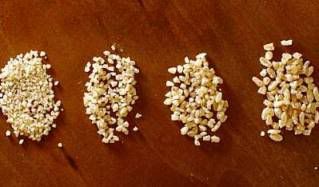
L to R: fine, medium, coarse, and extra-coarse bulgur (photo by Craig Lee, SF Chronicle)
What about the nutrition in bulgur? Bulgur is made by pre-cooking whole wheat kernels, drying them, and then cracking them. That's why it cooks so quickly. According to this interesting article on bulgur, "Bulgur Wheat is a natural whole grain food in that no chemicals or additives are used in processing the product. Many of the wheat's naturally occurring vitamins and minerals permeate the kernel during cooking thus maintaining more nutritive content than other forms of processed wheat products."
This is similar to what happens with “parboiled” or “converted” rice.
This article also reports: "The Center for Science in the Public Interest (CSPI) published two posters in 1992 describing the nutritional characteristics of bulgur wheat. The first, titled 'Nutrition Scoreboard', listed bulgur wheat as the number one grain in terms of nutrition scoring. Bulgur (69 points) outpaced wheat germ (61 points), pearled barley (60 points), brown rice (45 points) and pasta (45 points). It beat oatmeal and the highly touted Wheaties cereal (both 38 points) by 31 points!
The second poster from CSPI, titled "Rough It Up", listed bulgur wheat as the third highest grain item in the Grains and Pasta category in terms of fiber content. In this category bulgur wheat beat out whole-wheat spaghetti, buckwheat pancakes, and had more than double the fiber of cous cous. The Food Research & Innovation Enterprises says "cereal foods like bulgur should be the cornerstone of our daily diet."
Cooking Light magazine published (June 2004) an excellent visual comparison between bulgur and brown rice, showing that a cup of bulgur has fewer calories, less fat, and more than twice the fiber of rice!" Here it is:
Here's an interesting food article on bulgur wheat.
And some follow-ups articles: http://healthyeating.sfgate.com/benefits-bulgur-wheat-6245.html and http://healthyeating.sfgate.com/bulgur-wheat-nutritional-information-1681.html
(PS: read more about Habeeb Salloum's prairie childhood and his mother's recipes in his fine book "Arab Cooking on a Saskatchewan Homestead: Recipes and Recollections". It was the Silver Winner of the 2006 Canadian Culinary Awards, Canadian Food Culture Category. It's not a vegetarian book, but there are many fine vegetarian recipes, and the cooking lore and history is fun to read. It's one of my favorite cookbooks.
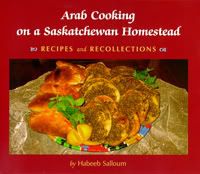
Habeeb is also the author of "Classic Vegetarian Cooking From The Middle East And North Africa", a book that should be in every vegetarian kitchen, and is co-author of From the Land of Figs and Olives, another excellent cookbook. He's also written many articles for The Vegetarian Journal, and a variety of articles on Canadian, Arab and Latin- American history, travel and the culinary arts in various journals.)
Cheers!

This post was updated on May 31, 2018.
BULGUR WHEAT IS A LOW-GLYCEMIC WHOLE GRAIN:
Articles on the nutrition of bulgur wheat:
https://www.livestrong.com/article/256333-what-are-the-benefits-of-bulgur-wheat/
https://www.livestrong.com/article/500635-can-you-eat-bulgur-wheat-with-diabetes/
https://www.quora.com/Is-bulgur-wheat-a-good-carbohydrate
http://www.nutridesk.com.au/bulgur.phtml
WHEAT-FREE BULGUR; GLUTEN-FREE BULGUR AND COUSCOUS SUBSTITITES (see end of this post)
BULGUR RECIPES ON THIS BLOG:
Mushroom-Tempeh Burgers
Potato Kibbeh
Pumpkin Kibbeh
Red Lentil and Bulgur Salad Balls with Dried Fruit in Butter Lettuce Cups
Sanaa Abourezk's Bulgur and Black Eyed Peas
Apple-Cinnamon-Bulgur Cereal
Summer Bulgur and Green Bean Salad
Bulgur Pilaf with Mixed Greens and Garlic
Orange Bulgur Salad
Cooking directions for different types of bulgur wheat.
The other day I was craving some tabouli, but I didn't have any tomatoes. I've made other versions before-- I guess you can't really call them tabouli, but I do, anyway!-- but I decided to use chopped fresh orange and mango instead of tomatoes and green peppers, and add a few kalamata olives for a savory touch. The result was delicious and I was sorry when there was no more left!
"Also known as bulgar, bulgour, or burghul, this very versatile food, is believed to have been first eaten in the Euphrates Valley as far back as 5000 BC. Since then, it has been on the daily menu of the people of the Middle East," writes Canadian cookbook writer and historian Habeeb Salloum in his article "Bulgur, the noblest food achieved by wheat" in the Vegetarian Journal, Jan/Feb 2004. In this article he describes how his Syrian immigrant family made their own bulgur on the Saskatchewan prairie. He and his young siblings did not appreciate the hard work involved in making bulgur, but he now appreciates the value of bulgur to Middle Eastern cuisine, and even modern, Western cuisine. He writes, "Simple to prepare, this ancient food is an inexpensive, succulent, and versatile cereal. It is cooked in the same fashion as rice, which it commonly replaces, and takes about 20 minutes to prepare. It can be used in all types of dishes, and it can be employed in every course and every meal of the day."
Bulgur pilaf was one of the first dishes I learned to make as a child. I learned it from Rosie, a good friend of our family who was an Armenian refugee in California. Now I always have 3 types of bulgur in my kitchen-- coarse (#3), medium (#2), and fine (#1)-- ready to make a nourishing, quick meal at any time. (There is also an "extra-coarse" grade [#4], but I've never used that.)
L to R: fine, medium, coarse, and extra-coarse bulgur (photo by Craig Lee, SF Chronicle)
What about the nutrition in bulgur? Bulgur is made by pre-cooking whole wheat kernels, drying them, and then cracking them. That's why it cooks so quickly. According to this interesting article on bulgur, "Bulgur Wheat is a natural whole grain food in that no chemicals or additives are used in processing the product. Many of the wheat's naturally occurring vitamins and minerals permeate the kernel during cooking thus maintaining more nutritive content than other forms of processed wheat products."
This is similar to what happens with “parboiled” or “converted” rice.
This article also reports: "The Center for Science in the Public Interest (CSPI) published two posters in 1992 describing the nutritional characteristics of bulgur wheat. The first, titled 'Nutrition Scoreboard', listed bulgur wheat as the number one grain in terms of nutrition scoring. Bulgur (69 points) outpaced wheat germ (61 points), pearled barley (60 points), brown rice (45 points) and pasta (45 points). It beat oatmeal and the highly touted Wheaties cereal (both 38 points) by 31 points!
The second poster from CSPI, titled "Rough It Up", listed bulgur wheat as the third highest grain item in the Grains and Pasta category in terms of fiber content. In this category bulgur wheat beat out whole-wheat spaghetti, buckwheat pancakes, and had more than double the fiber of cous cous. The Food Research & Innovation Enterprises says "cereal foods like bulgur should be the cornerstone of our daily diet."
Cooking Light magazine published (June 2004) an excellent visual comparison between bulgur and brown rice, showing that a cup of bulgur has fewer calories, less fat, and more than twice the fiber of rice!" Here it is:
 |
| Click on photo for larger view |
And some follow-ups articles: http://healthyeating.sfgate.com/benefits-bulgur-wheat-6245.html and http://healthyeating.sfgate.com/bulgur-wheat-nutritional-information-1681.html
(PS: read more about Habeeb Salloum's prairie childhood and his mother's recipes in his fine book "Arab Cooking on a Saskatchewan Homestead: Recipes and Recollections". It was the Silver Winner of the 2006 Canadian Culinary Awards, Canadian Food Culture Category. It's not a vegetarian book, but there are many fine vegetarian recipes, and the cooking lore and history is fun to read. It's one of my favorite cookbooks.
Habeeb is also the author of "Classic Vegetarian Cooking From The Middle East And North Africa", a book that should be in every vegetarian kitchen, and is co-author of From the Land of Figs and Olives, another excellent cookbook. He's also written many articles for The Vegetarian Journal, and a variety of articles on Canadian, Arab and Latin- American history, travel and the culinary arts in various journals.)
For those of you with a wheat sensitivity (not a gluten allergy or sensitivity, however), there is now a Kamut® bulgur on the market! Check it out here. Kamut® bulgur could be used in place of couscous, as well. From what I've read, it can be used just like wheat bulgur.
If you must eat gluten-free, you can substitute millet or quinoa for bulgur and couscous. This recipe from Whole Foods explains how to cook millet, especially for a salad. Here's how to cook quinoa.
There used to be a product called "Rice-Cous" (not sure if that was the spelling) on the market, but it's no longer available. However, you can make a kind of "bulgur rice" or "rice couscous" by pulsing uncooked white basmati rice, 1/2 cup at a time, in a good blender (make sure the interior of the blender is dry!) until the rice is broken into small pieces, like bulgur or couscous. Toast the rice, spread thinly on an ungreased baking sheet, at 350ºF for 20-30 minutes, stirring on and off, until it is lightly toasted. Let it cool thoroughly and store in a covered container, or zipper-lock bags. It's worth making several cups at a time.
There used to be a product called "Rice-Cous" (not sure if that was the spelling) on the market, but it's no longer available. However, you can make a kind of "bulgur rice" or "rice couscous" by pulsing uncooked white basmati rice, 1/2 cup at a time, in a good blender (make sure the interior of the blender is dry!) until the rice is broken into small pieces, like bulgur or couscous. Toast the rice, spread thinly on an ungreased baking sheet, at 350ºF for 20-30 minutes, stirring on and off, until it is lightly toasted. Let it cool thoroughly and store in a covered container, or zipper-lock bags. It's worth making several cups at a time.
You can't simply soak this “bulgur rice” in boiling water for salads, like you do with wheat bulgur-- you have to cook it as you would cook ordinary rice, but using 1 cup liquid (water or broth) for each 1/2 cup toasted rice, bringing to a boil, then turning to low heat, covering the pot, and cooking for about 1/2 an hour. Fluff it with a fork. Then serve as you would couscous or bulgur, or use in a salad recipe.
Kamut® Bulgur
Subscribe to:
Posts (Atom)