Showing posts with label Habeeb Salloum. Show all posts
Showing posts with label Habeeb Salloum. Show all posts
Saturday, May 30, 2009
BULGUR WHEAT, AN ANCIENT, HEALTHFUL FAST FOOD!

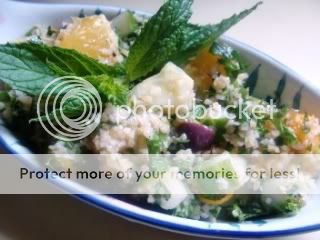
"Fruity Tabouli" from my book "World Vegan Feast".
This post was updated on May 31, 2018.
BULGUR WHEAT IS A LOW-GLYCEMIC WHOLE GRAIN:
Articles on the nutrition of bulgur wheat:
https://www.livestrong.com/article/256333-what-are-the-benefits-of-bulgur-wheat/
https://www.livestrong.com/article/500635-can-you-eat-bulgur-wheat-with-diabetes/
https://www.quora.com/Is-bulgur-wheat-a-good-carbohydrate
http://www.nutridesk.com.au/bulgur.phtml
WHEAT-FREE BULGUR; GLUTEN-FREE BULGUR AND COUSCOUS SUBSTITITES (see end of this post)
BULGUR RECIPES ON THIS BLOG:
Mushroom-Tempeh Burgers
Potato Kibbeh
Pumpkin Kibbeh
Red Lentil and Bulgur Salad Balls with Dried Fruit in Butter Lettuce Cups
Sanaa Abourezk's Bulgur and Black Eyed Peas
Apple-Cinnamon-Bulgur Cereal
Summer Bulgur and Green Bean Salad
Bulgur Pilaf with Mixed Greens and Garlic
Orange Bulgur Salad
Cooking directions for different types of bulgur wheat.
This time of the year almost always keep a grain salad on hand for snacking. Grain salads are hearty, filling, nutritious, and, the way I make them, low in fat. Tabouli (also spelled tabbouleh or tabbouli), the lemony Levantine bulgur wheat and parsley salad, is well-known to vegans and omnis alike. Sometimes it's the only thing we vegans can eat at a potluck! But I never get tired of it.
The other day I was craving some tabouli, but I didn't have any tomatoes. I've made other versions before-- I guess you can't really call them tabouli, but I do, anyway!-- but I decided to use chopped fresh orange and mango instead of tomatoes and green peppers, and add a few kalamata olives for a savory touch. The result was delicious and I was sorry when there was no more left!
"Also known as bulgar, bulgour, or burghul, this very versatile food, is believed to have been first eaten in the Euphrates Valley as far back as 5000 BC. Since then, it has been on the daily menu of the people of the Middle East," writes Canadian cookbook writer and historian Habeeb Salloum in his article "Bulgur, the noblest food achieved by wheat" in the Vegetarian Journal, Jan/Feb 2004. In this article he describes how his Syrian immigrant family made their own bulgur on the Saskatchewan prairie. He and his young siblings did not appreciate the hard work involved in making bulgur, but he now appreciates the value of bulgur to Middle Eastern cuisine, and even modern, Western cuisine. He writes, "Simple to prepare, this ancient food is an inexpensive, succulent, and versatile cereal. It is cooked in the same fashion as rice, which it commonly replaces, and takes about 20 minutes to prepare. It can be used in all types of dishes, and it can be employed in every course and every meal of the day."
Bulgur pilaf was one of the first dishes I learned to make as a child. I learned it from Rosie, a good friend of our family who was an Armenian refugee in California. Now I always have 3 types of bulgur in my kitchen-- coarse (#3), medium (#2), and fine (#1)-- ready to make a nourishing, quick meal at any time. (There is also an "extra-coarse" grade [#4], but I've never used that.)
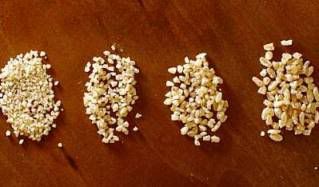
L to R: fine, medium, coarse, and extra-coarse bulgur (photo by Craig Lee, SF Chronicle)
What about the nutrition in bulgur? Bulgur is made by pre-cooking whole wheat kernels, drying them, and then cracking them. That's why it cooks so quickly. According to this interesting article on bulgur, "Bulgur Wheat is a natural whole grain food in that no chemicals or additives are used in processing the product. Many of the wheat's naturally occurring vitamins and minerals permeate the kernel during cooking thus maintaining more nutritive content than other forms of processed wheat products."
This is similar to what happens with “parboiled” or “converted” rice.
This article also reports: "The Center for Science in the Public Interest (CSPI) published two posters in 1992 describing the nutritional characteristics of bulgur wheat. The first, titled 'Nutrition Scoreboard', listed bulgur wheat as the number one grain in terms of nutrition scoring. Bulgur (69 points) outpaced wheat germ (61 points), pearled barley (60 points), brown rice (45 points) and pasta (45 points). It beat oatmeal and the highly touted Wheaties cereal (both 38 points) by 31 points!
The second poster from CSPI, titled "Rough It Up", listed bulgur wheat as the third highest grain item in the Grains and Pasta category in terms of fiber content. In this category bulgur wheat beat out whole-wheat spaghetti, buckwheat pancakes, and had more than double the fiber of cous cous. The Food Research & Innovation Enterprises says "cereal foods like bulgur should be the cornerstone of our daily diet."
Cooking Light magazine published (June 2004) an excellent visual comparison between bulgur and brown rice, showing that a cup of bulgur has fewer calories, less fat, and more than twice the fiber of rice!" Here it is:
Here's an interesting food article on bulgur wheat.
And some follow-ups articles: http://healthyeating.sfgate.com/benefits-bulgur-wheat-6245.html and http://healthyeating.sfgate.com/bulgur-wheat-nutritional-information-1681.html
(PS: read more about Habeeb Salloum's prairie childhood and his mother's recipes in his fine book "Arab Cooking on a Saskatchewan Homestead: Recipes and Recollections". It was the Silver Winner of the 2006 Canadian Culinary Awards, Canadian Food Culture Category. It's not a vegetarian book, but there are many fine vegetarian recipes, and the cooking lore and history is fun to read. It's one of my favorite cookbooks.
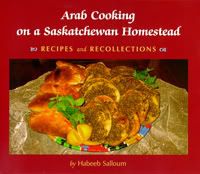
Habeeb is also the author of "Classic Vegetarian Cooking From The Middle East And North Africa", a book that should be in every vegetarian kitchen, and is co-author of From the Land of Figs and Olives, another excellent cookbook. He's also written many articles for The Vegetarian Journal, and a variety of articles on Canadian, Arab and Latin- American history, travel and the culinary arts in various journals.)
Cheers!

This post was updated on May 31, 2018.
BULGUR WHEAT IS A LOW-GLYCEMIC WHOLE GRAIN:
Articles on the nutrition of bulgur wheat:
https://www.livestrong.com/article/256333-what-are-the-benefits-of-bulgur-wheat/
https://www.livestrong.com/article/500635-can-you-eat-bulgur-wheat-with-diabetes/
https://www.quora.com/Is-bulgur-wheat-a-good-carbohydrate
http://www.nutridesk.com.au/bulgur.phtml
WHEAT-FREE BULGUR; GLUTEN-FREE BULGUR AND COUSCOUS SUBSTITITES (see end of this post)
BULGUR RECIPES ON THIS BLOG:
Mushroom-Tempeh Burgers
Potato Kibbeh
Pumpkin Kibbeh
Red Lentil and Bulgur Salad Balls with Dried Fruit in Butter Lettuce Cups
Sanaa Abourezk's Bulgur and Black Eyed Peas
Apple-Cinnamon-Bulgur Cereal
Summer Bulgur and Green Bean Salad
Bulgur Pilaf with Mixed Greens and Garlic
Orange Bulgur Salad
Cooking directions for different types of bulgur wheat.
The other day I was craving some tabouli, but I didn't have any tomatoes. I've made other versions before-- I guess you can't really call them tabouli, but I do, anyway!-- but I decided to use chopped fresh orange and mango instead of tomatoes and green peppers, and add a few kalamata olives for a savory touch. The result was delicious and I was sorry when there was no more left!
"Also known as bulgar, bulgour, or burghul, this very versatile food, is believed to have been first eaten in the Euphrates Valley as far back as 5000 BC. Since then, it has been on the daily menu of the people of the Middle East," writes Canadian cookbook writer and historian Habeeb Salloum in his article "Bulgur, the noblest food achieved by wheat" in the Vegetarian Journal, Jan/Feb 2004. In this article he describes how his Syrian immigrant family made their own bulgur on the Saskatchewan prairie. He and his young siblings did not appreciate the hard work involved in making bulgur, but he now appreciates the value of bulgur to Middle Eastern cuisine, and even modern, Western cuisine. He writes, "Simple to prepare, this ancient food is an inexpensive, succulent, and versatile cereal. It is cooked in the same fashion as rice, which it commonly replaces, and takes about 20 minutes to prepare. It can be used in all types of dishes, and it can be employed in every course and every meal of the day."
Bulgur pilaf was one of the first dishes I learned to make as a child. I learned it from Rosie, a good friend of our family who was an Armenian refugee in California. Now I always have 3 types of bulgur in my kitchen-- coarse (#3), medium (#2), and fine (#1)-- ready to make a nourishing, quick meal at any time. (There is also an "extra-coarse" grade [#4], but I've never used that.)
L to R: fine, medium, coarse, and extra-coarse bulgur (photo by Craig Lee, SF Chronicle)
What about the nutrition in bulgur? Bulgur is made by pre-cooking whole wheat kernels, drying them, and then cracking them. That's why it cooks so quickly. According to this interesting article on bulgur, "Bulgur Wheat is a natural whole grain food in that no chemicals or additives are used in processing the product. Many of the wheat's naturally occurring vitamins and minerals permeate the kernel during cooking thus maintaining more nutritive content than other forms of processed wheat products."
This is similar to what happens with “parboiled” or “converted” rice.
This article also reports: "The Center for Science in the Public Interest (CSPI) published two posters in 1992 describing the nutritional characteristics of bulgur wheat. The first, titled 'Nutrition Scoreboard', listed bulgur wheat as the number one grain in terms of nutrition scoring. Bulgur (69 points) outpaced wheat germ (61 points), pearled barley (60 points), brown rice (45 points) and pasta (45 points). It beat oatmeal and the highly touted Wheaties cereal (both 38 points) by 31 points!
The second poster from CSPI, titled "Rough It Up", listed bulgur wheat as the third highest grain item in the Grains and Pasta category in terms of fiber content. In this category bulgur wheat beat out whole-wheat spaghetti, buckwheat pancakes, and had more than double the fiber of cous cous. The Food Research & Innovation Enterprises says "cereal foods like bulgur should be the cornerstone of our daily diet."
Cooking Light magazine published (June 2004) an excellent visual comparison between bulgur and brown rice, showing that a cup of bulgur has fewer calories, less fat, and more than twice the fiber of rice!" Here it is:
 |
| Click on photo for larger view |
And some follow-ups articles: http://healthyeating.sfgate.com/benefits-bulgur-wheat-6245.html and http://healthyeating.sfgate.com/bulgur-wheat-nutritional-information-1681.html
(PS: read more about Habeeb Salloum's prairie childhood and his mother's recipes in his fine book "Arab Cooking on a Saskatchewan Homestead: Recipes and Recollections". It was the Silver Winner of the 2006 Canadian Culinary Awards, Canadian Food Culture Category. It's not a vegetarian book, but there are many fine vegetarian recipes, and the cooking lore and history is fun to read. It's one of my favorite cookbooks.
Habeeb is also the author of "Classic Vegetarian Cooking From The Middle East And North Africa", a book that should be in every vegetarian kitchen, and is co-author of From the Land of Figs and Olives, another excellent cookbook. He's also written many articles for The Vegetarian Journal, and a variety of articles on Canadian, Arab and Latin- American history, travel and the culinary arts in various journals.)
For those of you with a wheat sensitivity (not a gluten allergy or sensitivity, however), there is now a Kamut® bulgur on the market! Check it out here. Kamut® bulgur could be used in place of couscous, as well. From what I've read, it can be used just like wheat bulgur.
If you must eat gluten-free, you can substitute millet or quinoa for bulgur and couscous. This recipe from Whole Foods explains how to cook millet, especially for a salad. Here's how to cook quinoa.
There used to be a product called "Rice-Cous" (not sure if that was the spelling) on the market, but it's no longer available. However, you can make a kind of "bulgur rice" or "rice couscous" by pulsing uncooked white basmati rice, 1/2 cup at a time, in a good blender (make sure the interior of the blender is dry!) until the rice is broken into small pieces, like bulgur or couscous. Toast the rice, spread thinly on an ungreased baking sheet, at 350ºF for 20-30 minutes, stirring on and off, until it is lightly toasted. Let it cool thoroughly and store in a covered container, or zipper-lock bags. It's worth making several cups at a time.
There used to be a product called "Rice-Cous" (not sure if that was the spelling) on the market, but it's no longer available. However, you can make a kind of "bulgur rice" or "rice couscous" by pulsing uncooked white basmati rice, 1/2 cup at a time, in a good blender (make sure the interior of the blender is dry!) until the rice is broken into small pieces, like bulgur or couscous. Toast the rice, spread thinly on an ungreased baking sheet, at 350ºF for 20-30 minutes, stirring on and off, until it is lightly toasted. Let it cool thoroughly and store in a covered container, or zipper-lock bags. It's worth making several cups at a time.
You can't simply soak this “bulgur rice” in boiling water for salads, like you do with wheat bulgur-- you have to cook it as you would cook ordinary rice, but using 1 cup liquid (water or broth) for each 1/2 cup toasted rice, bringing to a boil, then turning to low heat, covering the pot, and cooking for about 1/2 an hour. Fluff it with a fork. Then serve as you would couscous or bulgur, or use in a salad recipe.
Kamut® Bulgur


Sunday, April 19, 2009
GOOD VEGAN MEALS ON THE WW CORE PLAN; LOW-FAT TIP; & UPDATE ON NONSTICK SKILLETS
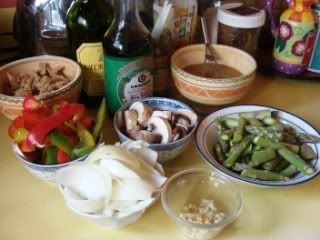 The ingredients for a delicious stir-fry using what I had available, and what needed using up.
DH and I have been on the Core Plan for almost 3 weeks now and have done pretty well, even with Easter and eating out a few times. I'd like to share some of the meals we've had (that I photographed, anyway!), and a tip for cutting down on oil. You will see that I DO use my own cookbooks!
One day we just HAD to have some Pasta alla Puttanesca, and it fit right into the plan! I used whole wheat pasta
 , and we used up our daily ration of 2 tsp. of oil (olive, of course) and 4 kalamata olives each on this recipe (I really like some olive oil in this dish-- I used 4 tsp. total in half the recipe):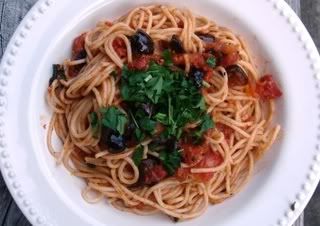
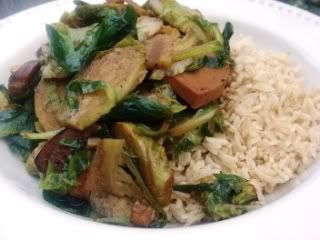
One night I decided to have an Asian version of "weiners and cabbage"-- stir fried veggie weiner slices (I use the Yves Veggie "Bavarian Sausages") with Brussels sprouts. It was delish! I was a remake of a recipe for stir-fried weiners and cabbage that I used to make over 40 years ago:
We took this Vegan "Chicken" Caesar Salad to a dinner party at a friend's house, to rave reviews. I used reconstituted Soy Curls® stir-fried with chopped garlic (no oil) for the "chicken", the Caesar Dressing that's in my books "Soyfoods Cooking for a Positive Menopause
 " and "20 Minutes to Dinner
 ", whole wheat garlic croutons (tiny bit of oil in a nonstick pan), and my New, Improved Okara Parmesan Substitute.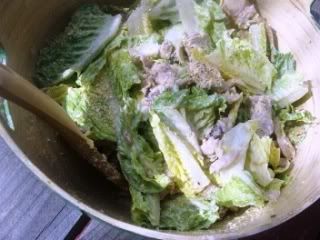
Another day I made a big pot of Vegetarian Feijoada (Brazilian Black Beans-- the recipe is in my books "The Almost-No-Fat Holiday Cookbook"
 and also in "The Fiber for Life Cookbook"
 ) and we had a simple meal of rice and beans: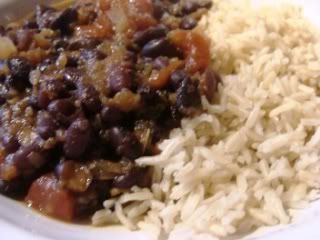
Then I made my Spicy Mexican Bean Dip (or "Refried Beans") with some of the pot (the recipe for the dip is in several of my books), which we used as a dip for veggies, and also in some tacos. I froze the rest of the beans for future meals.
I made a variation one night on my Asparagus Tofu with Black Bean Sauce from my book "Authentic Chinese Cuisine for the Contemporary Kitchen" , using ingredients that needed using up and that I had on hand (see photo at top of his blog post). I used I used reconstituted Soy Curls® instead of tofu, because I had just the right amount in the fridge:
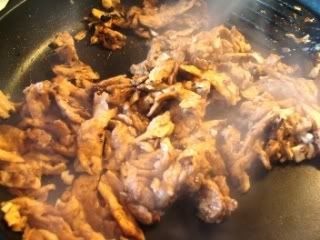
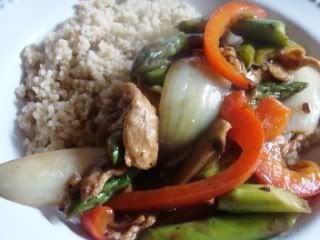
Instead of rice, we ate the stir-fry with a mixture of steamed bulgur and quinoa:
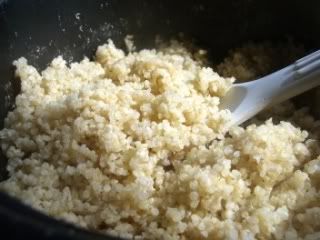
I really like this mixture (it's cheaper than quinoa only, too), and we use it alot instead of rice on the Core Plan. I make it in my electric rice cooker. I just cook 1 part medium bulgur , 1 part quinoa
 , 4 parts water, and a little salt. I make quite a bit at a time and freeze portions of it to microwave for quick meals.
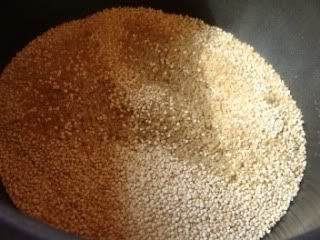
Quinoa and bulgur in the rice cooker.
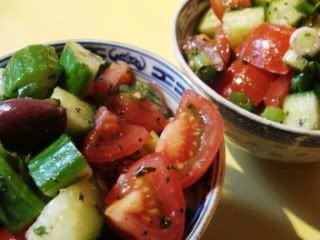
One evening we had a lovely Syrian Tomato and Cucumber Salad with Mint (using our daily quota of olive oil and olives!), a recipe from Habeeb Salloum's lovely book, "Arab Cooking on a Saskatchewan Homestead ": Recipes and Recollections" (you can read more about it at this blog post):
One recent meal was a virtually-fat-free version of my Vegan "Chicken" Divan Casserole (I wrote about it and gave the original recipe in this blog post). I had a whole bunch of broccoli to use up and felt like something "homey" and comforting. I stir-fried the Soy Curls® with the garlic in a nonstick pan, and I omitted the fat from my Vegan Bechamel Sauce (just blended the flour in with the ingredients and cooked it in the microwave). I omitted the bread crumb topping and used a light sprinkling of my New, Improved Okara Parmesan Substitute. I didn't have any vegan cheese handy to grate, so I made my easy Melty Chedda Cheeze (2 x the recipe, from my book "20 Minutes to Dinner"), also in the microwave, just before assembling the casserole, and drizzled half of it in the middle:
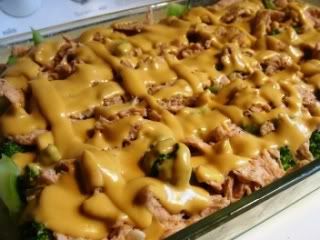
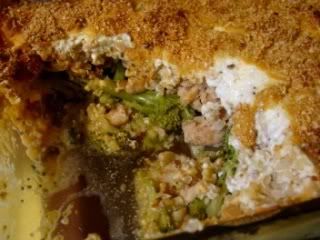
and half of it on the top, covered with the Okara Parmesan sprinkle. It came out very well! The Bechamel puffed up nicely during the baking:
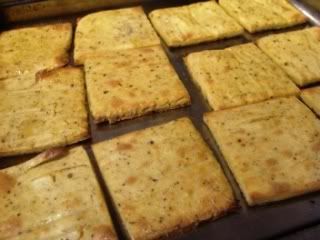
Here's a little preview of an upcoming post I'm working on about using chickpea flour for various treats. This was my first attempt at making Panella, which is a sort of deep-fried Italian chickpea polenta, only I oven-fried it. It was too thin, but otherwise very tasty:
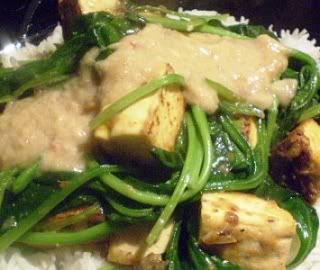
One night we had a craving for peanut sauce, and some fresh spinach to use up, so I made low-fat version of my Thai-Style Spinach and Tofu with Peanut Sauce. The only changes I made to the recipe were to omit the 1 tsp. sesame oil and to dry-fry the tofu in a nonstick skillet instead of frying it in oil (you could also brown them on a cookie sheet under the broiler). The peanut butter made up our daily fat ration.
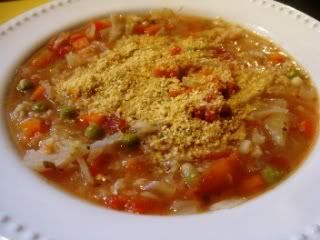
Today for lunch we had my vegan Minestrone alla Milanese (from my book "Nonna's Italian Kitchen" ). I used cooked brown Basmati rice in it and used no oil:
A FAT-SAVING TIP:
The way I saved on oil in the Minestrone recipe was something that I use frequently-- I "sweat", soften or "steam-fry" (saute without oil) the onions, and other chopped or sliced veggies, in a covered Pyrex casserole or pie plate in the microwave. Then you can use your oil or fat ration in a more interesting way-- a salad dressing or whatever. (PS: If you are afraid of using a microwave, please read this compilation of info.)
Microwave option for “sweating” the vegetables: Spray a microwave-safe pie plate or casserole lightly with oil from a pump sprayer , add the chopped or sliced vegetables.
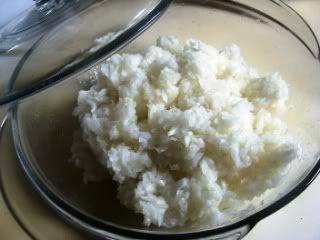
Cook the mixture on high power for about 5 minutes, covered with a microwave-safe lid, plate or pie plate. If you are doing alot at one time, you might need 10 or more minutes. Cook until they are softened.
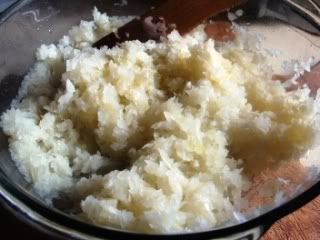
(To "sweat" vegetables with no oil on the stove-top: Spray a sturdy nonstick skillet lightly with oil from a pump sprayer, heat over high heat, then add the chopped or sliced vegetables. Stir-fry for a few minutes over high heat, then reduce the heat, cover the pan and cook gently over low heat for 5 to 10 minutes to soften the vegetables.)
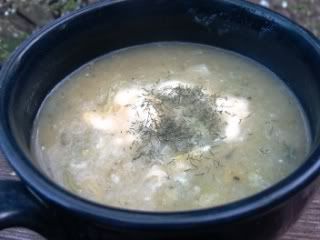
I made the following soup using this method to cook the leeks, onions, and garlic:
Printable Recipe
BRYANNA'S FAT-FREE CREAMY LEEK AND POTATO SOUP
Servings: 4
A very easy and deliciously rich-tasting leek soup. I like the green parts of the leek, so I use them as well as the white part.
3 medium leeks, cleaned and sliced thinly crosswise
1 small onion, chopped
4 cloves garlic, chopped
1 teaspoon coarse salt
1/2 teaspoon dried thyme leaves
4 cups good vegetarian chicken-style broth
2 cups (@ 12 oz.) diced, peeled Yukon Gold potatoes (or Russets, in a pinch!)
1 small bay leaf
Garnishes:
a few tablespoons minced fresh parsley (or dill)
Tofu Sour Creme (Tofutti or homemade)
freshly-ground black pepper
Combine the white part of the leeks with the onion, garlic, coarse salt and thyme in a Pyrex casserole sprayed lightly with oil from a pump sprayer. Cover and microwave on High for 10 minutes. (Or use the Stove-Top Method above.)
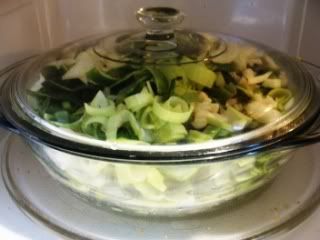
In a heavy soup pot , mix about half of the leek-onion mixture (reserve the rest) with the broth, potatoes and bay leaf and bring to a boil, then reduce the heat to a simmer. Cover and cook about 15 minutes, or until the potatoes are tender.
Remove the bay leaf from the pot and discard. Blend the soup right in the pot with a stick/immersion blender until smooth. Add the reserved cooked leek mixture and stir briefly. Taste for salt and pepper.
Serve immediately, garnished as you wish.
Nutrition Facts
Nutrition (per serving): 134.0 calories; 1% calories from fat; 0.2g total fat; 0.0mg cholesterol; 1179.7mg sodium; 717.2mg potassium; 32.4g carbohydrates; 2.9g fiber; 4.3g sugar; 29.5g net carbs; 4.3g protein; 2.1 points.
, using ingredients that needed using up and that I had on hand (see photo at top of his blog post). I used I used reconstituted Soy Curls® instead of tofu, because I had just the right amount in the fridge:Instead of rice, we ate the stir-fry with a mixture of steamed bulgur and quinoa:
I really like this mixture (it's cheaper than quinoa only, too), and we use it alot instead of rice on the Core Plan. I make it in my electric rice cooker. I just cook 1 part medium bulgur
, 1 part quinoa, 4 parts water, and a little salt. I make quite a bit at a time and freeze portions of it to microwave for quick meals.Quinoa and bulgur in the rice cooker.
One evening we had a lovely Syrian Tomato and Cucumber Salad with Mint (using our daily quota of olive oil and olives!), a recipe from Habeeb Salloum's lovely book, "Arab Cooking on a Saskatchewan Homestead
": Recipes and Recollections" (you can read more about it at this blog post):One recent meal was a virtually-fat-free version of my Vegan "Chicken" Divan Casserole (I wrote about it and gave the original recipe in this blog post). I had a whole bunch of broccoli to use up and felt like something "homey" and comforting. I stir-fried the Soy Curls® with the garlic in a nonstick pan, and I omitted the fat from my Vegan Bechamel Sauce (just blended the flour in with the ingredients and cooked it in the microwave). I omitted the bread crumb topping and used a light sprinkling of my New, Improved Okara Parmesan Substitute. I didn't have any vegan cheese handy to grate, so I made my easy Melty Chedda Cheeze (2 x the recipe, from my book "20 Minutes to Dinner"), also in the microwave, just before assembling the casserole, and drizzled half of it in the middle:
and half of it on the top, covered with the Okara Parmesan sprinkle. It came out very well! The Bechamel puffed up nicely during the baking:
Here's a little preview of an upcoming post I'm working on about using chickpea flour
for various treats. This was my first attempt at making Panella, which is a sort of deep-fried Italian chickpea polenta, only I oven-fried it. It was too thin, but otherwise very tasty:One night we had a craving for peanut sauce, and some fresh spinach to use up, so I made low-fat version of my Thai-Style Spinach and Tofu with Peanut Sauce. The only changes I made to the recipe were to omit the 1 tsp. sesame oil and to dry-fry the tofu in a nonstick skillet instead of frying it in oil (you could also brown them on a cookie sheet under the broiler). The peanut butter made up our daily fat ration.
Today for lunch we had my vegan Minestrone alla Milanese (from my book "Nonna's Italian Kitchen"
). I used cooked brown Basmati rice in it and used no oil:A FAT-SAVING TIP:
The way I saved on oil in the Minestrone recipe was something that I use frequently-- I "sweat", soften or "steam-fry" (saute without oil) the onions, and other chopped or sliced veggies, in a covered Pyrex casserole or pie plate in the microwave. Then you can use your oil or fat ration in a more interesting way-- a salad dressing or whatever. (PS: If you are afraid of using a microwave, please read this compilation of info.)
Microwave option for “sweating” the vegetables: Spray a microwave-safe pie plate or casserole lightly with oil from a pump sprayer
, add the chopped or sliced vegetables.Cook the mixture on high power for about 5 minutes, covered with a microwave-safe lid, plate or pie plate. If you are doing alot at one time, you might need 10 or more minutes. Cook until they are softened.
(To "sweat" vegetables with no oil on the stove-top: Spray a sturdy nonstick skillet
lightly with oil from a pump sprayer, heat over high heat, then add the chopped or sliced vegetables. Stir-fry for a few minutes over high heat, then reduce the heat, cover the pan and cook gently over low heat for 5 to 10 minutes to soften the vegetables.)I made the following soup using this method to cook the leeks, onions, and garlic:
Printable Recipe
BRYANNA'S FAT-FREE CREAMY LEEK AND POTATO SOUP
Servings: 4
A very easy and deliciously rich-tasting leek soup. I like the green parts of the leek, so I use them as well as the white part.
3 medium leeks, cleaned and sliced thinly crosswise
1 small onion, chopped
4 cloves garlic, chopped
1 teaspoon coarse salt
1/2 teaspoon dried thyme leaves
4 cups good vegetarian chicken-style broth
2 cups (@ 12 oz.) diced, peeled Yukon Gold potatoes (or Russets, in a pinch!)
1 small bay leaf
Garnishes:
a few tablespoons minced fresh parsley (or dill)
Tofu Sour Creme (Tofutti or homemade)
freshly-ground black pepper
Combine the white part of the leeks with the onion, garlic, coarse salt and thyme in a Pyrex casserole
sprayed lightly with oil from a pump sprayer. Cover and microwave on High for 10 minutes. (Or use the Stove-Top Method above.)In a heavy soup pot
, mix about half of the leek-onion mixture (reserve the rest) with the broth, potatoes and bay leaf and bring to a boil, then reduce the heat to a simmer. Cover and cook about 15 minutes, or until the potatoes are tender.Remove the bay leaf from the pot and discard. Blend the soup right in the pot with a stick/immersion blender
until smooth. Add the reserved cooked leek mixture and stir briefly. Taste for salt and pepper.Serve immediately, garnished as you wish.
Nutrition Facts
Nutrition (per serving): 134.0 calories; 1% calories from fat; 0.2g total fat; 0.0mg cholesterol; 1179.7mg sodium; 717.2mg potassium; 32.4g carbohydrates; 2.9g fiber; 4.3g sugar; 29.5g net carbs; 4.3g protein; 2.1 points.
UPDATE ON PFOA AND PTFE-FREE NON-STICK SKILLETS:
(UPDATE ON THE UPDATE April 2012-- It's been a few years now and I'm still using some non-stick pans, but even some of the ones I paid alot of money for have not withstood the test of time. (The Swiss Diamond pans held up better than the Berndes ones did.)
I am beginning to think that I should acquire some smaller cast iron skillets. (I only have one left and it's 14" one-- very heavy, but great for baking pizza!) I have another 10" cast iron skillet from Ireland (I got it at a garage sale, I think) that has a nonstick coating on the inside, but it never peels or chips or loses its non-stick quality, as some do. I use it all the time , but I can't make out what company was the maker. I'll keep an eye out at thrift stores, etc., because I know how to season and care for a cast iron pan (however, you can by them pre-seasoned new).
HARD-ANODIZED ALUMINUM:
I acquired 2 small Calphalon hard-anodized aluminum pans years ago and I use them often, but one is a small (2 1/2 qt.) stockpot and the other is a small lidded shallow (1 qt.) saucepan. These are the old-fashioned kind (they call them Calphalon Commercial now-- all the other Calphalon lines, except for their stainless steel line, have a nonstick coating), and they don't seem to make these particular-sized pots anymore. I recently found a 12" Calphalon sauté pan (holds 3 qts.) at Value Village, in great condition, for $4 (new, it would be over $80-- I believe that it's this one.)! The pans heavy, but not as heavy as cast iron, and honestly, it is almost non-stick. It conducts heat so well-- it's my new favorite! You can buy a 13-piece set of Calphalon Commercial at amazon.com, as well as many other individual pieces of cookware in this line. This 12" "Everyday Pan" with a lid would be a good one in any kitchen.
Is it safe? "Anodized Aluminum Cookware May Be a Safer Alternative [to stainless steel] These days, many health conscious cooks are turning to anodized aluminum cookware as a safer alternative. The electro-chemical anodizing process locks in the cookware’s base metal, aluminum, so that it can’t get into food, and makes for what many cooks consider an ideal non-stick and scratch-resistant cooking surface. Calphalon is the leading manufacturer of anodized aluminum cookware, but newer offerings from All Clad (endorsed by celebrity chef Emeril Lagasse) and others are coming on strong." Source. (I think they all have a nonstick interior, though I could be wrong.)
And here's a long article explaining the process of anodizing and the benefits.)
(UPDATE ON THE UPDATE April 2012-- It's been a few years now and I'm still using some non-stick pans, but even some of the ones I paid alot of money for have not withstood the test of time. (The Swiss Diamond pans held up better than the Berndes ones did.)
I am beginning to think that I should acquire some smaller cast iron skillets. (I only have one left and it's 14" one-- very heavy, but great for baking pizza!) I have another 10" cast iron skillet from Ireland (I got it at a garage sale, I think) that has a nonstick coating on the inside, but it never peels or chips or loses its non-stick quality, as some do. I use it all the time , but I can't make out what company was the maker. I'll keep an eye out at thrift stores, etc., because I know how to season and care for a cast iron pan (however, you can by them pre-seasoned new).
HARD-ANODIZED ALUMINUM:
I acquired 2 small Calphalon hard-anodized aluminum pans years ago and I use them often, but one is a small (2 1/2 qt.) stockpot and the other is a small lidded shallow (1 qt.) saucepan. These are the old-fashioned kind (they call them Calphalon Commercial now-- all the other Calphalon lines, except for their stainless steel line, have a nonstick coating), and they don't seem to make these particular-sized pots anymore. I recently found a 12" Calphalon sauté pan (holds 3 qts.) at Value Village, in great condition, for $4 (new, it would be over $80-- I believe that it's this one.)! The pans heavy, but not as heavy as cast iron, and honestly, it is almost non-stick. It conducts heat so well-- it's my new favorite! You can buy a 13-piece set of Calphalon Commercial at amazon.com, as well as many other individual pieces of cookware in this line. This 12" "Everyday Pan" with a lid would be a good one in any kitchen.
Is it safe? "Anodized Aluminum Cookware May Be a Safer Alternative [to stainless steel] These days, many health conscious cooks are turning to anodized aluminum cookware as a safer alternative. The electro-chemical anodizing process locks in the cookware’s base metal, aluminum, so that it can’t get into food, and makes for what many cooks consider an ideal non-stick and scratch-resistant cooking surface. Calphalon is the leading manufacturer of anodized aluminum cookware, but newer offerings from All Clad (endorsed by celebrity chef Emeril Lagasse) and others are coming on strong." Source. (I think they all have a nonstick interior, though I could be wrong.)
And here's a long article explaining the process of anodizing and the benefits.)
*******************************************************************
ORIGINAL UPDATE:
Many people I talk to are afraid to use non-stick skillets, even though such respected doctors as John A. McDougall and Neal Barnard advocate their use. (Here is Dr. McDougall on the subject.) These folks are unaware that the industry has really been listening to the public and the technology is more advanced. Gone are the days of non-stick surfaces peeling off into your food!
The new coatings are inert (see the McDougall article) AND PFOA and PTFE-free (these are the substances that caused alarm).
There are so many makes of cookware out there, it's hard to know what to buy! And I know that not everyone can afford to or wants to spend over $100 on a skillet! If you want a mid-priced, but sturdy, skillet you can do very well with the new Cuisinart Green Gourmet line. The skillets were reviewed very favorably by Fine Cooking magazine in terms of construction and performance. From the Cuisinart website: "...Exclusive Cuisinart Ceramica ™ nonstick technology is ceramic based instead of petroleum based, helping to conserve existing oil supplies and the coating is applied at a temperature one half that of conventional nonsticks. And it’s completely free of PTFE and PFOA. The cookware’s hard anodized construction provides high heat conductivity, which requires less energy to reach desired cooking temperatures. Riveted stainless handles stay cool on the stovetop and are made from 70% recycled stainless steel. ..."
™ nonstick technology is ceramic based instead of petroleum based, helping to conserve existing oil supplies and the coating is applied at a temperature one half that of conventional nonsticks. And it’s completely free of PTFE and PFOA. The cookware’s hard anodized construction provides high heat conductivity, which requires less energy to reach desired cooking temperatures. Riveted stainless handles stay cool on the stovetop and are made from 70% recycled stainless steel. ..."
(It's important to have a sturdy pan with some heft-- otherwise it will warp. That's what usually happens to the cheaper pans, even the "green" ones. [I have some myself!] The popular Green Pan™ feels too light to me.)
There is a Cuisinart Green Gourmet Hard-Anodized line of cookware and a Stainless Steel Green Gourmet
 line, but the inner surface is the same. In the USA, they offer full lines of Green Gourmet cookware, not just skillets. (Only the hard-anodized seems to be available in Canada, and only some of the skillets.)
(You can get it for $49.99 Cnd or $41.31 USD at this Canadian source ! They also have the 10" model for $34.99 Cnd or $28.92 USD. These are the hard-anodized line only.)
Here's a blog review.
There is a Cuisinart Green Gourmet Hard-Anodized
line of cookware and a Stainless Steel Green Gourmet line, but the inner surface is the same. In the USA, they offer full lines of Green Gourmet cookware, not just skillets. (Only the hard-anodized seems to be available in Canada, and only some of the skillets.)(You can get it for $49.99 Cnd or $41.31 USD at this Canadian source ! They also have the 10" model for $34.99 Cnd or $28.92 USD. These are the hard-anodized line only.)
Here's a blog review.
I hope this helps!
Friday, March 7, 2008
AN EASY, SPICY MIDDLE EASTERN PASTA AND CHICKPEA CASSEROLE

This post is going to be short and sweet. I'm under a deadline and, most of the time, when I'm cooking these days, it's for the Field Roast book I'm finishing, and I can't post those recipes!
The other night I had some chickpeas to use up and I decided to try this dish from one of my favorite authors, Habeeb Salloum, a wonderful Canadian writer/cook of Syrian descent. This recipe is from his very readable book "Arab Cooking on a Saskatchewan Homestead: Recipes and Recollections". It was the Silver Winner of the 2006 Canadian Culinary Awards, Canadian Food Culture Category.

Here's a review from Brian Fawcett at the Books in Canada website:
"Possibly the most uniquely Canadian book I've seen in several years is Habeeb Salloum's Arab Cooking on a Saskatchewan Homestead: Recipes and Recollections from the Canadian Plains Research Centre at the University of Regina. Salloum's parents emigrated to Canada from Syria in the early 1920s, and settled in Saskatchewan. He grew up as a prairie farm kid, joined the RCAF for World War II, then worked for the federal government for thirty-six years before retiring to a third career as a freelance historian, writer, and, on the evidence presented in the book, a food lover.
As cookbooks go, this is the real deal for people who like Middle Eastern cuisine, but it is a lot more than merely a cookbook. It is also a fine piece of cultural history written by a man about equally rooted in Arab and Canadian culture, in agricultural and nutritional science, and, most firmly, in Saskatchewan's history of rural immigration. It is therefore a useful book on several grounds."
There's another great description and review here.
Here's a passage from that review: "'With their food, Syrian immigrants were 100 years ahead of their time,' he says. He sent in the unsolicited cookbook manuscript to the University of Regina's Canadian Plains Research Center and crossed his fingers. 'If it had been a straight-up cookbook we wouldn't have published it. It's the recollection part that interested us," says publication coordinator Brian Mlazgar. 'I've been publishing books in Saskatchewan for 30 years and I had no idea there were Syrian-Lebanese people here that early.'"
I love checking out the recipes for lentils, chickpeas, bulgur and other simple foods that were staples for this family during the Great Depression, cooked with Middle Eastern panache of his mother.
This recipe is a keeper! It's simple but very yummy, and naturally vegan.
HABEEB SALLOUMS'S CHICKPEAS WITH MACARONI
Like many Middle Eastern pasta dishes, this recipe utilizes an unusual cooking method-- you just chuck the raw pasta into the dish with some extra liquid. It really works! From "Arab Cooking on a Saskatchewan Homestead: Recipes and Recollections" by Habeeb Salloum.
2 Tbs olive oil
2 medium onions, minced
3 cloves garlic, crushed or minced
1/4 cup chopped fresh cilantro (I had only dried, so I used 1 Tbs.)
1 small hot pepper, minced (I had only dried so I used 1 small one, crushed)
2 cups tomatoes, chopped (he specified stewed, but I used canned, diced, with juice)
2 cups well-cooked chickpeas
1 1/2 cups raw macaroni (I used small shell pasta-- and wholewheat is fine)
1 cup water
1 tsp salt
1/2 tsp pepper (black, freshly-ground)
1/2 tsp ground allspice
1/2 tsp ground cumin
Preheat the oven to 350 degrees F.
Heat the oil in a large skillet and saute the onions and garlic in it over medium heat until they begin to brown. Stir in the cilantro and hot pepper and saute a few minutes more.
Mix in the remaining ingredients, mix well, and scoop into a 2 qt. oiled casserole dish. Cover and bake for 1 hour.
Servings: 6
Nutrition Facts
Nutrition (per serving): 267.7 calories; 21% calories from fat; 6.6g total fat; 0.0mg cholesterol; 512.7mg sodium; 539.5mg potassium; 45.8g carbohydrates; 8.4g fiber; 8.0g sugar; 37.4g net carbs; 10.1g protein; 5.1 points.
Enjoy!
Subscribe to:
Posts (Atom)