Showing posts with label soy parmesan. Show all posts
Showing posts with label soy parmesan. Show all posts
Monday, September 15, 2014
CRISPY VEGAN CUTLETS WITH ROASTED TOMATOES


The tomatoes are coming in fast and furiously, from our garden and from the gardens of friends. We have big ones and little ones, red ones and yellow ones. We're eating them on salads, in sandwiches and many other dishes, but it's hard to keep up. Yesterday, I slow-roasted a small tray of tomatoes of various sizes and varieties and knew I could do something with them for dinner that night.

If you've never slow-roasted tomatoes, cut them in half horizontally if round, lengthwise if the long paste type. Cover your rimmed baking sheet with foil and then with baking parchment. Lay the tomato halves cut-side-up and sprinkle with olive oil and a little salt and unbleached sugar. Bake at 250-300 degrees F for about 3 hours. The paste tomatoes get a bit chewy, and the ripe eating tomatoes get a bit more juicy-- I had to cook the juicy ones for another 45 minutes or so at 350 degrees F. Use right away on pasta or crusty bread or in a grain salad, or refrigerate.
For our dinner, I coated 2 of my homemade "chikn" cutlets (recipe in my book World Vegan Feast, but you could also use these new cutlets on this blog post) with whole wheat flour, dipped them in a mixture of nondairy milk with vegan sour cream whisked in to thicken it, and then coated them all over with panko (crisp Japanese breadcrumbs) mixed with Go Veggie or Follow Your Heart/EarthIsland vegan Parmesan. (You can use any vegan cutlet you like, homemade or commercial; you can use soy, hemp or nut milk curdled with a little lemon juice for the wet mixture, if you like; and you could use GF bread or cereal crumbs instead of panko, and any vegan parmesan sub you like.)

You could pan-fry these in a little olive oil, or brown them in a 400 degree F oven, turning once, but I browned them under my oven's broiler, about 6 inches below the heat source, just spraying with a little oil from a pump-sprayer.
For the tomato topping, I drizzled about half of the roasted tomatoes with about 1/2 tablespoon balsamic vinegar and mixed in some chopped fresh basil. I heated the tomatoes gently in the microwave and spooned them over the hot crispy cutlets, serving immediately.
Simple, but DELICIOUS!
Enjoy!


Sunday, November 30, 2008
NEW AND IMPROVED OKARA PARMESAN!

Back in May, I developed a recipe for a vegan "parmesan" utilizing dried okara-- the residue or pulp leftover from making soymilk or tofu. It was not bad, but I have been wanting to improve on it. I love Galaxy vegan soy parmesan, but it is only available in Canada online at one venue that I know of and is kind of pricey, considering how much I like to use it! That's my motivation for coming up with something I really like.
So I started playing with the recipe the other day, adding ingredients I thought would improve both flavor and texture. I like to add miso to my vegan cheeses for a fermented flavor, but you can't add much to a vegan parmesan made out of a light powdery substance, such as dehydrated okara, because it will make it soggy. So, I decided to dehydrate some miso for this recipe, in order to add more flavor. Miso powder does exist, but I have never been able to find it in my area. It was easy to make in an inexpensive home food dehydrator, and the directions are in the recipe.
So, here is the improved version, and I hope you'll like it! It contains more calories, due to the almonds and sesame seeds, but I think the calories are worth it! The recipe also uses up the okara from 2 batches of soymilk-maker okara, squeezed as dry as possible in a cloth (this is important!). The recipe makes 4 cups, which makes your effort worthwhile, too!

Printable Recipe
BRYANNA'S NEW AND IMPROVED OKARA PARMESAN SUBSTITUTE
Yield: 4 cups
Updated Sept. 10, 2010
This is a great way to use up okara, the residue from making soymilk. This really looks like grated cheese and tastes "cheesey" (the dried miso powder adds a fermented flavor). It shakes out easily, too. This makes quite alot , but keeps well in the refrigerator.
2 2/3 cups dried okara (about 4 cups fresh, squeezed dry in a cloth--this is the amount from 2 batches of soy milk using my new, richer soy milk recipe)
(see Cooking Tips below for how to dry okara)
1 1/3 cups blanched, slivered almonds OR 1 1/2 cups raw cashews (raw or lightly toasted)
1 cup nutritional yeast flakes
2/3 cup raw sesame seeds
3 tablespoons miso powder (see Cooking Tips below)
1 tablespoon garlic granules or powder
1/2 tablespoon salt
Process all of the ingredients in a dry food processor until it looks about the consistency of parmesan. You don't want a powder-- you want a little texture. You can use a DRY blender, but you'll have to watch the texture closely.

Place some in a covered container or shaker, and the rest in a ziplock bag, and keep refrigerated. (Make sure that the container is tightly closed so that no moisture gets in while in the refrigerator.)
Nutrition Facts
Nutrition (per 2 tablespoons): 79.0 calories; 48% calories from fat; 4.6g total fat; 0.0mg cholesterol; 182.5mg sodium; 182.3mg potassium; 6.6g carbohydrates; 2.1g fiber; 0.4g sugar; 4.5g net carbs; 4.6g protein; 1.5 points.
COOKING TIPS
DRYING OKARA:
If you have a large amount of okara, you can use a food dehydrator (use fruit-leather liners, or make a liner with cooking parchment), or spread it on cookie sheets and set it in the oven at its lowest temperature, with the oven door cracked open a little to let out moisture, until dry, stirring now and then.

To dry a small amount in a microwave oven:
Get a microwave-safe plate, or use the carousel in your microwave. Line it with two sheets of paper toweling (this will absorb the moisture), and top that with a piece of cooking parchment cut to fit (this will keep the okara from sticking as it dries). Spread the okara evenly on that, breaking up clumps as much as possible. Leave a space in the center empty (it burns easily in the center of the plate).
Microwave at half power (#5) in 5 minutes increments, stirring after each one, until dried. I took away the paper toweling after the first 5 minutes because it was quite wet, and replaced it with new paper toweling.
Let it cool thoroughly before using or storing (in zip-lock bags).
DRIED MISO POWDER:
This company makes freeze-dried miso powder. You may be able to find miso powder in a Japanese or Asian grocery store-- I'll have a look next time I have a chance. I wasn't going off-island when I made this recipe, so I made some myself.
HOMEMADE MISO POWDER:
(400g or 14 oz. of miso make about 2 cups of powdered miso.)
You might as well make a whole bunch of miso powder at one go-- it keeps well if very dry and airtight.
I used a cheap little home food dehydrator with 2 trays. You could probably use the oven or microwave methods, as well. Check the dried okara notes above for directions. You'll have to dry the miso in small "dabs".

This is the whole 400 g carton of miso on one tray.
When the miso is shrunken and partially dried, break it up a bit more. I broke it up in the Vita-Mix until it was almost powdery-- more granulated, really-- and ten spread it back on the drying tray. Continue drying until you feel no moisture.
When it is dried and cooled off, grind it in a DRY Vita-Mix or other heavy-duty blender, or in small amounts in a DRY electric coffee/spice mill until powdery. If there are any hard resistant bits which refused to be pulverized, you can sift them off. Store in a tight jar or zip-lock bag.

Cheers!

Friday, May 30, 2008
A PRACTICAL WAY TO USE OKARA
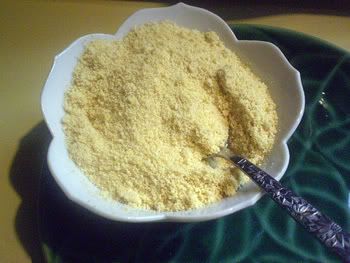
Okara "Parmesan"
What is okara? It's the pulp, or residue, leftover from making soymilk (see this blog post and this page on my website). If you make soymilk frequently you will have lots of it! Many people make interesting recipes with it, but, I must confess, I usually simply compost it!
Does it have any nutrition left? Yes, it does! It's full of fiber-- both soluble and non-soluble-- for one thing. It also contains some protein, calcium, iron and B vitamins. If you want to save it to use later, you can freeze it or dehydrate it (see the Tips in the recipe below).
The justhungry blog has some great ideas for using okara that I hadn't thought of (though not all vegetarian)! For instance, she mentions that you can rehydrate dried okara by simmering it in water or soymilk until soft, and then draining it. One great idea is to use fresh okara in polenta.
I never liked using fresh okara in breads, as it seems to sometimes "weigh them down". But justhungry suggest using dried okara in quick breads, etc., for a lighter texture-- sounds promising!
I just remembered that Dori from the Bakehouse blog (who has lots of okara recipes!)!) recommended using okara in my nut-based parmesan substitute recipe, but I never tried it. The other day I did, and it's good! Thanks, Dori! We can't get the Galaxy Foods Vegan Soy Parmesan up here anymore, so this is something I will definitely use often!
I'll post a few more okara recipes soon!
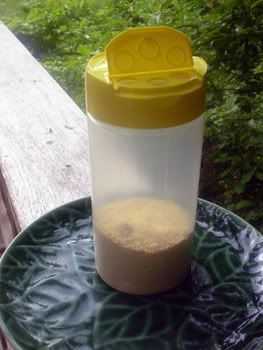
PS: for a new and improved version see this blog post!
BRYANNA'S OKARA PARMESAN SUBSTITUTE (Hat Tip to Dori from the Bakehouse blog!)
This is derived from my recipe for “Almonzano” (from my book "Nonna's Italian Kitchen"), but Dori from the bakehouse blog suggested using okara in it instead of almonds. The measurement for the okara is mine. This really looks like grated cheese and tastes "cheesey" (the miso adds a bit of fermented flavor). It shakes out easily, too. You can easily double, triple or quadruple the recipe and keep it refrigerated or frozen. IT'S ONLY 12 CALORIES A TABLESPOON!!
PS: By "squeezed", I mean okara that comes after squeezing and twisting the soymilk out of a cloth or cloth bag, or pressing through a fine filter. The okara left in the filter of a soymilk maker is much wetter and you would need to squeeze that further.
1 1/3 cups dried okara (2 cups fresh, squeezed) (see Cooking Tips below for how to dry and store)
4 tablespoons nutritional yeast flakes
1/2 teaspoon salt
2 teaspoons light miso
Process the okara, yeast and salt in a DRY blender until as fine as possible. Add the miso in tiny bits. Process again so that there are no lumps. Place in a covered container or shaker and keep refrigerated. (Make sure that the container is tightly closed so that no moisture gets in while in the refrigerator.)
Yield: 1 1/2 cups
Nutrition Facts
Nutrition (per tablespoon): 12.7 calories; 18% calories from fat; 0.3g total fat; 0.0mg cholesterol; 58.3mg sodium; 49.3mg potassium; 1.8g carbohydrates; 0.4g fiber; 0.0g sugar; 1.5g net carbs; 1.0g protein; 0.2 points.
Cooking Tips
DRYING OKARA:
If you have a large amount of okara, you can use a food dehydrator, or spread it on cookie sheets and set it in the oven at its lowest temperature, with the oven door cracked open a little to let out moisture, until dry, stirring now and then.
To dry a small amount in a microwave oven:
Get a microwave-safe plate, or use the carousel in your microwave. Line it with two sheets of paper toweling (this will absorb the moisture), and top that with a piece of cooking parchment cut to fit (this will keep the okara from sticking as it dries). Spread the okara evenly on that, breaking up clumps as much as possible. Leave a space in the center empty (it burns easily in the center of the plate).
Here's my set-up for microwave-drying small amounts:
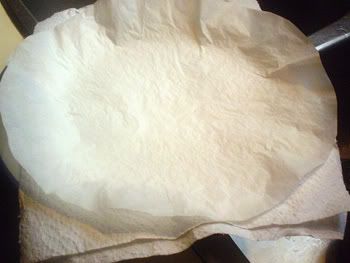
Microwave at half power (#5) in 5 minute increments, stirring after each one, until dried. I took away the paper toweling after the first 5 minutes because it was quite wet, and replaced it with new paper toweling.
Let it cool thoroughly before using or storing (in zip-lock bags).
Cheers!

Thursday, March 8, 2007
YUMMY, CREAMY PASTA IMPROVS

Sorry I haven't blogged for ages-- family business and catching up on other business got in the way. I haven't cooked anything terribly interesting this week, but I did make a couple of good improvisational quick pasta dishes for lunch, using what I had in the house. I didn't write them down as I cooked, but I have a pretty good eye and memory for what I cooked (I wrote them down later), if too much time doesn't pass, so I'm pretty sure these recipe should be accurate.
In the following recipe I used a vegan "cheese" from Scotland called "Sheese" as the topping. I have just been sent a box of Sheese-- many kinds, including some creamy spreads, which I don't think are available in North America yet! The "strong cheddar" is the only one we have tried yet, but we like it! Nice texture, punchy taste. No hydrogenized fats, either!
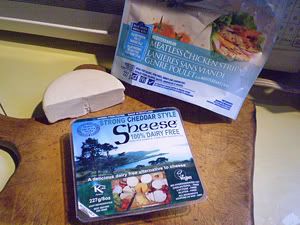
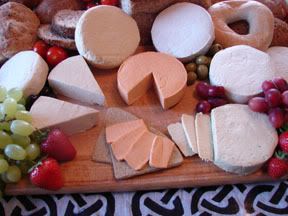
"Sheese" is available in the UK, and in many other countries; see where to buy.
(UPDATE 2015: Unfortunately, Sheese is not available in the USA anymore, and only available in Canada via Koyo Foods' Ontario catalogue.)
I used my low-fat vegan Alfredo sauce to moisten the pasta.
Printable Recipe
RECIPE #1:
BRYANNA'S ALFREDO MUSHROOM-"CHICKEN"-FARFALLE CASSEROLE (WW CORE PLAN COMPATIBLE)
Servings: 6
12 oz wholewheat farfalle (bowtie or butterfly) pasta
1 cup frozen baby peas, thawed
1 Tbs olive oil 2 cups sliced mushrooms
1 medium onion, chopped
4 cloves garlic, chopped
227 g (about 8 oz.) vegan "chicken strips" (I used President's Choice, which is produced by Gardein, but you can use any brand you like; or you could use some reconstituted Soy Curls) salt and freshly-grated pepper to taste
1 cup grated vegan cheese", a strong cheddar style (or any favorite strongly-flavored vegan "cheese")
1/2 cup water
1/4 cup corn flour
 (or yellow cornmeal ground to a fine flour in a dry electric coffee/spice grinder)
 2 cup nondairy milk
2 cloves garlic, peeled
1 tsp salt
1/4 cup Go Veggie! vegan soy parmesan
 or your favorite vegan parmesan sub
freshly ground black pepper to taste
Put the water for the pasta on to heat before starting the sauce. Preheat the oven to 350 ° F.
Make the sauce:
In a small saucepan or microwavable bowl, whisk together the water and the corn flour. If you are cooking the mixture in the pot on the stovetop, stir it constantly over high heat until very thick.
Microwave option: microwave at full power for 20 seconds. Whisk. Repeat three times, or until very thick.
Mix the cooked corn mixture in the blender along with the remaining soy milk, garlic, and salt. Blend until very smooth, which may take a couple of full minutes. Add the soy parmesan and black pepper to taste. Blend briefly. Heat gently before adding to the pasta.
Cook the pasta until "al dente" in plenty of salted boiling water; drain in a colander and set aside mixed with the peas.
Sauté the mushrooms, onions and garlic in the oil in a large nonstick skillet until the onions soften. Add the veggie "chicken" strips and stir to heat.
Add the pasta, peas, and sauce to the pan and mix well. taste for salt and pepper. Scoop the mixture into an oiled 10" round casserole with a cover. Sprinkle the top with the grated Sheese. Cover and bake for 20 minutes. Serve hot.
Nutrition Facts
Nutrition (per serving): 424.8 calories; 16% calories from fat; 7.9g total fat; 0.0mg cholesterol; 664.4mg sodium; 556.6mg potassium; 61.8g carbohydrates; 6.0g fiber; 5.2g sugar; 55.9g net carbs; 24.7g protein; 8.4 points.
RECIPE #2:
This is a creamy pasta recipe, too (I seem to be in the mood for this!). I had ordered some Porcini Mushroom Powder by mail from Pistol River Mushrooms in Oregon-- only $24.95 US for a lb., which lasts a LONG time!!
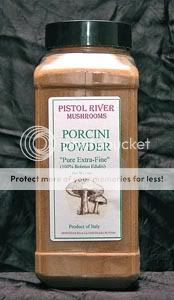
It is made in Italy, smells and tastes divine! I want to experiment with using this product in my mushroom broth and in seitans.
Anyway, they sent me a little packet of dried portobello mushrooms as a gift, so I decided to try them in the following dish, which I made for lunch today.
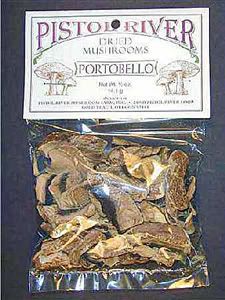 They are really delicious!
I also had some silken tofu from an open box that needed using, some reconstituted Soy Curl "crumbs" (the small bits left in the bottom of the box) in the freezer, and a little bit of wholewheat fusilli left in the box. This is what I came up with:

Printable Recipe
BRYANNA'S CREAMY MUSHROOM FUSILLI (WW CORE PLAN COMPATIBLE)
Servings: 2
NOTE: If you don't have any suitable dried mushrooms, use about 1 1/2 cups sliced fresh portobello mushrooms, and sauté them with the other veggies.
3 oz. fusilli pasta
 ("corkscrews"), or other similar pasta
1/2 oz. dried, sliced Portobello mushrooms
 (or other favorite dried mushrooms), soaked in about 1 cup boiling water
1 cup reconstituted Soy Curls
 "crumbs" (or finely-chopped veggie "chicken" strips of your choice, or Yves Veggie "Ground Round Chicken", which is only available in Canada)
1/2 Tbs olive oil
3 green onions, chopped
4 cloves garlic, chopped
1/2 a red bell pepper, seeded and diced
3/4 cup firm or extra-firm SILKEN tofu
 OR medium firm tofu
3/4 cup mushroom soaking water
2 tsp. veggie broth powder or paste

salt and freshly-ground pepper to taste
Go Veggie! or EarthIsland/Follow Your heart vegan soy parmesan
, or your favorite parmesan sub to sprinkle on topSoak the dried mushrooms in the boiling water and let sit for 10 minutes. then drain them and save the soaking water.
Cook the fusilli in a medium pot of salted boiling water until "al dente". Drain and set aside.
Meanwhile, sauté the onion, garlic and pepper over medium heat in the olive oil in a large nonstick skillet until they soften. Add the Soy Curl "crumbs" and stir to heat.
Mix the tofu and 3/4 cup mushroom soaking water with the broth powder in the blender until smooth.
Pour the tofu sauce, drained mushrooms, and cooked pasta into the skillet and stir until it is well-heated. taste for salt and pepper. Serve with vegan soy parmesan.
Nutrition Facts
Nutrition (per serving): 487 calories, 86 calories from fat, 9.8g total fat, 0mg cholesterol, 968.3mg sodium, 526.5mg potassium, 78.5g carbohydrates, 5.7g fiber, 4.8g sugar, 23.9g protein, 13.4 points.
Enjoy!

Subscribe to:
Posts (Atom)