Showing posts with label dosa. Show all posts
Showing posts with label dosa. Show all posts
Sunday, March 22, 2015
FERMENTED OAT AND URAD DAL UTTAPAM-- SO TASTY!

UPDATE MARCH 23, 2015: I MADE A VARIATION THIS MORNING-- FRUIT UTTAPAM! SEE END OF RECIPE

I was interested in making uttapam for my husband as a more interesting way for him to eat oats, and as a way to includes legumes in a breakfast food. Oats and legumes contain lots of soluble fiber, which is helpful for many conditions, such as angina. After perusing many South Indian cooking blogs, I was interested to find that oats are being incorporated into Indian cuisines because they are a healthful addition to diabetic diets, and diabetes is unfortunately becoming more prevalent in India.
I tried some quick recipes with rolled oats or quick oats and urad dal (hulled, split black gram-- easy to find in Indian markets and well-stocked grocery stores) and they were good, but I realized that I wanted a fermented batter, leavened with the natural fermentation of the oat and legume batter sitting overnight. The fermentation in good for the gut and it makes the batter foamy and full of flavor, with no added leavening.
I decided to start the batter with soaked oat groats (whole oats) and either urad dal, moong dal (split hulled mung beans) or the easily-available split yellow peas. Our local Real Canadian Superstore carries urad dal in their bulk section, so I had plenty of it on hand and that's what I have been using most often. But yellow split peas are another excellent option.
 |
| Soaked Oat Groats (steel cut oats or rolled oats can also be used) |
This is not an "instant recipe, but the "hands-on" time is very minimal and the finished batter can be stored in the refrigerator for a week or so-- it just gets better!

Printable Recipe
UPDATE: SEE FRUIT UTTAPAM VARIATION BELOW RECIPE
BRYANNA'S FERMENTED OAT AND URAD DAL UTTAPAM
Servings: 18 uttapam
Yield: about 6 cups batter
An excellent breakfast, lunch, supper or substantial snack dish. Serve with your favorite dal or sambar, and/or chutneys, and perhaps some non-dairy yogurt or cheese. The Nutrition facts are for one Uttapam, without toppings. NOTE: You can use this batter to make dosa as well.
1 cup oats groats (whole oats)-- (steel cut oats or rolled oats can also be used-- I've used both successfully)
1 cup urad dal (split, hulled black gram), moong dal (split, hulled mung beans), or even red lentils, chana dal or yellow split peas
1 teaspoon fenugreek seeds (NOTE: This is a fermentation aid, but, if you can't find them, omit.)
water
For the Batter:
2- 2 1/2 cups mixed soaking water from oats and dal
1/2- 1 teaspoon salt
For Cooking: (amounts will vary depending on how many uttapam you are making at one time)
oil for greasing the pan
thinly-sliced onion
thinly-sliced vegetables of your choice (could include: sweet potato, cooked potato, squash, cabbage, kale or other greens [dry], halved grape tomatoes, chiles, any color bell peppers, halved grape tomatoes, grated carrots, grated coconut, chopped cilantro, green onion, or leeks, etc.
Non-dairy cheese shreds
For Garnishing:
Your favorite dal or sambar (here's a good sambar recipe: http://abcdsofcooking.com/2009/12/sambar-south-indian-lentil-stew/)
Indian chutney and/ or raita (vegetable and yogurt salad, made with non-dairy yogurt)
chopped fresh cilantro, basil and/or mint
The day before you plan to make the Uttapam, about 6 hours before you go to bed:
1. In separate bowls or pitchers, cover the oats and dal or split peas with water by several inches. Add the fenugreek seeds to the dal. Cover with a clean cloth and let stand at room temperature for about 6 hours.
Just before you retire for the night:
1. Drain the soaked oats and dal separately, saving the soaking water.
2. If you have a large, high-speed blender, you can blend the drained oats, drained dal, salt and 2 to 2 1/2 cups reserved soaking water all at once.
3. If you have a less sturdy blender, blend the oats with 1- 1/4 cups soaking water, and the dal with 1- 1 1/4 cups soaking water in separate batches and then mix them together in a large bowl with the salt.
4. Whichever way you do it, the batter should be like a pancake batter-- thicker than a crepe batter-- but very smooth.
5. Scrape the batter into a large mixing bowl and cover loosely with a lid or towel. Place in a warm-ish spot (maybe the oven with the light on) and leave overnight.
In the morning the batter should have risen a bit and be full of bubbles.

6. You can use it immediately, or place the batter in a covered jar or storage container and refrigerate for up to a week. It will get more flavorful as it sits! If you are cooking some uttapam, immediately, prepare your veggie toppings and veggie cheese, if using, and set out your Garnishes. Have some plates heating in a low oven.
To cook the Uttapam:
1. Have your veggie toppings ready and heat your favorite pancake skillet or griddle over high heat until cold water sizzles when sprinkled on it. Turn the heat down to medium-high and spray with a bit of oil from a pump-sprayer. I use a soup ladle with a rounded bottom that holds about 1/3 cup to scoop out some batter and also to spread the batter.
2. For each uttapam, pour the ladle-full of batter into the center of the pan and , starting from the center, use the bottom of the ladle in a circular motion going outwards to shape a round "pancake" about 6" across.


3. Cover the pan briefly, if you like. When the bottom is golden brown, quickly sprinkle the top with a handful of your veggie toppings, press it down lightly into the batter, loosen the bottom of the uttapam and quickly flip it over.


4. Cook just until the veggies look cooked and a bit charred. Serve at once, veggie side up, or you can make several at a time and keep them hot in a 200 degree F oven until you are ready to serve.


Nutrition Facts
Nutrition (per “pancake”): 55 calories, 4 calories from fat, .5 g total fat, 0 mg cholesterol, 54 mg sodium, 123.1 mg potassium, 9.6 g carbohydrates, 3.2 g fiber, .5 g sugar, 3.4 g protein, 9.8 points.
FRUIT UTTAPAM VARIATION:
I had a brainstorm last night while trying to fall asleep (long story)-- why not use fruit on the uttapam batter instead of veggies, and serve with maple syrup (maybe with some vegan ricotta or vegan yogurt).

I decided to make blueberry uttapam this morning and served it with maple syrup-- it was fantastic!


Tuesday, February 17, 2015
SWEET AND SAVORY (INTERNATIONAL) VEGAN RECIPES FOR "PANCAKE TUESDAY"
It's Pancake Tuesday (Shrove Tuesday)-- I almost forgot!

What is Shrove Tuesday and what does it have to do with pancakes? Here's a short history. It's known as "Mardi Gras" in French-speaking regions (including New Orleans, as I'm sure you are aware). "Mardi Gras" means "Fat Tuesday", the day before Ash Wednesday, when Christian Lent begins. It's referred to as "Fat Tuesday" because fat and eggs, etc. had to be used up before the Lenten fast. Cakes, rich breads and pastries, and pancakes were made in order to consume these foods and not let them go to waste, and also to let loose and celebrate before the fast. Pancakes seem to be a nearly universal way to celebrate.
I actually had pancakes for breakfast this morning, even though I had forgotten it was Shrove Tuesday. Yesterday I had made some batter for grain and bean-based Indian crepes called Adai. These were made with soaked, split. skinned mung beans (mung dal), oatmeal and chickpea flour. They were so easy to make and quick to cook, AND nutritious and delicious. I'll post the recipe soon. (There are two other Indian crepe recipes listed below.)
So, pancakes and crepes can be made out of all sorts of ingredients and they can be sweet or savory. I've compiled a list (with links to the appropriate blog post) of all the pancake and crepe recipes currently on my blog. They are all delightful for any meal of the day. A few can only loosely be described as pancakes, being flat or flattish, but no matter, they are all delicious.
Of course, being vegan and often low-fat, these recipes are not necessarily the best way to use up fat (and certainly not eggs and milk), but you can always slather them with vegan butter to keep the spirit of the day. And, vegans don't have to "give up" meat, eggs, dairy products and animal fat, but any excuse to eat pancakes!
NORTH AMERICAN-STYLE PANCAKES (or pancakes that are normally eaten with sweet toppings or fillings):
 |
| VEGAN ALL-AMERICAN "BUTTERMILK" PANCAKE MIX "I wanted a healthful vegan mix that produced a light, fluffy, white pancake (it's full of whole grains, but it looks white!). I also wanted it to have very few additions, so that it was really quick and easy. You only have to add water and a little lemon juice to this mix, and it produces pancakes you can be proud to serve to children, picky eaters, omnis, anybody!" |
 |
| MULTI-GRAIN, HEMP PROTEIN PANCAKE MIX (There are some options if you don't want to use hemp.) "Why a hemp pancake mix?
This is a multi-grain vegan pancake mix that I originally devised for a proposed hemp book. That deal fell through, but it's a good mix, and a fun way to add some hemp to your diet. You can read about the ecological benefits of hemp here. Hemp can play a role in an anti-inflammatory diet, since it is rich in omega-3 fatty acids. Hemp is a good source of fiber and protein, and it is a very sustainable, versatile crop that can grow in North America without pesticides! It is grown in many countries, including Canada, and is considered a good crop to replace tobacco."
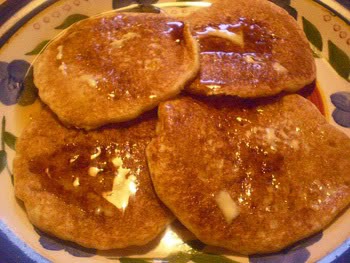
"Here is my vegan version [of sourdough pancakes, using whole grain flours. It turned out beautifully! BTW, sourdough pancakes have a slightly different texture from regular pancakes-- fluffy, but a little more "bready". And, of course, with that sourdough tang that I love."

VEGAN ORANGE-CRANBERRY-PECAN MULTIGRAIN
"BUTTERMILK" PANCAKES (Can be GF and SF)
"Light, fluffy ALL-whole-grain vegan pancakes with the added fiber and antioxidants of flax, cranberries, and pecans. You can use this recipe as a template for plain multi-grain pancakes or pancakes with other flavors, fruits and nuts or seeds...They contain four different kinds of whole grain flour, a combo that makes a very light pancake. I like to keep all of these flours together in the freezer to have at a moment's notice when we feel like having pancakes, without scrambling around to find everything."

BLUEBERRY-OAT PANCAKES (No-Fat)
"This is a great basic high-fiber, but very light and tender pancake recipe, due to the oat flour and wholewheat pastry flour."

"When I was at the McDougall Celebrity Weekend in Santa Rosa in June [2008] , we were not supposed to use any added fat or oil, even pan-spray on the pans. I was planning to make no-fat crepes made with whole wheat pastry flour, chickpea flour and oat flour. In the nonstick pans Mary [McDougall] provided, I made about 50 crepes for audience tasting, and then, in the workshop, I made several in front of the audience, with no mishaps. They were very impressed, and Chef Kevin Dunn told me he never would have tried that! This is the crepe recipe I made at that McDougall event."
|


"Uttapam (or ooththappam or Uthappa) is a South Indian or Tamil pancake-like dish made with a batter of grain (such as rice, semolina or millet), or grain and legumes, similar to dosa batter. Dosa is thinner and crepe-like--sometimes crisp and sometimes softer. Uttapam is a thick pancake, with toppings of vegetables added to the "pancake" when it is just ready to be flipped over. Uttapam is sometimes called an "Indian pizza". It's a common breakfast and snack food in Southern India." PS: There is also a fruit variation!

"These crepes are a type of dosa that is made only from dal and is unfermented. These are actually a bit sturdier than the crepes we're used to, but they fold and roll nicely. You can just eat them with chutney or an Indian-style vegetable stir-fry, or with a more elaborate vegetable curry, if you like. They can be eaten for breakfast, as a snack, or for a lunch or supper dish. (They would be great for a gluten-free diet, too.)... this simple, delicious, nourishing, and filling meal was so inexpensive to make!"

VEGAN OKONOMIYAKI (JAPANESE OMELET OR PANCAKE) (Can be GF and Soy-free)
"I've worked on this recipe on-and-off for a little while. Besides making them vegan, I wanted to use ingredients that most North Americans would be able to obtain easily. These vegan savory omelets or pancakes, however you choose to think of them, are so simple, cheap and quick to make, but absolutely addictive! They originated as frugal street food and were eaten often in the days of reconstruction after WWII."

"So what is this mysterious “pancake”? It’s a delicious and nourishing snack food, a flatbread, really. In Nice, their version, Socca, is a street food, cooked huge copper pans over wood burners (rather than baked), pieces eaten out of hand like French fries in a cone of paper with lots of pepper. In Italy, it is eaten at home, with a knife and fork, or at a bar. In Genoa, there are farinata bakeries everywhere. In Argentina, they eat it on pizza! Both Italians and Niçois will tell you that it should not be made at home and it won’t taste the same if it’s not made over a wood-fired stove or in a wood-fired oven, but, trust me, a very reasonable approximation can be made and enjoyed at home!...This from my book Nonna's Italian Kitchen.
This is a thin version, which I prefer. You can sprinkle the top with chopped garlic and rosemary, thyme or sage before baking, if you like. Ligurians, who eat it with a knife and fork, sometimes also top it with thinly sliced onions or green onions, or even slices of baby artichoke. I like the leftovers cold, too. (UPDATE: Here's another great way to serve farinata.)"

For some reason, I've always been fascinated with recipes using plain beans and whole grains that are soaked and ground and used to make delicious, simple and healthful breakfast treats, breads and snacks. We need more recipes like this under our belts, so to speak, to get through hard financial times in good health and spirits... I used to make this type of dosa years ago for my children for breakfast. They loved it and I still do!" (These crepes are gluten-free and soy-free, BTW.)

In Arabic and Persian cuisines there is a type of thick baked omelet or fritatta that can utilize almost any vegetable (but always contains some green herbs). It can be eaten hot or cold and is often used as a picnic food. In Arabic it is called "eggah" ( عجة ʻaggah or ʻajjah) and in Perisan it is called "kuku" (کوکو). According to food historian Alan Davidson, these are most probably the origin of Italian fritattas and Spanish tortillas (not the Mexican corn variety)... Sometimes the mixture is made into "pancakes" or "patties" and is shallow-fried in oil or clarified butter instead of baked. This is the type of thing I wanted to try, but, of course, egg-free and made with only a little oil. I also wanted to make the potato variety because it sounded nicely substantial and I thought the potato would help hold things together. (It can be made with eggplant, parsley and green onions, leeks, broad beans, spinach and other greens, cauliflower, squash...) I decided to try a mixture of mashed tofu and chickpea flour instead of the egg....It was super simple to make and very tasty—open to alot of variation, too, so I will be playing with it further. I think the potato did help, but you could probably use less if it was baked—something for further experimentation."
Enjoy!
instead of the egg....It was super simple to make and very tasty—open to alot of variation, too, so I will be playing with it further. I think the potato did help, but you could probably use less if it was baked—something for further experimentation."Enjoy!
Wednesday, July 6, 2011
HEALTHFUL, EASY, INEXPENSIVE SOAKED BEAN AND WHOLE GRAIN RECIPES
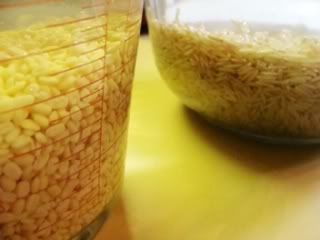 Urad dal
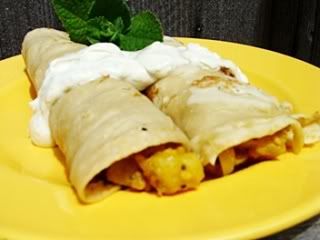 Brown Basmati Rice and Urad Dal Adai (Indian crepes) with Masala Potato filling and Lime Tofu Yogurt
 Rather fuzzy pic (sorry!) of white bean and oat waffles I developed for my book "The Fiber for Life Cookbook
 "-- recipe here. (There's also a fancier version of this recipe at this blog post.)
For some reason, I've always been fascinated with recipes using plain beans and whole grains that are soaked and ground and used to make delicious, simple and healthful breakfast treats, breads and snacks. We need more recipes like this under our belts, so to speak, to get through hard financial times in good health and spirits. These two recipes come from very different cooking traditions (one ancient and the other more recent) that have used soaked beans and grains to advantage over the years-- Indian cuisine and Seventh Day Adventist cooking. This last weekend I had occasion to serve a recipe from each tradition.
My stepson and his girlfriend were visiting and Laurie mentioned that a buddy of his (in Vancouver) wanted him to try a dosa restaurant. Dosai are Indian crepes made from soaked grain (usually semolina or rice) and dried legumes. Sometime these crepes have different names, such as adai. He had never tasted them, so (being a fan of dosas) I thought I'd make some while they were here. And, as it happened, I already had some white beans soaking for waffles, so we had those for breakfast the following day, and the adai/dosai for brunch the next day.
I used to make this type of dosa years ago for my children for breakfast. They loved it and I still do!
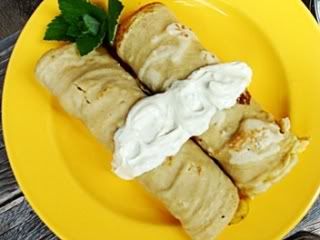
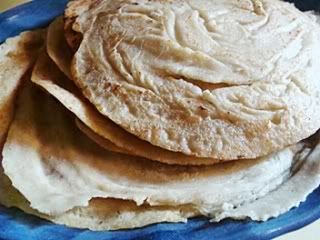 Finished adai
Printable Recipe
BROWN RICE AND LENTIL ADAI (INDIAN DOSAS OR CREPES) (GF,SF)
Makes about 14
Start this recipe on the morning of the day before you want to make them! PS: There is an all-bean type of adai at this blog post.)
 , but you can use a mixture of dals, or split moong dal , or even split yellow peas)
(Note: Urad dal is split, skinned Indian black lentils)
2 cups brown basmati rice
2 tsp salt
1 1/2 cups water
oil from a pump sprayer
Masala Potatoes (see recipe below)
Lime Tofu Yogurt (see note below)
oil from a pump sprayer
Masala Potatoes (see recipe below)
Lime Tofu Yogurt (see note below)
Soak the dal in one bowl with plenty of water, and the rice in another bowl with plenty of water. Soak them until the evening.
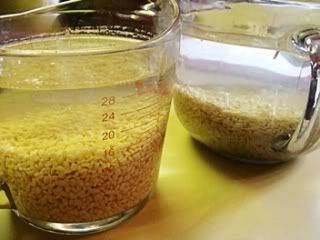
Before bedtime, drain the rice and the dal and place in a large blender or VitaMix with the salt and water. Blend until smooth.
Before bedtime, drain the rice and the dal and place in a large blender or VitaMix
with the salt and water. Blend until smooth.
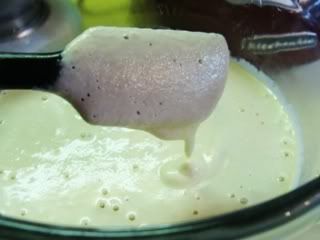
Now place the batter in a large bowl, cover with a clean tea towel and leave overnight at room temperature. This allows the batter to ferment. (This step is optional, but traditional—it gives the batter more flavor and adds some natural leavening.)
The batter should feel like a normal crepe batter—add more water if necessary. (If it's too thick, it won't spread easily.)
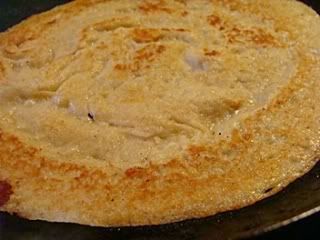
The day you are making the crepes, make or assemble your filling(s) and toppings before starting to cook the adai. Spray an 8 to 10" well-seasoned cast iron or anodized aluminum
 or nonstick skillet
 well with oil from a pump sprayer and heat over high heat. When cold water sprinkled on the pan sizzles, scoop about 1/3 cup of batter into the center of the pan with a small ladle and then use the bottom of the ladle to go in circles and spread the batter out from the center. It's easier than you might think! See the "action" pictures here from a similar recipe (grain-free).
or anodized aluminum or nonstick skillet well with oil from a pump sprayer and heat over high heat. When cold water sprinkled on the pan sizzles, scoop about 1/3 cup of batter into the center of the pan with a small ladle and then use the bottom of the ladle to go in circles and spread the batter out from the center. It's easier than you might think! See the "action" pictures here from a similar recipe (grain-free).
PS: If your batter doesn't spread easily, it may be too thick—cautiously stir in a little more water.
I turned the heat down just a notch or two from the "high" setting. Almost as soon as you have the batter spread, it will start looking a bit dry on top.
Carefully turn the adai and cook for a few seconds, then lay on a platter with a clean tea towel over them (you can fold them in half if you like).
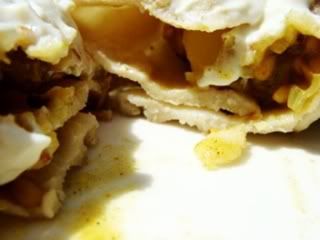
Place some filling (in this case Masala Potatoes, see recipe below) down the middle of each adai and roll up. Serve with the Lime Tofu Yogurt (see NOTE below) and any hot sauces and/or chutneys you like.
Nutrition Facts
Nutrition (per crepe without filling): 145.8 calories; 5% calories from fat; 0.9g total fat; 0.0mg cholesterol; 273.0mg sodium; 197.0mg potassium; 28.9g carbohydrates; 4.5g fiber; 1.4g sugar; 24.4g net carbs; 5.6g protein; 2.2 points
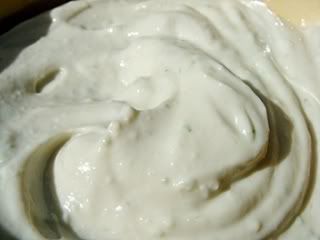
NOTE: For the Lime Tofu Yogurt, use this recipe, but use 3 tablespoons fresh lime juice and 1 tablespoon lemon juice (instead of 1/4 cup lemon juice) , plus the finely-grated zest of 1 medium organic lime.
*************************************************************
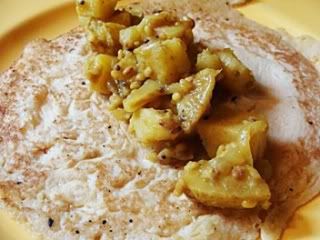
MASALA POTATOES
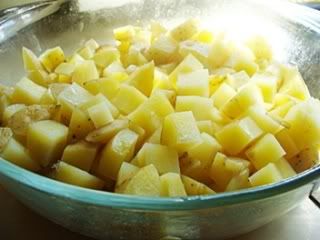
2 lbs. Yukon Gold potatoes, scrubbed and cut into 1/2" dice
2 tablespoons olive oil
1 teaspoon black mustard seeds
1 large onion, thinly sliced
7-8 curry leaves (or bay leaves, if you can't find curry leaves)
1/4 teaspoon turmeric
2 teaspoons ground coriander
1/2 teaspoon cayenne pepper
1 teaspoon salt
3/4 cup water
4 teaspoons fresh lemon or lime juice
Steam the potato cubes until just tender OR (the way I prefer because it saves time and electricity), place the cubes in a microwave-safe casserole with 2 tablespoons water, cover and cook on high for about 8 minutes, or until tender.
Heat the oil in a large well-seasoned or nonstick skillet over medium-high heat. Add the mustard seeds. When they pop, add the onions, curry leaves, turmeric, coriander, cayenne and salt. Stir-fry, adding a small splash of water as needed to keep things moving, until the onions are nicely wilted.
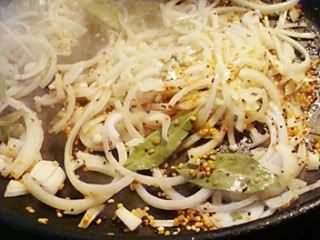
Add the potatoes and water, cover and cook on low heat for about 5 minutes. Add the lemon or lime juice and serve.
Enjoy!

NOTE: For the Lime Tofu Yogurt, use this recipe, but use 3 tablespoons fresh lime juice and 1 tablespoon lemon juice (instead of 1/4 cup lemon juice) , plus the finely-grated zest of 1 medium organic lime.
*************************************************************
MASALA POTATOES
Serves 6-7
2 lbs. Yukon Gold potatoes, scrubbed and cut into 1/2" dice
2 tablespoons olive oil
1 teaspoon black mustard seeds
1 large onion, thinly sliced
7-8 curry leaves (or bay leaves, if you can't find curry leaves)
1/4 teaspoon turmeric
2 teaspoons ground coriander
1/2 teaspoon cayenne pepper
1 teaspoon salt
3/4 cup water
4 teaspoons fresh lemon or lime juice
Steam the potato cubes until just tender OR (the way I prefer because it saves time and electricity), place the cubes in a microwave-safe casserole with 2 tablespoons water, cover and cook on high for about 8 minutes, or until tender.
Heat the oil in a large well-seasoned
or nonstick skillet over medium-high heat. Add the mustard seeds. When they pop, add the onions, curry leaves, turmeric, coriander, cayenne and salt. Stir-fry, adding a small splash of water as needed to keep things moving, until the onions are nicely wilted.Add the potatoes and water, cover and cook on low heat for about 5 minutes. Add the lemon or lime juice and serve.
Enjoy!
Subscribe to:
Posts (Atom)