Showing posts with label za'atar. Show all posts
Showing posts with label za'atar. Show all posts
Monday, May 30, 2011
WHAT ARE YOUR (CURRENT) FAVORITE CONDIMENTS?
 Just wondering! Here are 5 of my fave condiments right now (What are yours?):
1.) Bacon Salt (yes, it can be vegan!):
 A baked potato with my homemade Bacon Salt-- here's my recipe. All the the bacon salt
 I have seen on the Internet is vegetarian-- it either just contains the flavorings for bacon (liquid smoke, brown sugar, etc.), or it contains some soy bacon bits
 , but some brands contain milk products (like J&D brand).
The sodium content of this condiment is much, much lower than table salt-- 1 teaspoon of my homemade recipe contains 90.2 mg. of sodium; 1 teaspoon of table salt contains 1880 mg of sodium! My recipe is much lower in sodium than the commercial brands I've checked.
If you don't want to make it yourself, this is the one I tasted first: Chef Salt Bacon BBQ Salt -- it is vegan.
USES FOR BACON SALT:
On corn on the cob and popcorn and homemade oven-fries; seitan steaks; in BBQ sauces; in marinades for seitan TVP and tofu; in dips, spreads, and vegan mayonnaise; in baked beans; in salad dressings and on salads; as a seasoning in homemade seitan products; in mashed potatoes; on scrambled tofu; in eggless egg salad (made with tofu); roll tofu pieces in it and pan-fry; mix with olive oil for a French bread dip; on potatoes; in potato salad; on or in veggie burgers; on a grilled (vegan) cheese sandwich; with vegan cream cheese and/or vegan sour cream as a dip or spread; on steamed or grilled or roasted veggies; on pasta with a thin creamy sauce (a sort of vegan carbonara); on grits; in vegan mac'n'cheeze; on many types of sandwiches; in soups (or on them); on homemade potato crisps (chips) or other veggie crisps-- kale chips, maybe?-- I'm sure that's just the beginning!
2.) Peruvian Restaurant-Style "Green Sauce":
 Sweet Potato Oven-Fries with Peruvian Restaurant-Style "Green Sauce". Here's my recipe.


 Pita bread with za-atar and olive oil


-- it is vegan.USES FOR BACON SALT:
On corn on the cob and popcorn and homemade oven-fries; seitan steaks; in BBQ sauces; in marinades for seitan TVP and tofu; in dips, spreads, and vegan mayonnaise; in baked beans; in salad dressings and on salads; as a seasoning in homemade seitan products; in mashed potatoes; on scrambled tofu; in eggless egg salad (made with tofu); roll tofu pieces in it and pan-fry; mix with olive oil for a French bread dip; on potatoes; in potato salad; on or in veggie burgers; on a grilled (vegan) cheese sandwich; with vegan cream cheese and/or vegan sour cream as a dip or spread; on steamed or grilled or roasted veggies; on pasta with a thin creamy sauce (a sort of vegan carbonara); on grits; in vegan mac'n'cheeze; on many types of sandwiches; in soups (or on them); on homemade potato crisps (chips) or other veggie crisps-- kale chips, maybe?-- I'm sure that's just the beginning!
2.) Peruvian Restaurant-Style "Green Sauce":
 Sweet Potato Oven-Fries with Peruvian Restaurant-Style "Green Sauce". Here's my recipe.
I still like good ketchup on fries, but we love this creamy, spicy sauce not only on sweet potato oven-fries, but also on veggie burgers and even tomato sandwiches! They use it as a dip for bread and yucca fries in Peruvian restaurants, too. It's pretty addictive! (But, that's no problem, as my recipe has negligible fat and calories.)

3.) Ajvar (Pronounced Eye-vahr) (Balkan or Serbian "Salsa"): This is a name of Turkish origin given to a popular Balkan spread or relish made of roasted peppers and eggplant (and sometimes other vegetables, too). I make it with zucchini instead of eggplant sometimes. Here's my recipe for making it at home, but it's widely available commercially.
This delicious condiment is originally from Macedonia, Croatia, and Serbia, but is popular also in Albania, Greece, Bulgaria, Hungary, Turkey, etc., and all over the Middle East now, it seems. It is sometimes called "vegetable caviar", and there are hot ajvars and mild ajvars
 . In some areas they use roasted green peppers.
Commercial versions are inexpensive in Middle Eastern stores and many brands are available from amazon.com. Trader Joe's sells it but they don't call it ajvar on the label. They call it Trader Joe's Red Pepper Spread with Eggplant and Garlic. I understand that Whole Foods sells an organic version with "Ajvar" on the label.
and mild ajvars. In some areas they use roasted green peppers.Commercial versions are inexpensive in Middle Eastern stores and many brands are available from amazon.com. Trader Joe's sells it but they don't call it ajvar on the label. They call it Trader Joe's Red Pepper Spread with Eggplant and Garlic. I understand that Whole Foods sells an organic version with "Ajvar" on the label.
I use it on all kinds of wraps, panini, and sandwiches,or as a cracker spread or a dip. Serve it as an appetizer to spread on thick slices of country-style bread or flatbread such as pita or lavosh, or use it as a side dish. Or just use it like salsa. You can use it with rice or potatoes, or as a quick pasta sauce; or use it in hummous and other dips. It's used on grilled meats, so why not on grilled seitan or tofu? Or on some of those big Field Roast or Tofurkey veggie sausages? Or with white beans, veggie "meatloaf", or "cheese" toast, or bruschetta? Spice Island Vegan used it with my tofu fritatta from "Nonna's Italian Kitchen " and it would be good on scrambled tofu and vegan omelets, too. I also use it to color vegan cheeses and sauces.
" and it would be good on scrambled tofu and vegan omelets, too. I also use it to color vegan cheeses and sauces.
4.) Za'atar ( a seasoning mixture of wild thyme, lemony ground sumac and sesame seeds) is a popular seasoning in Armenia, Iran, Iraq, Israel, Jordan, Lebanon, Libya, Morocco, Palestine, Saudi Arabia,Syria, Tunisia, and Turkey.
 Pita bread with za-atar and olive oil
If you've never tasted za'atar (also spelled za'tar, zatar, zatr, zahatar, satar), prepare to be hooked! The taste of a za'atar mixture can described be tangy, herbal, nutty, or toasty-- actually all of the above!(The word can be used for wild thyme, or for the mixture of thyme, sumac, sesame and salt, by the way.)
You can either spread it on flatbreads or pita with olive oil, or dip the bread in a mixture of olive oil and za'atar. (Use a really good extra virgin olive oil that you enjoy uncooked.) I sprinkle it on top of roasted cauliflower, steamed broccoli and stir-fried Brussels sprouts, some soups (try it on Palestinian Red Lentil Soup , Levantine Bean Soup , Silky Sweet Potato and Red Lentil Soup or Balkh Brown Lentil Soup), on tofu feta and on dips and other vegan cheese preparations. It would be great on grilled or fried tofu, or rubbed into your favorite seitan. Try it in salad dressings and on latkes (potato pancakes) or oven-fried potatoes, sweet potatoes, couscous, grilled zucchini, cucumber salad, tomatoes-- I'm sure you'll come up with many other ways to use it!
There are many, many different versions-- here's a formula to start with. Or you can buy some at Greek or Middle Eastern Markets, or on amazon here and here
 and more.
and here and more.
My absolute favorite za'atar is Zatoun fair trade brand, available from Ten Thousand Villages fair trade markets in Canada (you can order online) and here in the USA. The aroma of the wild thyme in this product is so amazing-- it bears no resemblance to the dried thyme we usually have available to use.
#5) Spanish Smoked Paprika (Pimentón): How did I ever live without this product? I know it's a bit "old hat" now, but I still love it! Smoked paprika is the Spanish cousin to sweet Hungarian paprika . It's made from pimiento peppers that have been dried and smoked over an oak fire, then ground into a fine powder.
. It's made from pimiento peppers that have been dried and smoked over an oak fire, then ground into a fine powder.
It was originally used in paella and in spicy Spanish sausages, but it's delicious sprinkled on soups, salads, dips (such as hummus) vegetables (especially roasted), pizza, potatoes, scrambled tofu, roasted tomatoes, and in stews and BBQ sauces. It's a great spice for adding smoky flavor and depth to vegan dishes, and low-fat dishes.
There are many, many brands available (amazon carries many) and in gourmet food stores and supermarkets.
 and
and kind:
kind:
There is also a moderately spicy smoked paprika (Pimentón Agridulce), but I haven't found it around here. Perhaps I should order the 3-pack from amazon!
from amazon!
Enjoy! (And I look forward to hearing what your favorites are!)


Sunday, May 15, 2011
VEGAN LABANEH (YOGURT CHEESE) SPREAD AND POMEGRANATE MOLASSES DRESSING ON ROASTED BEETS

We're off to Whitehorse, Yukon on Tuesday, so I wanted to get this blog post out there before I get caught up in packing, etc.. I'm going to be teaching 2 vegan cooking classes at my friend Suat's amazing organic bakery in Whitehorse-- an Italian menu and a South American menu. (Yes, there are vegans in the Yukon!) Whitehorse is a beautiful, friendly place and we're looking forward to going there again!
But last week I was in the mood for Middle Eastern food and I have been wanting to make some vegan labeneh spread. Labaneh is a drained yogurt spread that is a common food in the Middle East, eaten at any meal.
I knew that I didn't want to just drain soy yogurt because, for one thing, it's too expensive and, for another, even though I've learned to like the plain Nancy's soy yogurt (UPDATE, 2015: the best we can get around here, now that WholeSoy- sob!- is no more), it doesn't really have the same taste as dairy yogurt. I also wanted something that was fairly quick to make-- I haven't had alot of time lately and I know that many of you probably don't either. And another thing-- I wanted it to taste RICH, like full-fat yogurt would.
So, I turned to my old stand-byes, extra-firm silken tofu and raw nuts. Squeezing the tofu in a cloth gives the mixture a firm texture. I didn't want to add lemon juice and thin it out too much, so I add a little soy yogurt and crushed vitamin C (ascorbic acid) for a little tang. I added some probiotic powder, too, but that's optional. I didn't serve it for a couple of days, and I swear that even in the refrigerator, it acquired a more "yogurty" flavor!
The result was better than I had hoped for and, topped off with some really good olive oil and fragrant za'atar, served with fresh pita bread (recipe here), my guests made short work of it! I hope you like it!

Printable Recipe
BRYANNA'S VEGAN LABANEH (“YOGURT CHEESE”) SPREAD
Yield: 1 1/2 cups
1/2 cup raw shelled Brazil nuts (my 1st choice), macadamia nuts or cashews
1 12.3 ounce box extra-firm silken tofu
1/4 cup of the most authentic-tasting vegan yogurt you can find
1/2 teaspoon salt
1/2 teaspoon probiotic powder (optional)
(optional)
1/ 1000-2000 mg vitamin C pill, crushed to a powder (for tanginess)
(place the pill on a flat surface and crush with the flat bottom of a bowl or plate, then crush any larger pieces left with the back of a spoon.)
1/4 teaspoon sugar
Traditional topping:
olive oil
Za'tar  (Levantine herb mixture of wild thyme, sesame seeds and sumac. The best I've ever had is Zatoun brand.) Read about it at this blog post-- and there's a simple recipe if you want to make your own.
(Levantine herb mixture of wild thyme, sesame seeds and sumac. The best I've ever had is Zatoun brand.) Read about it at this blog post-- and there's a simple recipe if you want to make your own.
Place the nuts in a bowl and cover with boiling water. Let stand while you prepare the tofu.
Crumble the silken tofu into a colander lined with a square of clean cotton sheeting or something similar (don't use cheap household cheesecloth-- the holes are to big!), with the cloth hanging over the side of the colander so that you have enough cloth to twist together at the top.
Gather the ends of the cloth together and twist and squeeze the cloth to extract as much water as you can from the tofu. After a few twists, open it up and scrape the tofu down to the bottom of the "bag" and twist again. With the ends of cloth twisted tightly and held in place, squeeze or press the bag-- anything to get as much water as possible out of the tofu.
Place the resulting tofu in a food processor or powerful blender. Drain the nuts well and pat dry and add them to the machine with the tofu, along with the other ingredients. Process or blend until as smooth as possible-- this may take several minutes.
Scrape the mixture into a wide, shallow bowl and spread it out evenly. Drizzle with olive oil and sprinkle with the Za'tar, too, if you like, or paprika, chopped fresh parsley or mint, etc.. Serve with Middle Eastern meals, pita or other flatbread, Greek olives, cucumbers and tomatoes, etc.
Nutrition Facts (not counting the olive oil)
Nutrition (per 1/4 cup serving): 102.1 calories; 54% calories from fat; 6.5g total fat; 0.0mg cholesterol; 195.9mg sodium; 163.7mg potassium; 5.3g carbohydrates; 0.5g fiber; 1.9g sugar; 4.8g net carbs; 6.6g protein; 2.5 points.
I served roasted beets with the following dressing at the same meal:
Printable Recipe
I served roasted beets with the following dressing at the same meal:
 |
| Roasted Beets with Pomegranate Molasses Dressing |
BRYANNA'S POMEGRANATE MOLASSES SALAD DRESSING
Yield: 1 1/3 cups
My friend Jane told me she didn't really like beets, but she ended up eating seconds of the beets with this dressing! PS: Read more about pomegranate molasses at this blog post.
Mix together all of the following ingredients:
1/2 cup vegan broth
 or water
or water

2 tablespoons olive oil
1 tablespoon red wine vinegar
1 tablespoon brown sugar
1/2 teaspoon salt
1 clove garlic, crushed
Nutrition Facts
Nutrition (per 2 Tbs.): 48.3 calories; 44% calories from fat; 2.5g total fat; 0.0mg cholesterol; 86.3mg sodium; 6.8mg potassium; 1.5g carbohydrates; 0.0g fiber; 1.2g sugar; 1.5g net carbs; 0.1g protein; 1.2 points.
Enjoy!

Saturday, November 13, 2010
ZA'ATAR, AN ANCIENT HERB, A FRAGRANT, TANGY SPICE MIX FROM THE MIDDLE EAST

(Still working on the photos for the book-- next week I'll have more freedom to blog!)

Homemade Pita Bread Triangles with Olive oil and Za'atar (“manakeesh” in Arabic; and I've seen it also referred to as "manoosh")
The bread above was served as part of a summer dinner with hummus and eggplant dip, but it is a common breakfast item in the Middle East and the Levant. In that region, it is commonly believed that za'atar, a mixture of wild thyme, lemony ground sumac and sesame seeds (and sometimes salt), strengthens and clears the mind-- for this reason school children in the region are urged ot eat a slice of manakeesh before leaving home to take exams! (Here's my recipe for wholewheat pita and manakeesh.) And who knows? Herbs are now being found to contain powerful antioxidants, so it may have some science behind it! (Thyme oil contains anti-inflammatory and antiseptic qualities.) It can't hurt, anyway, and anything that may clarify my mind is a good thing! Of course, if it tastes good, too, all the better!
If you've never tasted za'atar (also spelled za'tar, zatar, zatr, zahatar, satar), prepare to be hooked! The taste of a za'atar mixture can described be tangy, herbal, nutty, or toasty-- actually all of the above!(The word can be used for wild thyme, or for the mixture of thyme, sumac, sesame and salt, by the way.) You can either spread it on flatbreads or pita with olive oil, or dip the bread in a mixture of olive oil and za'atar. (Use a really good extra virgin olive oil that you enjoy uncooked.) I sprinkle it on top of some soups (try it on Palestinian Red Lentil Soup , Levantine Bean Soup , Silky Sweet Potato and Red Lentil Soup or Balkh Brown Lentil Soup), on tofu feta and on dips and other vegan cheese preparations. It would be great on grilled or fried tofu, or rubbed into your favorite seitan. Try it in salad dressings and on latkes (potato pancakes) or oven-fried potatoes, sweet potatoes, cauliflower, couscous, grilled zucchini, cucumber salad, tomatoes-- I'm sure you'll come up with many other ways to use it!
UPDATE, June 1, 2012: This is a GREAT article on za'atar!!)
According to many who grew up eating za'atar every day, the flavor of our domestic thyme pales in comparison to the flavor of wild thyme picked in the spring by mothers and grandmothers and dried for the year at home. But it gets confusing-- I've seen wild thyme equated with wild marjoram or hyssop, too. In any case, I'm sure that the wild herb does have a stronger flavor than our domestic type. In our part of the world, experiment with combinations of our domestic thyme, marjoram and/or oregano. You may be able to find wild thyme, perhaps from Greece or Lebanon, in Middle Eastern or Greek grocery stores.
You can buy za'atar, of course, in Middle Eastern stores (online, too). But it's fun to come up with your own recipe (see below). My absolute favorite za'atar is Zatoun fair trade brand, available from Ten Thousand Villages fair trade markets in Canada (you can order online) and here in the USA. The aroma of the wild thyme in this product is soooooo amazing-- it bears no resemblance to the dried thyme we usually have available to use.
A SIMPLE ZA'ATAR FORMULA TO START WITH:
Of course everyone's mother or grandmother has the perfect formula, so go online and search for za'atar recipes (see all the different spellings above), or check out Middle Eastern and Levantine cookbooks for recipes. (Here is one.) I've seen recipes that also add caraway seed and/or a little allspice. In the book "Classic Vegetarian Cooking from the Middle East and North Africa
 ", by the great Canadian scholar and author Habeeb Salloum, there is a recipe with equal parts thyme and sumac, with the addition of pulverized cooked, roasted chickpeas and marjoram (and a little salt and sesame seeds)! I'm sure that there are many regional varieties, and then many more family variations. You'll eventually develop your own formula.
For a small amount, mix 4 tablespoons dried thyme (or a combination of herbs as mentioned above) with 2 tablespoons ground sumac
 , 2 tablespoons toasted white sesame seeds and a pinch or two of salt. Multiply these amounts if you want some on hand all of the time.
ABOUT SUMAC: This ingredient is ground from a berry from the Mediterranean Sumac tree. Sumac is deliciously tangy and sour with hints of lemon. Because of its flavor it is used as a souring agent instead of, or in addition to, citrus juice or vinegar. (It is a main ingredient in the delicious Lebanese salad, Fattoush. Read more about it here and here.
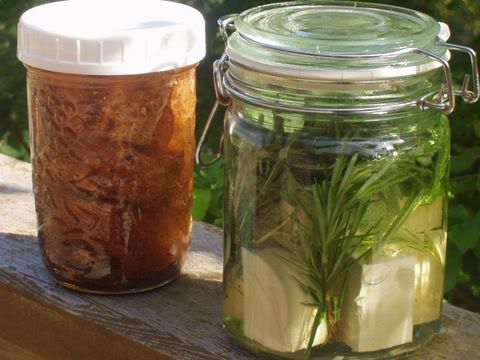
My Tofu Feta -- one jar with za' atar and oil.
Happy Experimenting with Za'atar!

Subscribe to:
Posts (Atom)