Showing posts with label homemade tofu. Show all posts
Showing posts with label homemade tofu. Show all posts
Monday, July 23, 2012
REVIEW OF A HANDSOME NEW TOFU PRESS (LARGER CAPACITY; HANDMADE)-- AND A CHANCE TO WIN ONE!

This is the first guest post I've ever hosted on my blog, written by one of my original Vegan Feast newsletter subscribers, who has become a friend. Brenda wrote the step-by-step, illustrated tofu-making article for my website (which is now located on her blog), so she is well-qualified to review this new product! Bryanna
UPDATE July 31, 2012:
The draw is over and the lucky winner is Courtney!
UPDATE July 31, 2012:
The draw is over and the lucky winner is Courtney!
Tofu Press
by
Earth First Innovations
A review by Brenda Wiley

NOTE: See the end of this post to learn how you can
enter a drawing for a free give away of one of these tofu presses.
I have finally found a tofu press that I
LOVE!!
I have been making my own tofu since
sometime around the late 1990’s or early 2000 (pure guess actually ... trying
to find a date on some of my photos without success).
When I first got ready to make homemade
tofu, I bought a tofu kit from Sanlink, and have been using that pressing box
ever since.

This press certainly serves the purpose,
but I've found it had two shortcomings:
First ... for the first 10 minutes or so of
pressing, I have to be "hands on", holding the two ten pound weights
sitting atop the can of tomatoes all of which is providing the weight to press
the tofu. During the initial few minutes of pressing, as the tofu is being
pressed, it is so soft and wobbly that this stack of weights and canned goods
literally weaves all over the place.

Even once the tofu gets firm enough to end
the "wobbling", I still keep a close eye on things to prevent 20
pounds of weights from crashing onto my wood floor.
The second short coming is the size ... the
box is only large enough to make a 1 to 1 1/4 pound (450 grams to 560 grams)
block of tofu at a time. For as much tofu as I make, I'd like the option of
making 2 pounds or more while I'm at it. (A check of the Sanlink page shows
their box is now larger --- 7.5" by 5.5" by 4" deep. The one I'm
using is 5.25" by 4" by 3" deep).
Due to the small size of the box
(5.25" by 4" opening), I've got to spoon 6 QUARTS of hot soymilk into
this little container. I've done this via 2 cup scoop.
I was pleasantly surprised to be contacted
by Kevin Kuhns who, after learning to make tofu, realized these were problems
needing a solution. He has developed a mechanical tofu press for small-scale
tofu production for commercial and home use.
He kindly sent me 2 units to use and
evaluate in exchange for a review on this website. Kevin provided only the 2
products .. the review that follows is totally my own and is based purely on my
experience with the product.
His units are made from select, eastern
white pine. He chose this because it is native to the US Northeast, readily
available in high quality lumber, and is about as rot-resistant as the
over-touted Japanese cypress. He ruled out using any of the tropical hardwoods
(teak or ebony) as a matter of conscience. One of the tenets of his company is
"Earth First", and his first priority was to use a sustainable wood.
He makes an unfinished unit, and one finished
with a food safe finish, and he sent me one of each. The only difference is
that with the unfinished one, before using, you would want apply a thin coating
of food grade mineral oil to the wood before using.
I simply cannot say enough about how useful
and practical this product is. It perfectly solves the two issues mentioned
above ... I found his method of pressing to be so simple and so intuitive, it
makes me wonder why no one else has thought of this as yet.
The pressing is done via a handle pressing
down on a top plate that is in contact with the top of the muslin wrapped tofu.
This handle is held in place with two "press bands" --- basically two
wide, super-strong, heavy duty rubber bands. These bands can apply as much as
20 pounds of weight to the tofu, or as little as 5 pounds, based on whether you
use one or two bands, and how much you stretch them (the amount of stretch is
controlled by where you put the lower pin to which the rubber band(s) attach.
This pin can be moved up or down).
The beauty of this is that you pour the
curds and whey into the muslin lined box, fold the muslin over the curds, apply
the top plate, attach the bands and walk away. No teetering tower of 20 pounds
of your husband's weights on top of a can of tomatoes to guard against toppling
and falling!
Kevin's box is also plenty large ... he
says it will make up to nearly 4 pounds of tofu at one time. I have used it to
make up to 2 pounds at one time, something I was never able to do before.
Another advantage of the size of his box is that you don't have to ladle 6
quarts of curds and whey into a tiny container (as mentioned above). I just
pour all the curds and whey right into this muslin lined box without a bit of
problem.
The box also is able to handle a
"regular" batch of tofu .... 5 1/2 quarts of Soymilk to make one
pound of extra firm tofu. Here is my one pound block of tofu made in Kevin's
Tofu Press.

Other Uses
Kevin also designed the box to act as a
press to press water out of commercial tofu. I tried this (yes, I do
occasionally buy commercial tofu when I don't have time to make my own !! ) and
his product works great! It is perfectly sized and shaped to allow two 14 to 16
ounce blocks of tofu (the size normally sold in the US) to lie side by side on
the bottom plate within the box. Using his press, I was able to press out 11
ounces of water from 2 store bought blocks of tofu.


He also says it will work well as a general
food press, when you need to, for example, press water from thawed, frozen
spinach, spring vegetables, etc.
I found Kevin to be very responsive to
input on his product. In fact, he changed a couple parts of the unit's design
in response to my feedback. (Note that
part of the redesign involved the plunger, and the new units’ plungers look
slightly different from what I have in my photos. Overall design is unchanged however.)
Besides the tofu pressing box itself, Kevin
also includes an amply sized piece of muslin, and 3 ounces of nigari flakes,
enough to coagulate approximately 10 pounds of dry soybeans.
He sells the units with the food-safe
finish for $46.99; the natural pine ones (no finish) are sold for $39.99.
Shipping is additional, based on your location and preferred shipping method.
He ships world-wide. All these units have been handmade by Kevin, and they are
fine, well made products. In fact, the thickness of the wood sides and pressing
plates is almost twice the thickness of my old Sanlink product.
I urge you to take a look at Kevin's
product ... it's always great to find something made to meet a specific need
... form and function perfectly meshing. From my uses, I can whole heartedly
recommend this!!
Kevin can be contacted via:
his Website:
http://www.earthfirstinnovations.com/tofu-press.html
Email: kevin (at) kuhns (dot) biz
or Phone: 603-557-4788
More pictures here (link:
http://www.brendajwiley.com/tofu_press.html).
About that contest:
Kevin is generously offering to provide one lucky winner with a tofu
press of their choice (either one with a food-safe finish or one of the plain,
unfinished ones) free of charge. If you
are interested in winning an Earth First Tofu Press, please leave a comment
below.
Please be sure to provide a valid email address so we can contact you if you win. Bryanna will draw the lucky winner via a random drawing on July 31, 2012 .
Please be sure to provide a valid email address so we can contact you if you win. Bryanna will draw the lucky winner via a random drawing on July 31, 2012 .
Brenda’s Bio:
Brenda is a 59 year old RN, who within the
last year and a half, has gradually reduced her work hours from full time, to
just a few hours per month to devote more time to her passions.
These passions include her husband of 32 years;
two canine family members; maintaining her physical health; growing
spiritually; cooking; and hiking. She
especially loves to connect with folks thinking about making the switch from a
meat based diet to a plant based diet, to show them the all the advantages of
that way of eating, and helping them avoid some of the stumbling blocks.
She has been vegetarian since 1976,
following a 6 month post-college experiment to see what vegetarian eating was
like. That 6 month experiment is now
almost 36 years and counting!!
She made the switch from vegetarian to
vegan sometime in the early 80’s. Brenda
very much sees clear-cut connections between her life interests: maintaining a healthy body, growing
spiritually, and following a vegan lifestyle.
Each supports the others.
Some 10 or 12 years ago, she started making
her own tofu. Her webpage has pictorial
step-by-step directions for this.
Bryanna graciously hosted those instructions on her own site until
Brenda set up her website some years ago.
Kevin C. Kuhns Bio:
Kevin is a dedicated horticulturist,
mycologist and out-spoken proponent of green industry and green initiatives. He
has operated his own small nursery specializing in hellebores and Japanese
maples and has developed a low-cost laminar flow hood and incubation device for
micropropagation applications. Kevin is also a long-time devotee of soy food
products, in particular tempeh and more recently tofu. In 2010 he established a
start-up company, Earth First Innovations LLC, in New Hampshire that is
dedicated to low-cost tofu and tempeh production devices.
In his early career, Kevin worked in the
telecommunications industry where he specialized in satellite communications
and television encryption for 30 years. He has three patents and numerous
publications in these fields.
Throughout his career Kevin has engaged in
extensive international assignments. He has lived as a resident of Indonesia
for 17 years, Singapore for 3 years, Viet Nam for 3 years, China for 2 years
with frequent travel to Europe and Africa and throughout southeast Asia. As a
result, Indonesia remains a second home to Kevin, and he has fully immersed
himself in Indonesian culture, language and cuisine over the many years there.
It is this immersion that has made Kevin a devoted promoter of fermented foods
such as tempeh, tape and oncom.
When asked, Kevin describes himself as a
deeply spiritual, yet non-conformist Christian with an abiding respect for the
tenets of Buddhism. He is a devoted father, husband and supportive friend to
those who may choose to know him.
********************************************************************
Thank you, Brenda and Kevin!


Monday, August 3, 2009
EASY VEGAN POPSICLES-- GROWN-UP ONES, TOO; & CONSERVING WATER WHEN MAKING HOMEMADE SOYMILK OR TOFU

A Vegan Pineapple Sherbet Pop about to be eaten, in front of a new batch of Vegan Orange Creamsicles
Last week all temperature records were broken in BC-- it was HOT! Popsicles and salads were the order of the day, and I'll get back to those popsicles very soon. A prime concern for many people, even in our rain forest, is water-- or the lack thereof. We had a dry winter and spring, and now a dry summer. Forest fires are raging in parts of the province; wells are drying up. You see trucks with huge water tanks waiting in the ferry lineups to bring water to fill island wells. (We are lucky-- we have a back-up deep well to fill up our well in the summer.)
A reader pointed out the problem of how much water is used in soymilk making some time ago. I recently began to use a more efficient way of utilizing water during the soymilk-making process, and I'd like to share it with you.
If you make your own soymilk and/or tofu and you are having water problems, here are some ideas to conserve water during the very water-intensive process:
You can use the same 2 quarts or so of water to:
a.) float the skins off the soybeans;
b.) scald your equipment;
c.) wash your equipment after making the soymilk;
and d.) water your plants or garden!
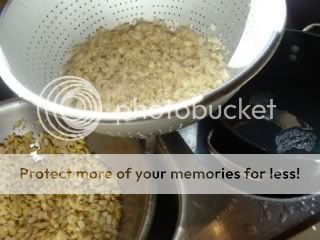
While rubbing the skins off of the beans before making the soymilk (removing the skins results in a product with a less "beany" taste), strain the water in which you are floating off the skins through a sieve into a pot or bowl each time. Re-use the same water for each round of rubbing off and floating off the skins and save the water after the last round. (NOTE: I have found that the age of the soybeans makes a difference in terms of removing the skins. For older, more shrunken soybeans, it takes me about 7 minutes to remove the skins; for nice plump newer soybeans it takes only about 3 minutes. I soak them in the refrigerator first for a few days. Freezing the soaked beans also helps the skins come off more easily.)
Now you can boil that same strained rinsing water and use it to scald your equipment in a basin. After making your soymilk, you can re-use the same water (in a washing basin and reheated) to wash out your straining cloth and clean and rinse your soymilk-making equipment. If you use dish soap, use a biodegradable one. You can then use this washing and rinsing water to water your plants or garden, or even flush your toilet, if water is very scarce.
If you make your own soymilk and/or tofu and you are having water problems, here are some ideas to conserve water during the very water-intensive process:
You can use the same 2 quarts or so of water to:
a.) float the skins off the soybeans;
b.) scald your equipment;
c.) wash your equipment after making the soymilk;
and d.) water your plants or garden!
While rubbing the skins off of the beans before making the soymilk (removing the skins results in a product with a less "beany" taste), strain the water in which you are floating off the skins through a sieve into a pot or bowl each time. Re-use the same water for each round of rubbing off and floating off the skins and save the water after the last round. (NOTE: I have found that the age of the soybeans makes a difference in terms of removing the skins. For older, more shrunken soybeans, it takes me about 7 minutes to remove the skins; for nice plump newer soybeans it takes only about 3 minutes. I soak them in the refrigerator first for a few days. Freezing the soaked beans also helps the skins come off more easily.)
Now you can boil that same strained rinsing water and use it to scald your equipment in a basin. After making your soymilk, you can re-use the same water (in a washing basin and reheated) to wash out your straining cloth and clean and rinse your soymilk-making equipment. If you use dish soap, use a biodegradable one. You can then use this washing and rinsing water to water your plants or garden, or even flush your toilet, if water is very scarce.
*******************************************
Now, ABOUT those popsicles:
Sure, I keep them around for treats for my grandchildren, but DH and I like them for a cold treat, too. And the ones I make are low in calories, fat, and even sugar. I don't have any of those fancy, flat Popsicle molds. I like the small ones you can buy in a large supermarket just because they ARE small. These small molds make a popsicle that's only around 50 cool calories and about 1 WW point.
If you are looking for BPA-free molds, here are three: Tovola molds [doesn't say they are BPA free, but I according to this site, they are]; Norpro molds
 ; and Soft Landing molds. Stainless-steel popsicle molds
 are also available. You can also use wooden popsicle sticks [buy them at craft stores if you can't find them elsewhere] with tiny glass jars or drinking glasses. Because it is a cold mixture that goes into them, and they can be removed from the mold as soon as they freeze, and the plastic is never heated, I personally don't worry too much about this.)
For special occasions, you can make "adult popsicles" by adding a little liquor or liqueur to the mix.
Here are two of our favorite popsicle recipes, and I'll share some more of our favorites in the weeks to come.
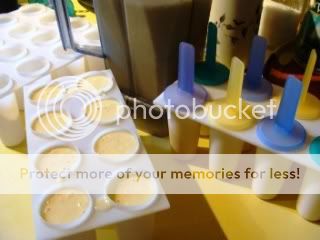
Printable Recipe
BRYANNA'S VEGAN ORANGE CREAMSICLES (WITH GROWN-UP OPTION)
Servings: 16
Yield: 16 small popsicles
1 cup non-dairy milk
(NOTE: you can even use soymilk that has turned to "buttermilk")
1/ 12.3 oz. box firm or extra-firm SILKEN tofu
 (use soft or medium tofu if silken is not available)
6 oz frozen orange juice concentrate
1/3 cup unbleached organic granulated sugar (or agave nectar
 )
)
1 teaspoon vanilla
1 pinch salt
GROWN-UP OPTION: 3 tablespoons citrus vodka or orange liqueur
Blend until smooth in a blender or Vita-Mix
 , fill your popsicle molds, put the sticks in place, and freeze solid. To remove, turn the mold upside down and run under hot tap water for a a few seconds, until the popsicles loosen in the molds enough to slide them out.
Nutrition Facts
Nutrition (per serving): 54.2 calories; 9% calories from fat; 0.6g total fat; 0.0mg cholesterol; 39.3mg sodium; 142.5mg potassium; 10.2g carbohydrates; 0.2g fiber; 9.7g sugar; 10.0g net carbs; 2.3g protein; 1.1 points.
Nutrition facts with the vodka or liqueur added: Nutrition (per serving): 60.3 calories; 8% calories from fat; 0.6g total fat; 0.0mg cholesterol; 39.3mg sodium; 142.6mg potassium; 10.2g carbohydrates; 0.2g fiber; 9.7g sugar; 10.0g net carbs; 2.3g protein; 1.2 points.
**********************************************
Printable Recipe
BRYANNA'S VEGAN PINEAPPLE SHERBET POPS (WITH GROWN-UP OPTION)
Servings: 18
Yield: 18 small popsicles
1/ 12.3 oz box firm or extra-firm SILKEN tofu (use soft or medium tofu if silken is not available)
1/3 cup unbleached organic granulated sugar (or agave nectar
 )
)
4 teaspoons lemon or lime juice
3/4 teaspoon vanilla extract
19 oz canned unsweetened crushed pineapple packed in juice (with the juice)
GROWN-UP OPTION: 3 tablespoons vodka, rum, pineapple liqueur or coconut liqueur
Blend until smooth in a blender or Vita-Mix
 , fill your popsicle molds, put the sticks in place, and freeze solid. To remove, turn the mold upside down and run under hot tap water for a few seconds, until the popsicles loosen in the molds enough to slide them out.
Nutrition Facts
Nutrition (per serving): 43.6 calories; 8% calories from fat; 0.4g total fat; 0.0mg cholesterol; 12.5mg sodium; 68.1mg potassium; 8.9g carbohydrates; 0.3g fiber; 8.2g sugar; 8.6g net carbs; 1.6g protein; 0.9 points.
Nutrition facts with the liquor added: Nutrition (per serving): 52.4 calories; 6% calories from fat; 0.4g total fat; 0.0mg cholesterol; 12.5mg sodium; 68.1mg potassium; 9.7g carbohydrates; 0.3g fiber; 8.2g sugar; 9.4g net carbs; 1.6g protein; 1.0 points.
Keep cool!

[doesn't say they are BPA free, but I according to this site, they are]; Norpro molds ; and Soft Landing molds. Stainless-steel popsicle molds are also available. You can also use wooden popsicle sticks [buy them at craft stores if you can't find them elsewhere] with tiny glass jars or drinking glasses. Because it is a cold mixture that goes into them, and they can be removed from the mold as soon as they freeze, and the plastic is never heated, I personally don't worry too much about this.)For special occasions, you can make "adult popsicles" by adding a little liquor or liqueur to the mix.
Here are two of our favorite popsicle recipes, and I'll share some more of our favorites in the weeks to come.
Printable Recipe
BRYANNA'S VEGAN ORANGE CREAMSICLES (WITH GROWN-UP OPTION)
Servings: 16
Yield: 16 small popsicles
1 cup non-dairy milk
(NOTE: you can even use soymilk that has turned to "buttermilk")
1/ 12.3 oz. box firm
or extra-firm SILKEN tofu (use soft or medium tofu if silken is not available)6 oz frozen orange juice concentrate
1/3 cup unbleached organic granulated sugar
(or agave nectar)1 teaspoon vanilla
1 pinch salt
GROWN-UP OPTION: 3 tablespoons citrus vodka or orange liqueur
Blend until smooth in a blender
or Vita-Mix, fill your popsicle molds, put the sticks in place, and freeze solid. To remove, turn the mold upside down and run under hot tap water for a a few seconds, until the popsicles loosen in the molds enough to slide them out.Nutrition Facts
Nutrition (per serving): 54.2 calories; 9% calories from fat; 0.6g total fat; 0.0mg cholesterol; 39.3mg sodium; 142.5mg potassium; 10.2g carbohydrates; 0.2g fiber; 9.7g sugar; 10.0g net carbs; 2.3g protein; 1.1 points.
Nutrition facts with the vodka or liqueur added: Nutrition (per serving): 60.3 calories; 8% calories from fat; 0.6g total fat; 0.0mg cholesterol; 39.3mg sodium; 142.6mg potassium; 10.2g carbohydrates; 0.2g fiber; 9.7g sugar; 10.0g net carbs; 2.3g protein; 1.2 points.
**********************************************
Printable Recipe
BRYANNA'S VEGAN PINEAPPLE SHERBET POPS (WITH GROWN-UP OPTION)
Servings: 18
Yield: 18 small popsicles
1/ 12.3 oz box firm
or extra-firm SILKEN tofu (use soft or medium tofu if silken is not available)1/3 cup unbleached organic granulated sugar
(or agave nectar)4 teaspoons lemon
or lime juice3/4 teaspoon vanilla extract
19 oz canned unsweetened crushed pineapple packed in juice (with the juice)
GROWN-UP OPTION: 3 tablespoons vodka, rum, pineapple liqueur or coconut liqueur
Blend until smooth in a blender
or Vita-Mix, fill your popsicle molds, put the sticks in place, and freeze solid. To remove, turn the mold upside down and run under hot tap water for a few seconds, until the popsicles loosen in the molds enough to slide them out.Nutrition Facts
Nutrition (per serving): 43.6 calories; 8% calories from fat; 0.4g total fat; 0.0mg cholesterol; 12.5mg sodium; 68.1mg potassium; 8.9g carbohydrates; 0.3g fiber; 8.2g sugar; 8.6g net carbs; 1.6g protein; 0.9 points.
Nutrition facts with the liquor added: Nutrition (per serving): 52.4 calories; 6% calories from fat; 0.4g total fat; 0.0mg cholesterol; 12.5mg sodium; 68.1mg potassium; 9.7g carbohydrates; 0.3g fiber; 8.2g sugar; 9.4g net carbs; 1.6g protein; 1.0 points.
Keep cool!
Saturday, July 7, 2007
UPDATE ON MUSHROOM-LEEK GOURMET TOFU-- AND ANOTHER VERSION, TOO!

Slices of Sundried Tomato/Garlic/Basil/Artichoke Gourmet Tofu drizzled with a peppery extra-virgin olive oil and balsamic vinegar
I hope I won't bore you with my tofu adventures! Since I tried making the fresh sage, leek, and dried wild mushroom tofu two blog posts ago, I have talked to various other cooks about it, and wanted to try it with dried porcini mushrooms not soaked beforehand, so that the mushroom taste was more concentrated than in my first version (I soaked them the first time, then chopped them and added them to the soymilk). The originators of this recipe, on the wishwewerebaking blog, did not soak them first, but they used dried champignon mushrooms, which are not as strong as porcinis. Another friend used them without soaking, but did not specify the type she used-- she thought the results "screamed" mushroom on the first bite!
So, I had to try it myself. I also wanted to try adding the chopped leeks and sage raw, without sauteing, as I had done before. I figured that this would save time and effort, and that the leeks would cook in the hot soymilk, anyway.
NOTE: There are explicit directions for making tofu, written by my friend Brenda Wiley, at this link. Just follow those directions, with my additions below. If you don't want to make your own soymilk, and you have access to fresh unflavored soymilk , you can use that instead. But make sure it is fresh and unflavored!
To the two soymilk maker batches (3 qts.total) hot, fresh unflavored soymilk this time I added:
about 7/8 cup dried porcini mushrooms, crumbled, so that the pieces wouldn't be too large
3 cups chopped leeks
18 fresh sage leaves
(I chopped the leeks and sage more finely in the food processor)
I added these to the hot fresh soymilk in a large pot BEFORE adding the coagulant, let it come up to over 180 degrees F, and added the coagulant (2 tsp. nigari powder dissolved in 1 cup boiling water) slowly, covered the pot and let it sit 10 minutes. Then I stirred gently again and began ladling out the curds as instructed.
(See that last blog post for pictures of the process, and some of the ways I used the results.)
BTW: I made this batch with 1 Tbs. (3 packets) nigari powder for coagulant, but I think I will use only 2 tsp. (2 packets) again next time. The extra nigari made the curds smaller, and I don't think that makes as nice a tofu.

Version #2 of the Mushroom/Leek/Sage Tofu
I thought the tofu was good, the mushroom flavor stronger in a subtle way, but I think I would saute the leeks and sage again next time. I think the leek and sage flavor came through better with the sauteed version, and the leeks did not "crunch".
We just had some for a snack with real tamari (the liquid that drains off miso) from our local miso maker-- a treat!
ANOTHER VERSION:
I made this early last week, just 1 block using 1 batch (1 1/2 qts.) soymilk. I added (for 1 1/2 qts.) :
1/2 cup sundried tomatoes in oil (I rinsed the oil off with hot water and chopped them small after measuring)
1/2 cup marinated sliced artichoke hearts (also rinsed and then chopped pretty finely after measuring)
3 large cloves garlic, minced
2 tsp. dried basil (didn't have any fresh-- if you do, use 2 Tbs. chopped)
One thing I noticed was that the acid from the tomatoes (and any residual marinade on the artichokes, I guess) started curdling the soymilk before I even added the coagulator. But I added it anyway. I also noticed that the curds were smaller as a result. The tofu was a bit fragile from all the stuf I loaded into it, but tasted great! I might cut the tomatoes and artichokes down to 1/3 cup each next time.

We ate this cold drizzled with a very peppery extra-virgin olive oil and just a dash of balsamic vinegar. Yum...
As I mentioned before, I did not store the tofu in water, as I don't want to destroy the flavor, and we ate it all up within a day or two. I just placed it in the fridge on a plate, covered with plastic wrap.
Enjoy!

Thursday, June 28, 2007
GOURMET TOFU FROM YOUR OWN KITCHEN!
 |
| Fresh sage, leek, and dried wild mushroom tofu, just made, drizzled with a bit of soy sauce |
Last week I came across this very cool blog post (UPDATE June 2015: The blog doesn't exist anymore, unfortunately) about making homemade tofu with vegetables and herbs added. The authors called it "tofeta", but, since that name conjures up a salty, fermented taste for me, I just call it "gourmet tofu". Whatever you call it, it's a brilliant idea.
That article inspired me (as the authors intended) to think of other flavors, and quite a few combinations came to mind. However, I decided to try it more or less according to their directions for a start. They did not specify the amount of soymilk they started with, so I used 2 batches from my soymilk maker, which is 3 quarts, un-flavored. (PS, June 2015: the soymilk makers I have are Soyquick, but that brand is no longer in business-- too bad, they are great and have lasted a long time. You can check the reviews on amazon.com of other brands [or amazon.ca or the one for your country]).
NOTE: There are explicit directions for making tofu, written by my friend Brenda Wiley, at this link. Just follow those directions, with my additions below. If you can't or don't want to make your own soymilk, and you have access to fresh unflavored soymilk from an Asian soy product store (most big cities have such a store), you can use that (but make sure tha the milk is fresh and un-flavored). OR you can use unsweetened, un-flavored commercial soymilk from an un-opened carton, or (preferably) from a shelf-stable UHT carton, you can use that instead.
They added dried mushrooms, dried leeks, and dried sage to the soymilk before coagulating. Since I had some fresh leeks and beautiful sage growing in the garden, I decided to use those, plus some dried mixed wild mushrooms, which I soaked in some hot water. I also decided to chop the sage and leeks (green and white part) in the food processor and then sauté them briefly in a little olive oil, to bring out the flavors and chopped the drained, soaked mushrooms (the directions from the blog mentioned were a bit vague).
I used:
1 cup dried mixed wild mushrooms
 , soaked them for 15 minutes in boiling water
3 cups roughly chopped leeks
18 fresh sage leaves
(I chopped the leeks and sage in the food processor)
1 Tbs. olive oil for sautéing
I used 1/2 cup of the hot mushroom soaking water instead of plain water to dissolve the coagulator (I used nigari
 ). I added the prepared veggies and herbs to the hot soymilk when it got to just over 180 degrees F, then drizzled in the dissolved nigari, stirred gently and briefly, covered the pan and let set for 10 minutes.
 |
| The tofu curds and flavorful sauteed vegetables |
 you often get with soymilk machines, but which you can purchase separately. If you have a nice wooden tofu mold
  (or in Canada here) you can do the whole batch in that.
 |
| Curds in the tofu molds before pressing |
I used 5/ 28 oz. cans of tomatoes and stacked the last 3 on a wooden cutting board placed over the first two cans to make the pressure even. That's about 9 lbs. and I pressed it for about 15 minutes. It's pretty firm tofu. It made about 1 lb. 2 oz. after pressing.
There are various types of more efficient tofu presses available, such as this one, the TofuXpress:

This press, and others shown on the same page (some of which hold more product) are available on amazon and various other sites.

This tofu is fantastic! We ate some fresh and warm, just drizzled with a little soy sauce, as the Japanese do.
Last night, as a starter, we had small pieces coated lightly with nutritional yeast flakes, pan-fried in just a little olive oil with a few drops dark sesame oil,
 and served with soy sauce. Divine!
This morning, I scrambled it with a good sprinkle each of nutritional yeast flakes and soy sauce to eat with toast. Lovely! (I apologize for not being very inventive-- it tastes so good in these simple preparations. I do want to try marinating, deep-frying, etc. at a later date.)

I did not store the remaining gourmet tofu (which is the way you would normally store fresh tofu), because I didn't want to destroy the flavor, and we plan to eat it up soon, anyway. I just refrigerated it on a plate, covered with plastic wrap.
Enjoy!

Thursday, March 30, 2006
LAST POST 'TIL NEXT THURSDAY-- ANOTHER FRESH TOFU DISH, AND HEADING FOR VEGAWAKENING!

This will be my last post for a week because I'm off to the above vegan chef's conference (the first!)at the crack of dawn on Saturday, April 1st. (Tomorrow, Friday, I'll be at work at the library, and today is packing day!). I get to Grand Rapids, MI that evening, try to have a good night's sleep, and then prep all day Sunday and Monday morning for my seitan-making workshop Monday afternoon. Wish me luck! I'm in exalted company! Besides Chef/Instructor Kevin Dunn, who organized the conference and is amazingly calm (!!), there will be:
Ken Bergeron, first chef to win a gold Medal in the Culinary Olympics with Vegetarian Cuisine.
Ian Brandt, chef at Sages Cafe, Salt Lake City, Utah
Fran Costigan, vegan baking instructor and cookbook author, New York, NY, and, I'm honoured to say, a friend
David Lee, President, Field Roast Grain Meats, Seattle, Washington
Ron Pickarski, 7-time Culinary Olympics medalist (including gold), President and executive chef /consultant for Eco-Cuisine, Cookbook Author
Tanya Petrovna, Chef, Native Food Restaurant, Four vegetarian restaurants in California
Eric Tucker, Chef, Millennium Restaurant, cookbook author, San Francisco, California
Chad Sarno, Executive Chef/Owner, Counter and Vital Creations, New York City, NY
and me. (No wonder I'm nervous!)
The keynote speaker will be the great Howard Lyman, "The Mad Cowboy"
I'll be reporting on my experiences when I get back.
In the meantime:

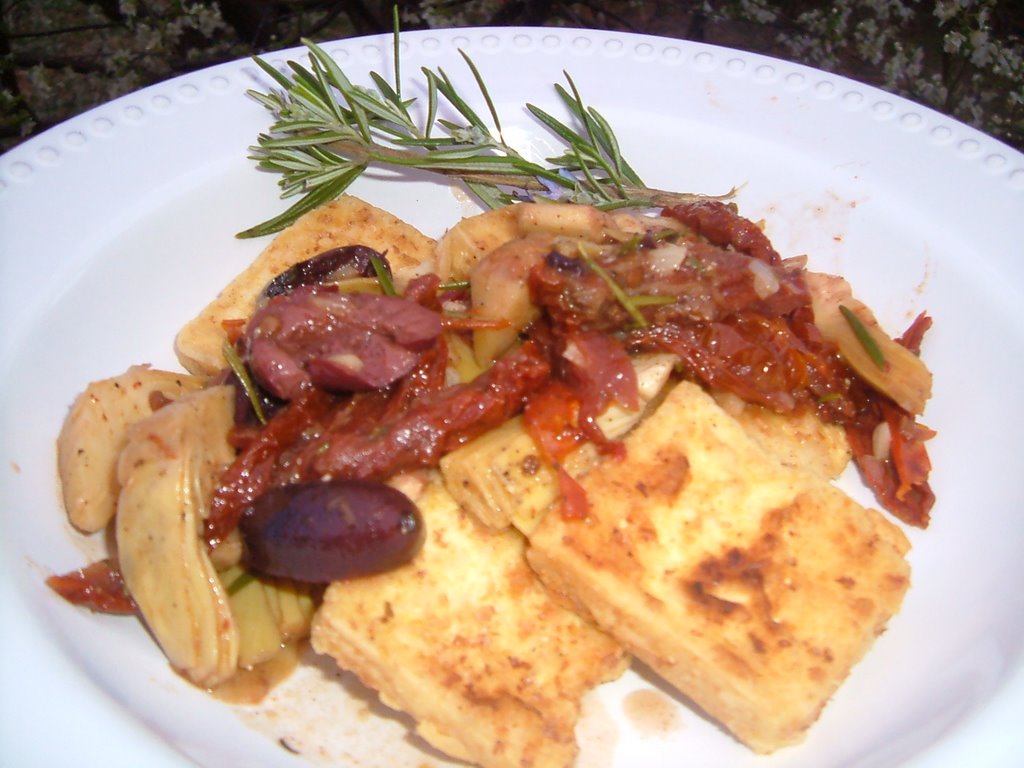
Homemade Fresh Tofu with Sundried Tomatoes and Artichokes
The following is a short description of a dish I did the other day, quickly using up the last of our fresh tofu. (The recipe will be in the next issue of my subscription newsletter, The Vegan Feast.) In case you missed that the other day, tofu eaten the same day it's made, or within a day or two of making, tastes lovely-- kind of like ricotta cheese--- and needs only minimal preparation and seasoning to please. Really! Trust me! Homemade is the best, of course, but if you can find out what day(s) the bulk tofu is delivered to your health food store (and you can ask the tofu makers if it's made the day it is delivered), you can make sure to buy some and use it that day for maximum tofu delight!
I have made this dish before, both with my own homemade tofu and fresh tofu from my health food store. This last time (photo below), I added Kalamata olives to the recipe. It's a quick dish to make and absolutely delicious. A little wine and fresh rosemary makes all the difference.
Have a good week!
Fresh (storebought) Tofu with Sundried Tomatoes and Artichokes (with olives)

Subscribe to:
Posts (Atom)