Showing posts with label cream-style corn. Show all posts
Showing posts with label cream-style corn. Show all posts
Saturday, July 28, 2018
MOIST & DELICIOUS LOW-GLYCEMIC/NO-ADDED-SUGAR CORN MUFFINS


As you might have noticed, I've been on vacation from blogging for almost a month. However, I haven't been idle. You might remember me mentioning back in April that I was diagnosed as pre-diabetic, so I have been adjusting my vegan diet to a low-glycemic vegan diet, which means also adjusting some recipes, totally revamping others, or even starting from scratch, and tossing some out, as well. (You can read a bit about this in this blog post and this one. And, PS: I've dropped 13 lbs without even trying, and my blood tests are definitely improving. )
We mostly eat fresh fruit (often with homemade soy yogurt) when we want a dessert, but occasionally I make Chocolate "Nice Cream", made with 3 sliced frozen ripe bananas, 1/3 cup dark unsweetened cocoa powder, 1/4 cup soy milk, a pinch of salt, a little vanilla extract, and sometimes a dollop of nut butter, blended until creamy-smooth in the food processor, then frozen-- no sugar or sweetener of any kind needed! So delicious!
We mostly eat fresh fruit (often with homemade soy yogurt) when we want a dessert, but occasionally I make Chocolate "Nice Cream", made with 3 sliced frozen ripe bananas, 1/3 cup dark unsweetened cocoa powder, 1/4 cup soy milk, a pinch of salt, a little vanilla extract, and sometimes a dollop of nut butter, blended until creamy-smooth in the food processor, then frozen-- no sugar or sweetener of any kind needed! So delicious!
I've been eating only sprouted grain or whole rye breads, and also investigating other low-glycemic grains and flours. Quinoa, teff, and amaranth are all very well, but they are expensive (as is commercial sprouted grain flour), difficult for some people to find, and often too strong in taste to use in many recipes. My favorite quartet of LG flours is comprised of oat flour, barley flour, millet flour (all can be ground from grain to flour in a dry high-speed blender if you do not have a grain mill) and chickpea flour. (White bean flour can be used in place of chickpea flour.) Buckwheat and rye are also excellent, and I always have some in my freezer, but their strong flavors make them less useful.
Lately, I've been working on a low-glycemic, low-fat vegan brownie-- can you tell that we love chocolate? I'm not there yet, but will report back. Another recipe that I've been working on is a low-fat, but moist, low-glycemic vegan cornbread or corn muffin. Cornbread is a particular favorite of mine. I've tried many recipes from online sources and cookbooks, but, in the end I successfully revised one of my own corn muffin recipes and it's easy, quick, and inexpensive, as well as delicious.
Lately, I've been working on a low-glycemic, low-fat vegan brownie-- can you tell that we love chocolate? I'm not there yet, but will report back. Another recipe that I've been working on is a low-fat, but moist, low-glycemic vegan cornbread or corn muffin. Cornbread is a particular favorite of mine. I've tried many recipes from online sources and cookbooks, but, in the end I successfully revised one of my own corn muffin recipes and it's easy, quick, and inexpensive, as well as delicious.
The following recipe is based on a recipe from my book "The Fiber for Life Cookbook" (Book Publishing Co., Summertown, TN; © 2002). It has been a favorite of ours for many years, because we love anything corn-y, and these are double-corn-y! The canned cream-style corn in the recipe (which contains no cream or dairy whatsoever) adds more fiber, and makes the muffins moist and sweet. If you don't have a can in your pantry, or prefer not to use it, you will need some thawed and drained frozen sweet corn-- see note at the end of the Ingredient List in the recipe.
In this close-up, you can see the nice moist crumb of the muffin.

Printable Recipe
BRYANNA'S
MOIST & DELICIOUS LOW-GLYCEMIC/NO-ADDED-SUGAR CORN MUFFINS
Makes 12
(This recipe also happens to be gluten-free, can be soy-free, and contains no sugar or syrup of any kind, and no artificial sweeteners.)
Makes 12
(This recipe also happens to be gluten-free, can be soy-free, and contains no sugar or syrup of any kind, and no artificial sweeteners.)
DRY
MIX:
1
cup yellow cornmeal
1/2
cup oat flour
1/4
cup barley flour
1/4
cup millet flour
1/2
T. baking powder
1/2
tsp. salt
1/4
tsp. baking soda
WET
MIX:
3/4
cup non-dairy milk
2
T. oil
2
tsp. powdered egg replacer (such as Ener-G or Orgran)
ADDITIONAL:
14
oz. can cream-style corn (This product
does NOT contain dairy products.) OR, in place of canned cream-style corn, you can mix 14 oz. of thawed frozen sweet corn (do not drain) with the Wet Mix ingredients in a blender or food processor for about 5 seconds-- some lumps of corn should remain. See photos below to judge texture.


Instructions:
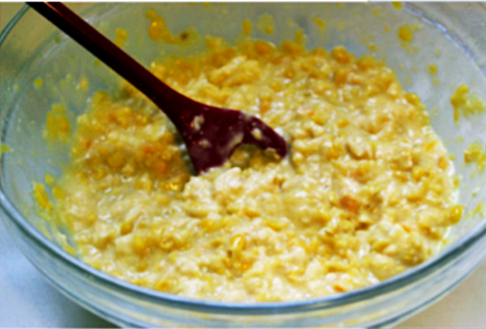

Instructions:
Preheat
the oven to 375 degrees F. Oil 12 muffin cups. Mix
the Dry Mix ingredients together well in a medium bowl. Mix the
Wet Mix ingredients in another (2 to 4-cup) bowl or pitcher with a
whisk or with a hand/immersion blender. Pour the contents of
the can of "cream-style" corn into the Wet Mix and stir
well.
Pour
this mixture into the Dry Mix and mix briefly. Spoon evenly
into the muffin tin. Bake 15-20 minutes. (Test one of the muffins with a toothpick
after 15 minutes, to see if the toothpick comes out clean-- if it dies not, bake for a few minutes more.).
Loosen
them carefully with a table knife and turn them on edge. Place
the muffin tin on a rack, cover the muffins with a clean tea towel
and cool for a few minutes before serving. Cool thoroughly
before storing. These freeze well.
Nutrition
Facts
Nutrition
(per serving): 126 calories, 30 calories from fat, 3.4g total
fat, 0mg cholesterol, 211.5mg sodium, 185.4mg potassium, 22.5g
carbohydrates, 2.1g fiber, 1.6g sugar, 3g protein, 3.7 points.
Enjoy!


Monday, March 5, 2018
WHY I HAVEN'T BEEN BLOGGING LATELY & 2 RECIPES-- QUICK & EASY CHINESE VELVET CORN SOUP; AND VEGAN SUKIYAKI


I apologize heartily for having neglected this blog in the past few months, and for not writing a post for over a month! There's been a lot going on lately, on top of which, DH and I are just getting over a very long and uncomfortable cold (not the flu this time, but not fun!).
One thing that is taking up a lot of my time has been a diagnosis of pre-diabetes! I almost fell off my chair when my doctor told me this. It may be an inherited tendency-- we don't know. So, I've been working up my exercise regime, which I had not been keeping up as well as I should have (especially while sick), and spending much of my time poring over books, websites, and charts to do with the Glycemic Index and Glycemic Load, and tailoring my already-pretty-good vegan diet to this advice:
From https://www.health.harvard.edu/diseases-and-conditions/glycemic-index-and-glycemic-load-for-100-foods
"The glycemic index is a value assigned to foods based on how slowly or how quickly those foods cause increases in blood glucose levels. Also known as "blood sugar," blood glucose levels above normal are toxic and can cause blindness, kidney failure, or increase cardiovascular risk. Foods low on the glycemic index (GI) scale tend to release glucose slowly and steadily. Foods high on the glycemic index release glucose rapidly. Low GI foods tend to foster weight loss, while foods high on the GI scale help with energy recovery after exercise, or to offset hypo- (or insufficient) glycemia. Long-distance runners would tend to favor foods high on the glycemic index, while people with pre- or full-blown diabetes would need to concentrate on low GI foods. Why? People with type 1 diabetes and even some with type 2 can't produce sufficient quantities of insulin—which helps process blood sugar—which means they are likely to have an excess of blood glucose. The slow and steady release of glucose in low-glycemic foods is helpful in keeping blood glucose under control.
But the glycemic index of foods tells only part of the story. What it doesn't tell you is how high your blood sugar could go when you actually eat the food, which is partly determined by how much carbohydrate is in an individual serving. To understand a food's complete effect on blood sugar, you need to know both how quickly the food makes glucose enter the bloodstream, and how much glucose it will deliver. A separate value called glycemic load does that. It gives a more accurate picture of a food's real-life impact on blood sugar. The glycemic load is determined by multiplying the grams of a carbohydrate in a serving by the glycemic index, then dividing by 100. A glycemic load of 10 or below is considered low; 20 or above is considered high. Watermelon, for example, has a high glycemic index (GI) (80). But a serving of watermelon has so little carbohydrate (6 grams) that its glycemic load (GL) is only 5."
So, I'm not making desserts these days, getting used to my morning latte without a teaspoon of brown sugar, using a few dates in my oatmeal instead of sugar on top (dates have alot of fiber, which counteracts the sugar in them), learning about resistant starch and low glycemic grains, and experimenting with making low GL bread with them (adding some bean flour, or okara [soy pulp] from my soy milk making, and/or some vital wheat gluten flour helps, too).
Who knew that converted/parboiled rice carries a lower glycemic load (GL) than brown rice and has? (The process creates resistant starch while protecting most of the nutrition of the whole grain rice.) We are loving parboiled basmati rice! (Here's a fairly simple explanation of resistant starch.) And my beloved semolina pasta is low GL, especially if cooked al dente and then refrigerated. The resistant starch remains when reheated. Ditto for potatoes. Buckwheat, oats, bulgur wheat, rye and quinoa are also good choices.We already eat lots of vegetables and fruits and protein-rich legumes, soy products, and seitan, and a pretty low-fat diet, so I don't have to change much there.
Anyway-- I have alot to learn, but I've lost 6 pounds without really trying to and we're eating well. I hope to have some good new recipes for you soon. In the meantime, here are some old favorites from two of my older cookbooks.
Thanks for your patience!

Printable Recipe
BRYANNA'S QUICK AND EASY CHINESE VELVET CORN SOUP
Servings: 4
(From my book, "Authentic Chinese Cuisine for the Contemporary Kitchen: All Vegan Recipes", Book Publishing Co., 2000)
Corn is probably not the first thing that comes to mind when you thick of Chinese cooking, but, when it was imported from the Americas, the Northern Chinese took to it readily. This soup, which often contains chicken or crab in its non-vegetarian incarnation, is extremely popular, even at formal banquets, but it's inexpensive, quick and simple to make.
6 ounces smoked tofu, cut into small dice (You can sauté the cubes in a bit of oil to brown, if you like, but that's optional.)
4 cup low-salt vegetarian "chicken-y" broth (such as Better Than Bouillon No-Chicken broth paste)
14-15 ounces canned creamed corn (this product contains no dairy ingredients)
1 cup frozen petit pois (baby peas)
1 Tbs low sodium soy sauce
pepper to taste
1 Tbs cornstarch dissolved in 1 T. cold water
1 tsp roasted sesame oil
OPTIONAL:
1 Tbs soy "bacon" bits OR 2 T. chopped vegetarian "ham"
Mix the broth, creamed corn, peas and soy sauce (and the optional soy "bacon" or "ham" at this point, if you're using it) in a medium pot or saucepan. When it comes to a boil, turn the heat down to a simmer and cook gently until the peas are barely tender. Add the smoked tofu, pepper to taste, and dissolved cornstarch, stirring. Simmer until the soup thickens, then drizzle the sesame oil on top and serve.
Nutrition Facts
Nutrition (per serving): 177 calories, 41 calories from fat, 4.7g total fat, 0mg cholesterol, 1249.5mg sodium, 240.5mg potassium, 28.9g carbohydrates, 3g fiber, 6.5g sugar, 10g protein, 5.3 points.
*****************************************************************

Printable Copy
BRYANNA'S VEGAN SUKIYAKI (CAN BE SOY-FREE)
Serves 4
My Peruvian father, Alejandro Jaime Urbina, loved Japanese food, so he took us to Japanese restaurants fairly often when we were growing up in San Francisco. It was always such fun to watch the kimono-clad server quickly make the sukiyaki right in front of us. This is my vegan version.
(From my book, 20 Minutes to Dinner, Book Publishing Co., 1997)
All you need is a pot of steamed rice to go with this wonderful Japanese classic. If you have a large electric skillet, you can cook this at the table in true Japanese style.
NOTE: If you do not have shirataki noodles (clear Japanese noodles made from the konjac yam), substitute Asian rice vermicelli, or bean thread noodles (also called "cellophane" noodles, made from mung beans), which have first been soaked for 15 minutes in warm water. If none of these is available, substitute 2 c. fresh bean sprouts.
 |
| Shirataki Noodles |
Sauce:
1/4 c. Japanese soy sauce, or tamari (or soy-free alternate, see note below)
1/4 c. honey, sugar, or alternate
1/2 c. water
2 T. dry sherry or mirin (Japanese rice wine)
NOTE:
Soy-Free Soy Sauce or Tamari Replacement: Substitute this mixture tablespoon-for-tablespoon for the soy sauce called for if you have a soy allergy.
**Mix 3/4 c. water, broth or mushroom soaking liquid mixed with 1 T. EACH yeast extract paste (such as Marmite), soy-free gravy browner (like Kitchen Bouquet), and salt. This replaces 15 T. (slightly less than 1 c.) of soy sauce.
**To replace some of the complex qualities that a good fermented soy sauce or tamari supplies, use some dry sherry or Japanese mirin wine, and/or mushroom broth or concentrate as some of the 3/4 cup liquid in the recipe.
Sukiyaki Ingredients:
For a soy-free version, omit the tofu and either use 1 1/2 lbs. seitan, OR use the 8 oz. seitan called for and double the amount of mushrooms
1 lb. regular medium-firm tofu
8 oz. seitan, very thinly-sliced
8 large fresh shiitake mushrooms, cut in half (or you can use thick slices of portobello mushrooms, or whole criminis)
10 oz. cleaned spinach leaves, sliced 1" thick
1 (8 oz.) can sliced bamboo shoots, rinsed and drained
1 bunch green onions, cut into 2" lengths OR 1 large white onion, sliced
2 to 4 cups fresh, cisp bean sprouts
1/4 lb. dried shirataki noodles, soaked in warm water 15 minutes (see Note above for substitutions)

**(Put a pot of rice of your choice on to cook before starting the recipe. Short grain white rice is the Japanese choice, or you could use short grain brown rice, if you prefer.)
Mix the sauce ingredients in a small saucepan and set over low heat while you prepare the ingredients.
Heat a large heavy skillet or large electric skillet (my choice). Cut the block of tofu in half horizontally and brown the halves on both sides in the hot pan. Remove from the pan and slice the pieces about 1/2" thick.
Place the sliced tofu, seitan, mushrooms, spinach, and bamboo shoots (and the white onion, if you are using it instead of the green onions) in separate piles side-by-side in the hot pan and pour the sauce over it all.

When the sauce is bubbling and the spinach begins to wilt, turn everything over carefully, not mixing it together. Make room for the green onions and soaked noodles (and/or bean sprouts), and cook for a few more minutes, until the spinach and mushrooms are cooked and everything is hot.
Serve immediately with steamed rice, dividing the ingredients equally between bowls.
Nutrition Facts (without rice)
Nutrition (per serving): 434 calories, 63 calories from fat, 7.8g total fat, 0mg cholesterol, 1190.2mg sodium, 1330.1mg potassium, 66.9g carbohydrates, 7.7g fiber, 22.8g sugar, 31.2g protein, 12.9 points.
Enjoy!

Subscribe to:
Posts (Atom)