Showing posts with label Book of Miso. Show all posts
Showing posts with label Book of Miso. Show all posts
Tuesday, June 3, 2008
MISO PÂTÉ, TWO WAYS


In any case, the following recipe contains a variation of a variation! The original recipe was from The Book of Miso, an amazing book by William Shurtleff and Akiko Aoyagi. I revised it to my own tastes many years ago and my version (with credit to the original) was published in my book, The Fiber for Life Cookbook. It is one of the two variations below, along with the newer okara variation. Both versions are much more delicious than the humble ingredients suggest, and are wonderful on celery sticks, crackers, and crusty rye bread or French bread.

Printable Recipe
BRYANNA’S MISO PÂTÉ, TWO WAYS
Adapted from a recipe in my book “The Fiber for Life Cookbook”. This recipe updated on June 7, 2019.
#1) Fiber for Life Cookbook Variation:
2 cups fresh, soft whole wheat breadcrumbs (Use a light-textured whole wheat bread for the crumbs.)
1/2 cup water
4 geen onions, roughly chopped
1 clove garlic, crushed or minced
1/4 cup tahini
2 1/2 Tablespoons light miso
pinch EACH of dried thyme, rosemary and sage
Optional: roasted (Asian) sesame oil or extra-virgin olive oil
A bit more minced green onion and/or parsley to sprinkle on top
In a small bowl, mash the water and breadcrumbs together with a fork until the crumbs absorb all the broth. Mince the onion and garlic in a food processor. Add the other ingredients and process JUST until everything is mixed. (Don't process too long or the breadcrumbs will make it too gummy.) Pack into a small serving bowl, cover and refrigerate for AT LEAST one hour (preferably overnight) before serving. If you like, drizzle the top with a little roasted (Asian/dark) sesame oil or extra-virgin olive oil, and sprinkle with more minced green onion or parsley before serving.
#2) Okara Variation:
1/2 cup fresh (soft, not dried) breadcrumbs (a light wholewheat is best; see above)
1 Tablespoon water
1 cup (squeezed) fresh okara
4 green onions, roughly chopped
1 clove garlic, crushed or minced
1/4 cup tahini1 clove garlic, crushed or minced
3 Tablespoons light miso
large pinch EACH of dried thyme, rosemary and sage
Optional: roasted (Asian) sesame oil or extra-virgin olive oil
A bit more minced green onion or parsley to sprinkle on top
In a small bowl, mash the water and breadcrumbs together with a fork until the crumbs absorb all the broth. Mince the onion and garlic in a food processor. Add the other ingredients to the processor and process JUST until everything is mixed. Pack into a small serving bowl, cover and refrigerate for AT LEAST one hour (preferably overnight) before serving. If you like, drizzle the top with a little roasted (Asian/dark) sesame oil or extra-virgin olive oil, and sprinkle with minced green onion or parsley before serving.
Enjoy!


Thursday, January 4, 2007
SOUP IS JUST THE THING! (AND MISO MYSTERIES EXPLAINED)
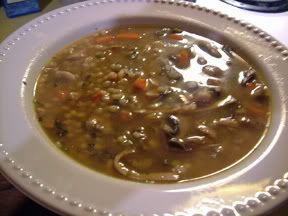
Barley-Mushroom Soup from my book "The Fiber for Life Cookbook" (recipe here).
I'm sure I'm not the only one who has eaten too much, and too richly over the holidays. This has extended until today, due to company and leftovers! Actually, I didn't even bake very much this year. But I want to start eating lightly, at least for while. The first thing I think of for light meals, especially in the winter, is soup. I love soup, and I have many soup recipes that I've developed over the years. (DH says I could easily open up a soup restaurant!) Soups are so easy to make fat-free, and yet still hearty and full of flavour. They are generally extremely inexpensive to make, and a good way to use up leftovers. Guests love homemade soups (and bread), too, because it seems such a novelty in this age of convenience foods.
 |
| This is a version of miso soup with squash and chard, as well as tofu cubes, onions and mushrooms. |
I would never be without miso in my house. It is one of the great flavor-boosters of vegan cooking, in my opinion. I generally use a brown rice or barley miso which is made the old-fashioned way right here on Denman Island, British Columbia by master miso-makers Yoshi and Susan-Marie Yoshihara. (Update on Shinmeido Miso-- unfortunately, they have retired and have ceased production; fortunately we have stockpiled quite a few containers!) In vegetarian/vegan foods, miso lends a fermented "cheesey" flavor, full of the "fifth flavor", umami, which enhances flavor (read more about umami here, here and here and can also replace salted anchovies or anchovy or fish paste (see this post on that particular subject.
(***If you are allergic to soy, you can use chickpea miso or adzuki bean miso.)
(To find recipes using miso on this blog [and there are lots!], do a blog search in the search bar at the top lefthand corner of the page, or click on "miso" in the "Labels" list at the bottom of this post.)
You can read more about this wonderful food in The Book of Miso by William Shurtleff and Akiko Aoyagi (Autumn Press, 1976). (You can also get an updated version in a combo book with the classic Book of Tofu.) They include a chart explaining the types of miso, their taste and color.

See what I wrote about this book at this post.
You can also go to the good old "Cook's Thesaurus" (bookmark this useful site!) and see some photos of different kinds of miso, which will give you a realistic idea of the colors.
By "light", I mean light brown or yellowish-- not white miso, which is almost sweet; and not dark brown or reddish, which is stronger in taste.The Japanese names which would fit my description are:
Shinshu Miso or Aka Miso (Light Yellow Miso/Rice and Soy): Bright light yellow
Amakuchi Tanshoku Miso, Aijiro Miso or Mochigome Miso (Mellow beige Miso/ Rice and Soy): yellow to tan
Shiro-Kiju Miso (Mellow White Miso/ Rice and Soy): light beige
Amakuchi Mugi Miso (Mellow barley miso): yellowish brown to russet
Here is a site that explain the differences between miso varieties:
Dom's Culture-Foods Site of Asia In-Site
These articles discuss miso nutrition and health benefits:
Wikipedia article about miso
World's Healthiest foods article on miso
Everyone who enjoys miso has their favorite ways of preparing miso soup. I am partial to miso with potatoes, onions and mushrooms. UPDATE: My miso soup recipe is in my new book World Vegan Feast.
Happy New Year!

By "light", I mean light brown or yellowish-- not white miso, which is almost sweet; and not dark brown or reddish, which is stronger in taste.The Japanese names which would fit my description are:
Shinshu Miso or Aka Miso (Light Yellow Miso/Rice and Soy): Bright light yellow
Amakuchi Tanshoku Miso, Aijiro Miso or Mochigome Miso (Mellow beige Miso/ Rice and Soy): yellow to tan
Shiro-Kiju Miso (Mellow White Miso/ Rice and Soy): light beige
Amakuchi Mugi Miso (Mellow barley miso): yellowish brown to russet
Here is a site that explain the differences between miso varieties:
Dom's Culture-Foods Site of Asia In-Site
These articles discuss miso nutrition and health benefits:
Wikipedia article about miso
World's Healthiest foods article on miso
Everyone who enjoys miso has their favorite ways of preparing miso soup. I am partial to miso with potatoes, onions and mushrooms. UPDATE: My miso soup recipe is in my new book World Vegan Feast.
Happy New Year!
Subscribe to:
Posts (Atom)