Showing posts with label vegan ricotta. Show all posts
Showing posts with label vegan ricotta. Show all posts
Saturday, January 27, 2018
HOW TO REPLACE EXPENSIVE (& SOMETIMES ECOLOGICALLY AND/OR ETHICALLY SUSPECT) NUTS IN VEGAN COOKING

 |
| My Lowfat Vegan Mayonnaise, utilizing peanuts, sunflower seeds and/or sesame seeds |
 |
| Peanut and/or Sunflower Seed and Tofu Ricotta |
 |
| Lasagne made with my Peanut and Tofu Ricotta |
| After almost 11 years of blogging, I must be getting lazy, because I found myself doing fewer and fewer blog posts every month, and then... nothing new, for about a month and a half. But, in the last little while my interest has been sparked again. My current interest is in cutting way down on the amount of oil and expensive (and potentially ethically and environmentally suspect) tree nuts that I use in creamy vegan mixtures, such as sauces, cheeses, mayo, ice creams, spreads, etc.. My reason is only peripherally due to the fact that we are trying to lose some weight. I know that nuts are good for us and I will certainly use walnuts, pecans, etc., in baking for special occasions or for our weekly treat, but it has bothered me for some time now that so many cashews and coconuts are used in vegan cooking these days. (Oh, and don't forget about almonds!) It's not that I have anything against cashews per se, but, to quote from this article, "What are the most eco-friendly nuts?" (worth a read): "Cashews are a little trickier. They’re light on the land, providing wildlife habitat and preventing erosion, but the processing stage is much more intensive. Cashews grow primarily in Vietnam, India, and northern Africa, but most are shipped to India for processing; there, workers shell the nuts by hand, sometimes exposing their skin to burns from the caustic oils inside. (Check out this detailed look at the system.) And that’s nothing compared to the human rights abuses suffered by some cashew processors in Vietnam, according to Human Rights Watch. Fortunately, there are some Fair Trade cashews to be had, and I’d go for them whenever possible." Here is an article about the treatment of cashew processors in India. Note from me: They, of course, are more expensive than non-Fair Trade. (And organic does not necessarily mean fair trade as well.) The other tropical nut that is over-used in vegan cooking lately (in my opinion) is the coconut. I won't go into the nutrition debate here, but there is an animal cruelty issue with coconut products, as well as human and ecological issues. The following is from an article entitled "Are coconut products bad for the environment?": "...The use of coconut oil grew 780 percent between 2008 and 2012, and the demand for coconut water jumped 168 percent between 2010 and 2013. And if an informal survey of my local yoga-goers and farmers market-shoppers is any indication, the boom is still going strong. So what kind of impact are we having? The first consideration: Everyone’s favorite hairy-on-the-outside, succulent-on-the-inside fruit (sorry, kiwi) comes to us from the tropics — Indonesia, most often, plus the Philippines and India, and to a lesser extent, Brazil, Sri Lanka, and Thailand. So unless you’re currently lounging on an idyllic beach — you lucky so-and-so — that coconut product was shipped a considerable distance to reach you, with all the transportation-related carbon emissions that entails. Locavore eating it’s not. Then there’s the growing of the trees themselves. Fortunately, coconut farming isn’t linked to the kind of deforestation that makes palm oil so devastating to local ecosystems. But those lovely coconut trees can still be grown in a monoculture, which hurts tropical biodiversity and soil quality. And finally, there’s the human rights side of things. As with other cultivators of the tropics (those who produce chocolate, cashews, and coffee, to look just at the Cs), coconut farmers very often toil in terrible poverty — as high as 60 percent of them in the Philippines. Coconut water alone sells for a couple of bucks or more per bottle, but the farmers behind it make as little as 12 cents per coconut. Kind of a bitter system, huh?" See also http://www.onegreenplanet.org/environment/is-your-obsession-with-coconuts-harming-the-environment/ Apart from the above concerns, there is the animal cruelty issue I mentioned above. I urge you to read the following and be an informed consumer: See this article for a list of cruelty-free brands of coconut products and other products that contain coconut oil. See photographs at this article: "Life in chains: Heartrending pictures of caged Indonesian monkeys being sold to coconut farmers" Published earlier this year, the most comprehensive article I read, Pay Coconuts, Get Monkeys, gives us an idea of what life is like for these monkeys, how valuable they are economically, and how legal loopholes enable trainers and “zoos” to essentially get away with animal abuse and neglect. Early on in the piece a man called Noi Petchpradab, who has been training macaques to harvest coconuts for thirty years, was interviewed and discusses daily life for these working monkeys: "When they are not working, the animals are chained to tree stumps, which Mr. Noi said is due to their aggressiveness. They are given three daily meals, consisting of rice mixed with Lactasoy milk." The article also goes on to say: "Due to their ability to work for long hours, the macaques are capable of collecting 600-1,000 coconuts per day, compared to only 100-200 for humans. On a few occasions, he admitted, the monkeys are so tired they faint. VIDEO: https://youtu.be/8gWEsNL-RJc This practice will surely continue as long as there is both a market for coconut oil and consumers who are ignorant to the fact that this is even happening. Also, there will always be an economic incentive for people in these areas to use monkeys as performers as long as tourists are willing to spend money to visit them." So, what about the domestic favorite, almonds?? See this article: Here’s the Real Problem With Almonds and this one: The Problem With Eating Almonds That No One Is Talking About "If you care about the drought in California, you might want to read this." **************** What to do? Yes, we could use macadamia nuts, Brazil nuts, hazelnuts, pistachios, pine nuts. But these nuts can be beyond the average budget even if they are grown in North America (especially the last two). I have not really researched macadamia nuts-- we think of Hawaii first, but they are native to and grown extensively in Australia. Organic macadamias sell for about $25 lb Cnd. I have used Brazil nuts because, according to this article, "What are the most eco-friendly nuts?: "What about those exotic nuts you mentioned? Brazil nuts, grown in – wait for it – Brazil’s Amazon, actually support the rainforest because they don’t grow well without their natural, diverse ecosystem around them. Cultivating them, then, gives locals an economic incentive not to slash and burn. "Hazelnuts are a dream to grow: long-lasting, hardy, erosion-blocking, and requiring no pesticides. You can find US hazels, mostly from Oregon, and that’s a good bet because of child labor issues associated with Turkish hazelnuts." But, again, not for everyone's budget in the long run. ****************** So, what's my solution, one that will allow me to make rich-tasting, creamy vegan dishes even on a tight budget and while trying my best to avoid humanitarian and ecological pitfalls? Peanuts and seeds! They are inexpensive, easy to find, grown in North America, and chock full of nutrition and good fats. I have only just begun my kitchen explorations, but have produced a few delicious items so far, so read on, if you are interested. I'd love to hear what you think, and/or any recipes you've come up with. MY THREE STAPLES: (You can use them alone or in combination.)
Calories 79.51, Calories From Fat 48.78, Total Fat 5.82g, Saturated Fat 0.73g, Cholesterol 0.00mg, Sodium 87.76mg, Potassium 105.07mg, Carbohydrates 2.42g, Dietary Fiber 0.75g, Sugar 0.06g, Sugar Alcohols 0.00g, Net Carbohydrates 1.67g, Protein 6.07g Another recipe using seeds instead of nuts: EASY, INEXPENSIVE, NO-COOK, OIL-FREE VEGAN CREAMER Enjoy! |


Sunday, August 30, 2015
VEGAN CORN CREPES WITH RICOTTA-"HAM" FILLING AND RED PEPPER COULIS

One crepe is filling, but hearty eaters can probably eat two. (These crepes are a little larger than the ones I usually make.)


Printable Recipe
BRYANNA'S CORN CREPES WITH RICOTTA-"HAM" FILLING AND RED PEPPER COULIS
Serves 6-12
Crepes: (makes 12 large crepes)
2 1/4 cups nondairy milk
3/4 cup wholewheat pastry flour
3/4 cup unbleached white flour
6 oz (3/4 cup) extra-firm SILKEN tofu or medium-firm tofu
1/3 cup corn flour (finely-ground yellow cornmeal, NOT cornstarch)
1 1/2 Tbs sugar
1/2 tsp salt
3/4 tsp baking powder
Optional:
3 pinches ground nutmeg
1 pinch turmeric
Filling:
1 recipe Bryanna's Vegan Ricotta (see 2 recipes here) -- you might have a bit left over.
285 g or 10 oz. vegan "bacon" or 'ham" of your choice
2 cups frozen sweet corn kernels, thawed, OR fresh corn kernels, lightly cooked and drained well
3 green onions, chopped
Red Pepper Coulis:
4 large roasted red peppers, peel removed, rinsed (can be from a jar)
3/4 cup Bryanna's Vegan Béchamel Sauce or this bean-based version
2 Tbs dry to medium sherry (or a nonalcoholic white wine, if you prefer)
To Make the Crepes:
Process all ingredients in a food processor or blender until very smooth. No need to "rest" the batter first. Tofu crepes are made just like ordinary crepes. Heat a nonstick 10-12" skillet over medium-high heat and wipe it lightly with oil before making each crepe. Use about 1/4 cup of batter per crepe (stirring the batter before you make each crepe), rolling and tilting the pan until it evenly covers the bottom. Cook for a few seconds, or until the top looks dry. Carefully loosen the crepe with a spatula and flip it over. After a few seconds the other side should be dry. Fold into quarters or roll like a jelly roll and place on a plate (or leave them flat if you are going to stack them with filling). If you are going to use the crepes shortly, cover them with a clean tea towel.

If you are going to store the crepes for later use, let them cool and place in a plastic bag or rigid container (with pieces of waxed paper in between each crepe) and refrigerate for up to 3 days, or freeze them for future use (thaw thoroughly before filling).
To Make the Filling:
Mix together all of the ingredients in a bowl and set aside.
To Make the Sauce (Coulis):
Mix together all the coulis ingredients in a blender or food processor and process until smooth. Heat gently in a microwave-proof bowl, or in a saucepan over low heat.
To bake and serve the crepes:
Divide the filling into 12 equal parts. Place each portion of filling down the center of one crepe and roll it up. If it seems like too much filling, cut it down to your liking, but I like these well-filled. Place the filled crepes in a large rectangular baking dish (in one layer-- use another baking dish, if necessary) lined with cooking parchment.
The crepes can be filled ahead of time and refrigerated for a few hours or overnight, well-covered. When you are ready to serve, heat the oven to 400°F. Cover the baking dish with foil and bake for about 20 minutes if the crepes have not been refrigerated, or 30 minutes if they have. Serve the crepes hot with the reheated Red Pepper Coulis.
Nutrition Facts
Nutrition (per 1 filled crepe with sauce): 251.2 calories; 23% calories from fat; 7.0g total fat; 0.0mg cholesterol; 449.3mg sodium; 513.5mg potassium; 30.9g carbohydrates; 3.7g fiber; 5.2g sugar; 18.3g protein.
Enjoy!

Saturday, June 27, 2015
I'M USING HOME-GROWN BASIL ALREADY, AND IT'S NOT JULY YET! 2 EASY, YUMMY RECIPES

It was such an early spring and summer, and the weather has been so warm, that my basil is doing wonderfully well. I had to use some of it, so I thought I'd share the two easy recipes, a spread and a salad dressing, that I came up with-- both use a whole cup of fresh basil leaves, packed down.
PS: We had the basil dressing on our whole-meal lunch salad toda. The salad was comprised of home-grown freshly-picked lettuce with snap peas, oven-broiled Crispy Tofu (or B of T- recipe at the end of this post but this time I crisped it under the broiler instead of sautéing in a skillet); sliced baby cukes, grape tomatoes, oven-grilled corn, with our first pattypan squash and onions. Mmmmmmm!

Here's the dressing recipe:

BRYANNA'S FRESH, CREAMY VEGAN BASIL SALAD DRESSING
Makes about 1 1/2 cups
1 cup (packed) fresh basil leaves, sliced
6 oz. (1/2 a tetrapak) firm or extra-firm silken tofu (OR 3/4 cup well-drained cooked or canned white beans)
1/2 cup vegan mayonnaise (I use my homemade)
2 tablespoons lemon juice
3/4 teaspoon salt
1/2 teaspoon dry mustard powder
1 clove garlic, peeled
Run all of the ingredients in your blender until smooth. If it's too thick, you can add a bit of water or non-dairy milk. Store in a covered jar in your refrigerator.
And here's the spread:

BRYANNA'S SUNDRIED TOMATO, BASIL AND KALAMATA OLIVE VEGAN RICOTTA SPREAD
Makes about 2 cups
1 lb. (2 cups) plain (no herbal seasoning) vegan ricotta (See my Tofu ricotta and Almond Ricotta recipes here-- at the very bottom of the post; and my Okara-Cashew Ricotta recipe here.)
1 cup (packed) fresh basil, sliced or chopped
2/3 cup drained and sliced pitted kalamata olives
3 oz. sliced sundried tomatoes in oil (squeeze most of the oil out, or rinse with warm water and drain well)
3 tablespoons vegan parmesan (I use Go Veggie!)
1 clove garlic
1/4 tsp. salt
Optional: a little bit of vegan milk or plain vegan creamer
Combine all of the ingredients (except Optional) in a food processor and run until mixed to your satisfaction. If it seems too thick, add a bit of nondairy milk or plain vegan creamer. Pack into a shallow container, seal and refrigerate.
Enjoy!
Saturday, April 25, 2015
PURPLE BARLEY & CHICKPEA SALAD; VEGAN RICOTTA, FETA & SUN-DRIED TOMATO SPREAD


We have a bulk food store in our nearest town now, and they carry an interesting array of whole grains. One that caught my eye was "Purple Prairie Barley", so I bought a small amount. But I never got around to using it until a few days ago.

I knew already that barley is a grain very low on the glycemic index, providing slow-acting, longer-lasting energy, and that it's a good source of soluble (viscous) fiber, too. Purple barley has an added bonus in that it is a variety sometimes called “naked barley,” or hull-less barley, which doesn't need pearling, so it still has the bran and germ intact. In addition, as we know, the colors in foods usually indicate the presence of antioxidants, and that's certainly true of purple barley!
"A press release on 15 August, 2011 by Ohio State University announced that anthocyanins, chemicals that offer red, blue and purple color to foods, are capable of inhibiting the growth of cancer cells while keeping healthy cells intact... Lead author of the study, Dr. Monica Giusti, commented, “These foods contain many compounds, and we’re just starting to figure out what they are and which ones provide the best health benefits.” Giusti added, “All fruits and vegetables that are rich in anthocyanins have compounds that can slow down the growth of colon cancer cells, whether in experiments in laboratory dishes or inside the body.” ...The bran fraction of purple barley has a significantly higher antioxidant activity than its paler cousins, by as much as six times."
See source links at http://www.bodybio.com/content.aspx?page=Purple-Foods
So this is a really nutritious grain, besides being a lovely color! It also has a nice chewy texture-- it's not mushy or slimey. I decided to make a hearty full-meal salad with my cup of Purple Prairie Barley, utilizing foods that I had in the refrigerator and pantry already. The result was delicious, nutritious and very colorful!

BRYANNA'S PURPLE PRAIRIE BARLEY & CHICKPEA SALAD
Servings: 8
This beautiful whole grain, bean and vegetable salad was a real hit and so nutritious!
Cook the barley several hours ahead of making the salad:
1 cup Purple Prairie Barley
2 cups water
1/2 tsp salt
Other salad ingredients:
2 cups rinsed and drained cooked or canned chickpeas
2 large red peppers, seeded and cut into 1/2-inch cubes (more or less)
1 cup chopped celery (with leaves)
1/2 cup dried cranberries (or chopped dried apricots)
4 large or 6 small green onions, chopped
1/2 cup slivered almonds, lightly toasted
Dressing:
1/2 cup aquafaba or Oil Substitute for Salad Dressings
1/4 cup extra-virgin olive oil
1/4 cup red wine vinegar
2 Tbs agave nectar or maple syrup
1 Tbs dark sesame oil
1 tsp dried oregano (or 1 tablespoon fresh, chopped)
1 tsp salt
1 tsp paprika or smoked paprika
1/2 tsp freshly ground black pepper
1. To cook the barley, mix the barely, water and salt in a small saucepan and bring to a boil. Turn down, cover and cook on Low for about 1 1/2 hours, or until the barley is tender, but a bit chewy, and all of the water has been absorbed. Cool at room temperature.
2. While the barley cools, prepare the other salad ingredients and make the Dressing by whisking or shaking all the ingredients together.
3. Combine the cooled barley, other salad ingredients and dressing and refrigerate. The salad is best when served at room temperature.
***************************************************************************
The same day that I made the salad, I needed to use up some of my homemade vegan "ricotta", and I also had some of my "Potted Tofu" in the fridge that was getting quite "ripe"! (The links to the recipes are in the recipe below.) I decided to make a spread-- spreads are always handy to have around to use on rye crisp, toast or vegetables for a quick snack. It turned out very well!

Printable Copy
Serves 12
6 ounces of any kind of vegan "Feta" (such as my "Potted Tofu" or Quick "Feta" Crumble)
2 7/8 cups (1 lb.) unseasoned vegan "Ricotta" (I used my Okara/Cashew Ricotta, but you could use my Tofu/Cashew Ricotta or Almond Ricotta)
2 cloves garlic, crushed
2 tablespoons fresh lemon juice
1 tablespoon extra-virgin olive oil
1 teaspoon dried thyme
1 teaspoon dried oregano (or 1 tablespoon fresh, chopped)
1/2 teaspoon salt
1/4 teaspoon red chile flakes
1/4 teaspoon onion granules
freshly-ground black pepper to taste
1/3 cup sliced sun-dried tomatoes in oil, rinsed under hot water and squeezed
Garnish:
extra-virgin olive oil, Kalamata olives, parsley
Combine all of the ingredients EXCEPT the sundried tomatoes in a food processor or high-speed blender and process until smooth. Add the tomatoes and process briefly-- you want it to have a little texture.
Scoop the spread into an attractive bowl, smooth it out, drizzle with olive oil and garnish with the olives and parsley.
Serve with crackers (we like rye crisp), thin slices of crusty bread, or raw vegetables.
Enjoy!
Monday, January 5, 2015
TWO RECIPES WITH GREENS: ITALIAN SAVORY CREPES STUFFED WITH VEGAN RICOTTA & SPINACH; & BABY BOK CHOY AND TOFU SOUP
HAPPY NEW YEAR, EVERYONE!


For lunch, I made Baby Bok Choy and Tofu Soup from my book "Authentic Chinese Cuisine for the Contemporary Kitchen: All Vegan Recipes", and, for dinner (because I had some vegan crepes left over from Saturday breakfast, and some of DH's spaghetti sauce in the refrigerator), I made Italian Savory Crepes Stuffed with Vegan Ricotta & Spinach from my book "Nonna's Italian Kitchen: Delicious Home-Style Vegan Cuisine", both with a couple of little tweaks. It's been too long since I made these recipes-- so delicious and healthful! So, I'd like to share the recipes with you. Enjoy!
Crepes have been made in
Many delicious vegetables stuffings
are popular (you can use a filling as simple as just steamed, chopped in-season
vegetables held together with thick besciamella sauce), particularly the spinach and ricotta filling
from Florence, which I have veganized and used in the following recipe.
Crespelle can be made ahead (even
frozen), and they make an elegant dinner dish for company or special occasions,
such as Easter dinner.
These vegan crespelle are nice and
tender, thin but not fragile, roll well, and have a delicate flavor. PS: The crepe recipe I used last night and publish here is actually from another on of my books, "Soyfoods Cooking for a Positive Menopause".

Printable Recipe (Includes crepe recipe)
Serves 6 (Can be soy-free)
12 vegan crepes (see my recipe below-- can be made ahead and refrigerated or frozen--OR you can use my recipe for Fat-Free Whole Grain Crepes)
Spinach and "Cheese" Filling:
2 onions, minced
1 T. extra-virgin olive oil
2 lbs. fresh cleaned spinach, OR 2/ 10 oz. pckgs. chopped frozen spinach, thawed
1 1/2 cups Tofu or Almond Ricotta OR Okara/Cashew Ricotta
4 to 6 tablespoons vegan Parmesan substitute (we like GoVeggie! brand)
salt, freshly ground pepper to taste, and a pinch of nutmeg
Bake crespelle with a light tomato sauce or a medium Besciamella (Bechamel) sauce, ( or you can layer Besciamella over the tomato sauce, for a really special dish), along with a vegan Parmesan substitute or alternate. There is a recipe for my low-fat Creamy White-Bean-Flour Based Bechamel here, and my basic vegan Bechamel/White sauce recipe is here.
Sauté the onions in the olive oil in a non-stick or cast iron or hard-anodized skillet until they are soft and starting to brown (adding a tiny bit of water as needed, to keep from sticking).
Meanwhile, place the fresh spinach in boiling water until it is completely wilted, then drain, squeeze dry, and chop it finely. OR, if using frozen chopped spinach, thaw it thoroughly (you can quick-thaw it by placing the whole carton in the microwave for 5 minutes) and squeeze it as dry as possible.
Mix the spinach in a bowl with the cooked onions, ricotta, Parmesan sub , and salt, pepper and to taste, and a pinch of nutmeg.

Preheat the oven to 425 degrees F.
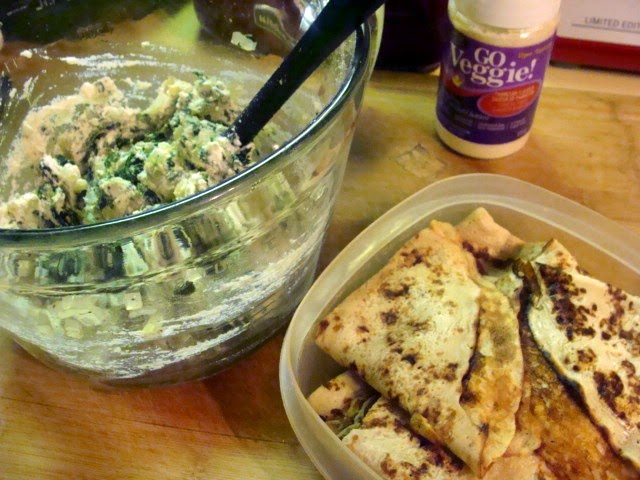
Place a generous amount of filling down the center of each crepe and roll it up.

Place the rolls in an oiled baking dish. (You can prepare the crepes up to this point several hours ahead of time.)

Pour a little of the sauce you are using over the crepes, sprinkle with Parmesan or alternative (and some shredded vegan mozza-type cheese, too, if you like) and bake for 20 minutes.


**********************************
BRYANNA'S TOFU CREPES
Makes 12-13 crepes
From my book "Soyfoods Cooking for a Positive Menopause".
These are really excellent--they have that flexible "eggy" texture of regular crepes. You can freeze them, too.
1 1/2 cups non-dairy milk
1 cup unbleached white flour or whole wheat pastry flour
1/2 cup medium-firm tofu or silken tofu
1/4 cup soy or chickpea flour
OPTIONAL: 1 to 2 tablespoons nutritional yeast flakes
1 tablespoon unbleached organic sugar
1/2 tsp. EACH salt and baking powder
a pinch of nutmeg
Process all ingredients in a food processor or blender until very smooth. If the batter seems too thick (and it should be like thick cream), whisk in a bit more non-dairy milk or water until it is the right consistency.
No need to "rest" this batter first. Tofu crepes are made just like ordinary crepes.
Heat a nonstick or cast-iron 8" skillet over medium-high heat and wipe it lightly with oil before making each crepe. Use 3-4 tablespoons of batter per crepe (stirring the batter before you make each crepe), rolling and tilting the pan until it evenly covers the bottom. Cook for a few seconds, or until the top looks dry.

Carefully loosen the crepe with a spatula and flip it over.

After a few seconds the other side should be dry.

Fold into quarters or roll like a jelly roll and place on a plate (or leave them flat if you are going to stack them with filling). If you are going to use the crepes shortly, cover them with a clean tea towel.

Either fill the crepes and serve according to the specific recipe directions, or let them cool and place in a plastic bag or rigid container (with pieces of waxed paper in between each crepe) and refrigerate for up to 3 days, or freeze them for future use (thaw thoroughly before filling).
********************************************************************************

Printable Recipe
BRYANNA’S BABY
BOK CHOY, MUSHROOM AND TOFU SOUP
Serves 4-8
This makes a wonderful light lunch. The sum is definitely greater than the simple parts of this delicious soup!
1 1/2
lb. baby bok choy, washed, dried and trimmed (separate the stems if they are on the larger side)
6-8 dried Chinese black mushrooms, soaked in boiling water for 30
minutes, and stems removed (save
soaking water)
1 cup
sliced fresh white or brown (cremini) mushrooms
1
tablespoon oil
12
cubes of commercial
fried tofu OR, for a lower-fat version, use Oven-Broiled Tofu (see below)
5 cups
light vegetarian broth (I like Better Than Bouillon No-Chicken Vegan Soup Base)
2 tablespoons soy sauce
2 tablespoons dry to medium sherry or rice wine
2 1/2 c. cooked gan mian or ji mian (plain, thin flour and water noodles), or
spaghettini (can be whole grain), or buckwheat soba
dark
sesame oil, for drizzling
If
using the commercial fried tofu cubes, pour boiling water over them, let stand
for a few minutes, then drain and squeeze out as much water and oil as you
can. Cut the cubes in half.
Heat a large wok or stir-fry pan or heavy pot over high heat. When hot, add the oil. When the oil is hot, add the bok choy, dried
mushrooms and fresh mushrooms. Stir-fry
for 2-3 minutes. Add the remaining
ingredients, including the mushroom soaking water and the fried or oven-broiled tofu. Let it simmer for a few minutes, until
everything is hot.
Serve immediately and pass the sesame oil to sprinkle
over each serving.
Nutrition Facts
Nutrition (per serving): 214 calories, 85
calories from fat, 9.8g total fat, 0mg cholesterol, 858.7mg sodium, 526mg
potassium, 24.7g carbohydrates, 4.9g fiber, 4.3g sugar, 11.3g protein.
BRYANNA'S OVEN-BROILED TOFU
This is my fat-free sub for fried tofu in certain recipes!
Cut 12-14 ounces of extra-firm tofu into cubes or triangles of your choice of size. Lightly oil a cookie sheet. Place the tofu pieces, not touching, on the sheet and spray lightly with oil from a pump sprayer. Place the sheet about 6 inches under a heated oven broiler. Broil for several minutes (checking every couple of minutes), until the tofu is golden and crusty, and maybe even a little charred, on top. Turn the pieces over and repeat for the other side. The 2nd side will take less time, so watch carefully! Remove from the oven immediately. PS: You can make a large batch of this and refrigerate for other recipes.
*************************
Enjoy!
Subscribe to:
Posts (Atom)