Showing posts with label yuba sticks. Show all posts
Showing posts with label yuba sticks. Show all posts
Saturday, May 17, 2014
NEVER EATEN YUBA? HERE'S A TASTY WAY TO TRY IT-- MALAY-STYLE YUBA & DAIKON CURRY

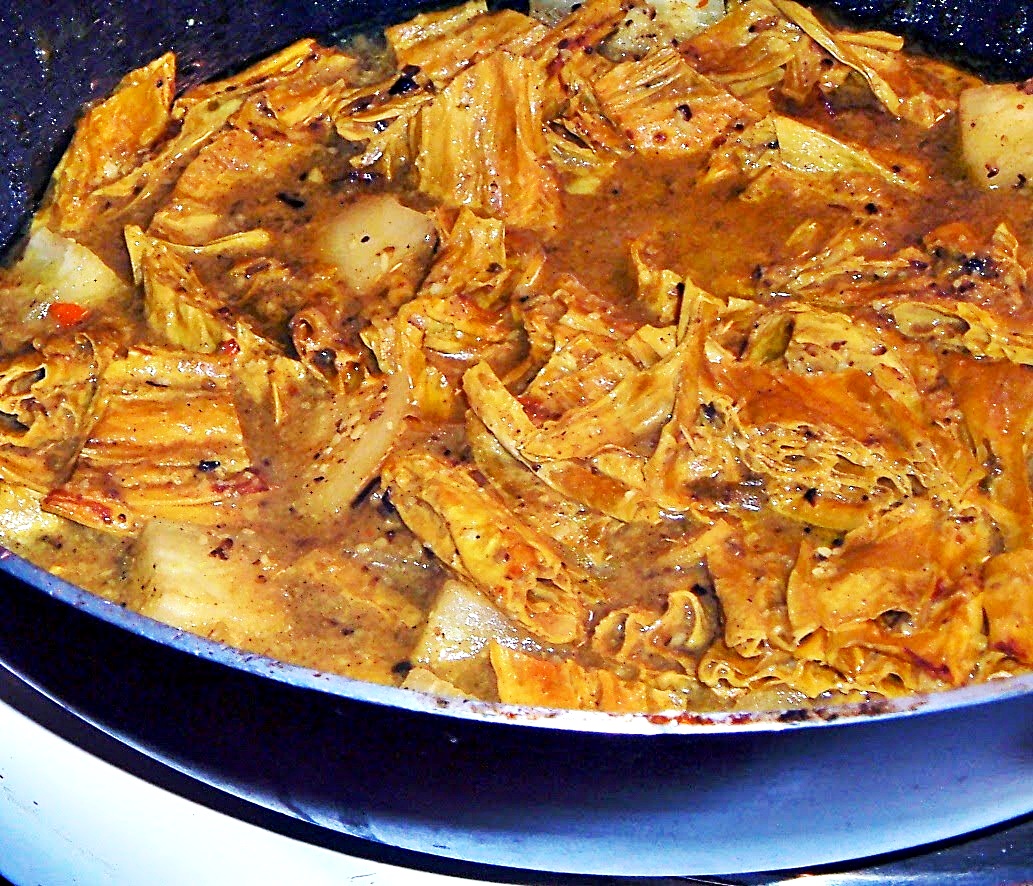
You may have seen the other yuba recipes I have shared on this blog. (See below for recipe links.) This recipe is quite different from both the Chinese "Buddha's Roast Duck" and the two European-style stews (one with a Peruvian flair). It's a recipe I developed for my now defunct vegan cooking newsletter, inspired by some Malaysian food I enjoyed in a Portland restaurant-- rich and spicy.
I love yuba-- it's a very versatile and satisfying food. I hope you'll give it a try after you've read the information below and checked out the recipe. Fortunately, you don't have to live in a city with a large Asian population anymore in order to source dried yuba sheets and sticks. These products, and most of the other more unusual ingredients required for a recipe like this, are available online (see links in recipe ingredient list) and in Asian grocery stores, and, more recently, in many large supermarkets, as well-- check the "International" aisle.
YUBA PRIMER: Yuba (also called “bean curd skin” or tou-p'i, doufu-p'i or doufu-i) is considered a delicacy Japan, but is a much more common food in China and Taiwan, where each city will have a number of shops or market stalls selling only bean curd skin and products made from it. It is made by simmering soymilk and lifting off the "skin" that forms on the top, just like that on dairy milk. This "skin" can be used fresh, or is dried in sheets or rolled-up "sticks". The sticks are used in soups, stews, and stir-fries, and can also be barbecued. The sheets, either fresh or dried and soaked, can be cut up like "noodles", or used in soups, stews, and stir-fries as well. They can be rolled around fillings and baked, steamed or fried for delicious appetizers, or used as a crispy "skin" around vegetarian poultry substitutes.
Fresh sheets are also available in large cities in Chinese tofu shops, and must be frozen for future use. They often come in 16"-diameter round sheets, or semi-circular sheets. These are sometimes labeled "Fresh Spring Roll Skins or Wrappers", but are not to be confused with the wrappers made from flour. The package will tell you that the ingredients are only soybeans and water. Some varieties are very thin, some are as thick as canvas. The sheets are folded into many forms and sizes to make rolls and stuffed pouches, or molded and steamed.
I refer to this product by its Japanese name, yuba, because it is shorter, is becoming more universally accepted (like tofu instead of “bean curd”), and is less confusing than the various English translations from the Chinese, such as "bean milk sheets", "pressed tofu", and other confusing monikers. Yuba is a very concentrated, rich-tasting soy food. The dried version, available in Asian markets and some large supermarkets, must be soaked in warm water before using.
Yuba products and probably usually available in Asian grocery stores, large supermarkets (in the "international" aisle), health food stores, and some delis and bulk food stores). You can order dried yuba products online, too. Amazon carries them, but the prices that I just checked today (May 17, 2020) are outrageously expensive!
Yuba products and probably usually available in Asian grocery stores, large supermarkets (in the "international" aisle), health food stores, and some delis and bulk food stores). You can order dried yuba products online, too. Amazon carries them, but the prices that I just checked today (May 17, 2020) are outrageously expensive!
SOAKING: Dried yuba MUST be soaked before it's cooked, so don't skip that step. The sticks need to be soaked an hour or two, in warm water; the sheets about 10 minutes. I have never experienced sheets not becoming flexible in that amount of time, but the sticks often have certain spots in them (usually where they were bent) that never get flexible. If you are deep-frying them, it doesn't matter. If not, just cut those parts off and discard.
(It's possible that really old yuba [like really old dried beans] won't ever rehydrate well. Try to go to a store that has a decent turnover.)
The Chinese have used amazing ingenuity to create "mock meats" using yuba. In Chinese yuba shops you will find replicas of chickens, ducks, fish, hams, rolled meats, sausages links, etc., all made primarily from yuba. These dishes, with names such as Buddha's Chicken or Buddha's Duck, as served on cold plates at fine restaurants or family banquets.
Here is a history of yuba.
OTHER YUBA RECIPES I'VE POSTED:
Buddha's "Roast Duck"
Buddha's "Roast Duck"
 |
| Dried Yuba sticks |
BRYANNA'S MALAY-STYLE YUBA (BEAN CURD
SKIN) AND DAIKON CURRY
Servings: 4
This
is even better a day after making it, and a great new way to serve yuba. If you haven’t used yuba before, please read all the information in the "Yuba Primer" in the text above.
1
pkg. (6 oz.) Chinese yuba (dried bean curd skin) "sticks" (See the "Yuba Primer" above.)
2
Tbs peanut oil or other neutral-tasting oil
PASTE INGREDIENTS:
2
small red hot chilies, fresh or dried, seeds removed
2
cloves garlic, crushed or chopped
2
green onions, chopped
1
Tbs grated fresh ginger
1
tsp galangal powder (or 1 cm. piece galangal root) (This is a rhizome related to ginger, available in Asian grocery stores.
Omit if you can’t find it.)
1
tsp turmeric
zest
of one organic lemon, grated OR 1 stalk lemon grass, smashed
1/2
Tbs tamarind paste (also called "concentrate")
1/4
cup coconut cream (in block form-- amazon.com carries it, including organic varieties, and so does amazon.ca and most Asian grocery stores, health food stores, large supermarkets, and some delis and bulk food stores)
2
1/2 cups vegetarian "chicken-style" broth (liquid measure)
6-8
oz daikon radish, peeled and cut into small chunks (Most large supermarkets sell this now, and any Asian grocery store will.)
ADDITIONAL:
1
tsp brown sugar
1/2
tsp salt
OPTIONAL:
If
you like more heat, add some chopped green chilies.
Soak
the yuba in a large bowl of hot water until it is flexible. Drain and cut it
into 1" pieces, discarding any hard bits.
 |
| Soaked yuba sticks |
 |
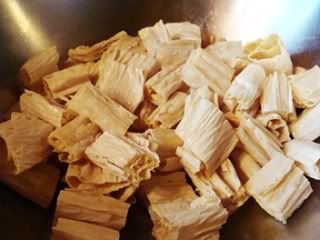
| Soaked yuba sticks cut up for a stew |
Grind
together the Paste Ingredients in a food processor.
Heat
the oil in a deep skillet, stir-fry pan or wok. Add the ground Paste ingredients,
along with the lemon zest or lemon grass stalk. Sauté until fragrant. Add the
drained yuba and stir to coat. Add the daikon, broth, tamarind, and coconut
cream and stir well. Cover and simmer over low heat for about 15 minutes. Add
the sugar and salt and simmer about 5 more minutes. Serve with steamed rice.
Enjoy!


Monday, June 13, 2011
A PERUVIAN STEW MADE WITH YUBA: ITALO-PERUVIAN CAU-CAU
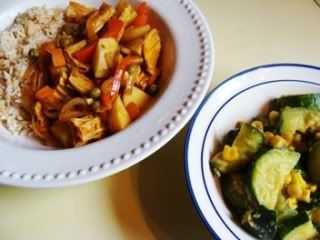
I know-- I'm giving you a second yuba stew very soon after the first one! (Read about yuba at this post, if you have no idea what I'm talking about!) I think you'll forgive me when you taste it! (And it's even better the second day!) I'm on a bit of a yuba kick right now and I had a package left, and a yen to mess with a Peruvian recipe I've been developing (and veganizing) for a few years. (My father was Peruvian, Peruvian cuisine is very unique and delicious, and I have a long list of Peruvian recipes to veganize!)
The original is a Peruvian stew, served with rice, called Cau-Cau, usually made from tripe (sometimes seafood). What is called the Creole version is simply tripe, sauteed onions, boiled potatoes, hot yellow peppers, turmeric, salt and pepper, and mint. The Italian-Peruvian version is a bit more elaborate and appealed to me more (plus, my Peruvian grandmother was of Italian descent). It contains some tomato, mushrooms, wine or Pisco (Peruvian grape brandy), and, typically Peruvian, fried potatoes added at the end of cooking! (Peruvians often combine potatoes and rice in one meal-- the potatoes are indigenous; the rice was brought by the Spanish and is now ubiquitous. With a Peruvian father, we had rice at almost every dinner when I was growing up.) I digress...
Why use yuba instead of the tripe (I won't go into what it actually is-- you can look it up!)? I've never actually tasted tripe, despite growing up with Peruvians and Italians around and eating meat for most of my life (been a vegan for about 22 yrs now). Every country seems to have at least one tripe recipe that seems to be a cultural comfort food (such as the Mexican soup, Menudo). Tripe is described as chewy and mild or subtle in flavor-- and that is how I would describe yuba! Typically, tripe stews and soups around the world are spicy and flavorful, so why not use yuba instead and enjoy some old-world cooking?
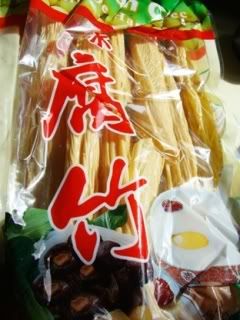 A package of yuba (bean-curd skin) sticks
I first thought of this when I was working on my Chinese vegan cookbook
 and veganized a traditional tripe recipe with a delicious sauce. Ever since, I have been on the lookout for traditional recipes to further utilize yuba, which is a favorite food of mine. I hope you will try and enjoy this one!
A thought: In some cultures, a related product called chitterlings (or chitlins) is used in traditional "comfort foods". I have never tasted them either, but have read that they have a similar taste and texture to tripe, so maybe yuba could be used in some of those traditional recipes, too?
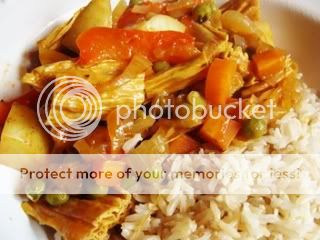
BRYANNA’S VEGAN ITALO-PERUVIAN CAU-CAU (A STEW)
Serves 6
Serve this spicy stew with steamed brown basmati rice. This dish is even better reheated the next day! NOTE: Often, fried potatoes are added to this stew, but I opted for cubes of raw potato cooked in the stew, similar to the Creole version (see text above). (See the link in the ingredient list below for where to buy yuba sticks online, or try an Asian grocery store. Read the yuba info at the 2nd link below for how to ask for it in a Chinese market.)
7 oz. package of yuba (Chinese bean curd skin) sticks (see info about yuba here)
juice of 1 lemon
2 T. olive oil
2 large onions, thinly sliced
3 large cloves of garlic, crushed
1 red bell pepper, seeded and thinly sliced
1 medium carrot, peeled and diced small
1 1/2 c. water
2 medium Yukon Gold potatoes, scrubbed and cut into 1/2” cubes
1 c. frozen peas
1/2 c. dry white wine (or dry white vermouth)
1/3 c. tomato paste (1/2 small can)
1-2 T. aji amarillo paste (Peruvian hot yellow chile paste) or Sriracha sauce
(Peruvian hot yellow chile paste) or Sriracha sauce
1 large bay leaf
2 teaspoons vegan bouillon powder  or paste
 , or enough cubes
 for 2 cups broth
or paste, or enough cubes for 2 cups broth
1/2 T. dried mint (or 2 T. chopped fresh)
1 tsp. salt
1/2 ounce dried porcini mushrooms , soaked for 1/2 an hour in boiling water (use mushrooms and strained soaking water in stew)
, soaked for 1/2 an hour in boiling water (use mushrooms and strained soaking water in stew)
OR use 1 tsp. dried porcini mushroom powder
1/2 tsp. ground cumin
1/2 tsp. dried oregano
1/4 tsp. tumeric
Soak the yuba in a large bowl of hot water for about 2 hours. Drain the yuba, squeeze gently to remove as much water as possible, and cut the yuba into 1” pieces. Mix them in a bowl with the lemon juice. Set aside.
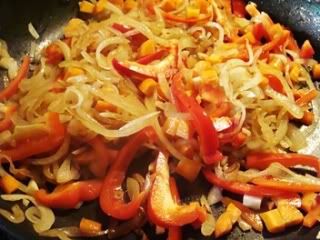
Heat the oil in a large pot. Add the onions and stir-fry over medium-high heat until the onions are softened and slightly browned. Add the garlic, carrot and bell pepper. Stir fry until the pepper softens a bit.
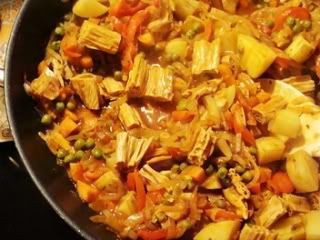
Add the remaining ingredients, including the yuba. Bring to a boil, then lower the heat. Cover and simmer for about 30 minutes.
Add the remaining ingredients, including the yuba. Bring to a boil, then lower the heat. Cover and simmer for about 30 minutes.
Nutrition Facts
Nutrition (per serving): 311.9 calories; 35% calories from fat; 12.9g total fat; 0.0mg cholesterol; 541.6mg sodium; 662.2mg potassium; 28.8g carbohydrates; 4.9g fiber; 11.2g sugar; 23.8g net carbs; 21.6g protein; 6.5 points.
Enjoy!

Subscribe to:
Posts (Atom)