Thursday, May 20, 2010
A DELICIOUS LATIN AMERICAN FRUIT AND OAT "SMOOTHIE"


Pineapple and Oat breakfast drink
Oddly enough, oatmeal is a staple in many Latin American and Caribbean households, and it is used, most interestingly, in wonderful, cheap, healthful hot and cold beverages. I came across this concept while researching Peruvian breakfast foods for my last post. These cinnamon-flavored oat-and-/milk or oat-and fruit drinks are variously called Avena or Cuaquer (Spanish translation of "Quaker", for the oats!), Jugo de Avena, Chicha de Avena, Atole de Avena, Colada de Avena, and Avena Caliente, depending on which country of origin. ("Avena" means oatmeal, BTW.)
It is so popular that there is a packaged version (actually several versions) called "Avena", made by Alpina, a South American company. You can read comments about it here, but I can't find out whether it it has milk in it or not. If anyone knows, please let me know! (There are also other brands of similar drink mixes.)
Some recipes call simply for oatmeal, a sweetener, milk and/or cream, water, and cinnamon; others contain fruit. Some are served hot, others cold. I was intrigued by the idea of a simple drink thickened by grain, so I just had to try it. I made a cold smoothie-type concoction with canned pineapple, which is what I had in the house. We love it! I plan to experiment with other fruits and combinations of fruits (mango, papaya, banana, passion fruit, even North American fruits and berries), as well as the non-fruit version. Similar drinks are also made with corn or masa flour, barley, and quinoa, so I have lots of experimenting to do. I'll post future results and recipes as I go!
Do give this a try! It is refreshing and delicious. Below is my original recipe, which you can fortify with soy or hemp protein powder, if you wish, and then, below that, another version made with more nondairy milk, so that it it makes a protein-rich breakfast drink or snack without adding protein powder.
Printable Recipe
BRYANNA'S VEGAN PINEAPPLE AVENA (OR CUAQUER)-- LATIN-AMERICAN-STYLE OAT “SMOOTHIE” (Version #1)
Servings: 4
Use soy or hemp milk for a decent protein count. Other nondairy milks are very low in protein. I have listed the nutrition facts for all of the variations based on the options given in the recipe.
NOTE: You need to make this ahead of time and chill it.
1/2 cup rolled oats
 (regular or quick)
2 cups water
1 cup soymilk
 or hemp
 milk
19 oz can unsweetened pineapple chunks with juice (you could also use about 2 cups of fresh pineapple chunks)
1 teaspoon cinnamon
1 1/2 tablespoons agave nectar
 or organic sugar

OPTIONAL:
1 oz. soy protein powder
 or hemp protein powder

You can cook the oats in the water in a small pot, turning the heat down when it boils and cooking it until it is thick and bubbly. I used the microwave oven-- place the oats and water (or non-dairy milk) in a 2 qt. microwave-save bowl (to avoid boil-overs) and cook on high 2 minutes, then 50% power for 3 minutes. Let it cool a bit.
Scoop the oatmeal into a blender with the rest of the ingredients. Blend until completely smooth. Taste for sweetener. Pour into a pitcher and refrigerate.
Nutrition Facts (These Nutrition Facts were calculated using 1 cup soymilk and 1 1/2 tablespoons of agave nectar, WITHOUT the optional protein powder.)
Nutrition (per serving): 150.4 calories; 9% calories from fat; 1.6g total fat; 0.0mg cholesterol; 36.9mg sodium; 237.6mg potassium; 32.1g carbohydrates; 1.6g fiber; 23.9g sugar; 30.5g net carbs; 3.5g protein; 2.8 points.
NUTRITION FACTS FOR VARIATIONS:
If you use the same amount of sugar instead of agave, they are as follows:
159.7 calories; 8% calories from fat; 1.6g total fat; 0.0mg cholesterol; 36.9mg sodium; 237.7mg potassium; 34.0g carbohydrates; 1.6g fiber; 25.8g sugar; 32.4g net carbs; 3.5g protein; 3.0 points.
If you use soymilk and agave, and add the optional soy protein powder, they are as follows:
174.3 calories; 9% calories from fat; 1.9g total fat; 0.0mg cholesterol; 108.1mg sodium; 243.3mg potassium; 32.6g carbohydrates; 2.0g fiber; 23.9g sugar; 30.6g net carbs; 9.2g protein; 3.2 points.
If you use soymilk and agave and add the optional hemp protein powder, they are as follows:
182.0 calories; 14% calories from fat; 3.1g total fat; 0.0mg cholesterol; 40.4mg sodium; 237.6mg potassium; 33.3g carbohydrates; 2.5g fiber; 24.1g sugar; 30.7g net carbs; 7.1g protein; 3.4 points.
If you use hemp milk and agave, and NO protein powder, they are are as follows:
160.1 calories; 13% calories from fat; 2.5g total fat; 0.0mg cholesterol; 28.1mg sodium; 237.6mg potassium; 32.3g carbohydrates; 1.8g fiber; 24.7g sugar; 30.4g net carbs; 3.4g protein; 3.0 points.
If you use hemp milk and the same amount of sugar instead of agave, and NO protein powder, they are as follows:
169.4 calories; 13% calories from fat; 2.5g total fat; 0.0mg cholesterol; 28.1mg sodium; 237.7mg potassium; 34.2g carbohydrates; 1.8g fiber; 26.6g sugar; 32.4g net carbs; 3.4g protein; 3.2 points.
If you use hemp milk and agave, and the optional hemp protein powder, they are as follows:
191.8 calories; 18% calories from fat; 3.9g total fat; 0.0mg cholesterol; 31.7mg sodium; 237.6mg potassium; 33.5g carbohydrates; 2.8g fiber; 24.9g sugar; 30.7g net carbs; 6.9g protein; 3.6 points.
If you use hemp milk and agave and use hemp protein powder with extra fiber
 , they are as follows:
190.1 calories; 15% calories from fat; 3.2g total fat; 0.0mg cholesterol; 30.5mg sodium; 237.6mg potassium; 35.6g carbohydrates; 5.2g fiber; 24.7g sugar; 30.4g net carbs; 6.0g protein; 3.3 points.

Printable Recipe
BRYANNA'S SOY OR HEMP/PINEAPPLE AVENA (OR CUAQUER)-- LATIN AMERICAN OAT SMOOTHIE (Version #2)
Servings: 4
This is a higher-protein version of my original one, without adding protein powder. Soy and hemp milks contain considerably more protein than other non-dairy milks. NOTE: You need to make this ahead of time and chill it.
1/2 cup rolled oats
2 cups soymilk
or hemp milk 1 cup soymilk
or hemp milk 19 oz can unsweetened pineapple chunks with juice (or about 2 cups of fresh pineapple chunks)
1 teaspoon cinnamon
1 1/2 tablespoons agave nectar
or organic sugar You can cook the oats in the 2 cups soy or hemp milk in a small pot, turning the heat down when it boils and cooking it until it is thick and bubbly. I used the microwave oven-- place the oats and soy or hemp milk in a 2 qt. microwave-save bowl (to avoid boil-overs) and cook on high 2 minutes, then 50% power for 3 minutes. Let it cool a bit.
Scoop the oatmeal into a blender with the rest of the ingredients. Blend until completely smooth. Taste for sweetener. Pour into a pitcher and refrigerate.
Nutrition Facts (Nutrition Facts were calculated using soymilk and agave nectar.) Nutrition (per serving): 185.9 calories; 15% calories from fat; 3.4g total fat; 0.0mg cholesterol; 99.5mg sodium; 237.6mg potassium; 35.1g carbohydrates; 1.6g fiber; 25.4g sugar; 33.5g net carbs; 6.3g protein; 3.7 points.
NUTRITION FACTS FOR VARIATIONS:
If you use agave and hemp milk, they are as follows:
215.1 calories; 24% calories from fat; 6.0g total fat; 0.0mg cholesterol; 73.3mg sodium; 237.6mg potassium; 35.8g carbohydrates; 2.3g fiber; 27.7g sugar; 33.4g net carbs; 5.9g protein; 4.3 points..
If you use soymilk and sugar, they are as follows:
195.2 calories; 14% calories from fat; 3.4g total fat; 0.0mg cholesterol; 99.5mg sodium; 237.7mg potassium; 37.0g carbohydrates; 1.6g fiber; 27.3g sugar; 35.4g net carbs; 6.3g protein; 3.9 points
If you use hemp milk and sugar, they are as follows:
224.4 calories; 23% calories from fat; 6.0g total fat; 0.0mg cholesterol; 73.3mg sodium; 237.7mg potassium; 37.7g carbohydrates; 2.3g fiber; 29.6g sugar; 35.4g net carbs; 5.9g protein; 4.5 points.
Enjoy!



Sunday, May 16, 2010
"PERUVIAN PENICILLIN", VEGAN-STYLE (PERUVIAN "CHICKEN" SOUP, MY VERSION)

I meant to blog earlier, but I was tired from my Portland blog-blitz and my poor mom went into hospital this week! She, typically, did not tell me she wasn't feeling well (some people are complainers-- I wish my mom would complain more!), so, when I went to see her, I was shocked at how wheezy and rattly her chest was and how weak she was-- she is generally in very good health. (She still was dressed to go, with her hair up and make-up on, at 92!) Whisked her off to her doctor, who told us to get her to hospital right away. Turns out she had congestive heart failure (water in heart and lung tissues). So she is still there, but feeling better and not on so much oxygen. My stepson Sean saw her last night and said she had finished the book she was reading and had make-up on-- a good sign.
Anyway, I have been reading about Peruvian food (some of you may know that my father was Peruvian) and also about breakfast in different countries, so this blog is a combination of those two interests. In Peru, depending on where you live, and probably your economic status, a typical breakfast (desayuno) might be a sweet bun, baguette, or some other kind of bread (mostly white) with coffee. (I remember it being cafe con leche, or, basically, a latte, when I was there.) But it could also be fruit, a sandwich, scrambled eggs, cheese, a Peruvian tamale or humita ( a sweet tamale), even beans or stews. Sounds good to me-- I like savory things for breakfast.
(Another interesting snack and breakfast is a fruit and oatmeal drink [taken hot or cold] called Avena or Cuaquer [Spanish translation of "Quaker", for the oats!]. It's popular in Latin America, especially Peru and Ecuador. I'll work on that for another post and I'm anxious to run it by my youngest daughter-- her son is part Ecuadorian as well as part Peruvian. UPDATE: here's the recipe.)
Another common breakfast item is soup (sopa), and a favorite one is Caldo de Gallina, sometimes called "Peruvian penicillin". (It's also called "levanta muertos", or "wake the dead"!) I'm told that it is a favored cure-all of Peruvian mothers. So, especially since I woke up with a sore throat, I decided to try making a vegan version of this for our Sunday breakfast. I have always enjoyed leftover soup for breakfast.
Traditionally, the vegetables are strained out of the broth (since they cook down to nothing after 3-4 hours of making real chicken broth from scratch), but I left them in the broth, for extra flavor, nutrition, and color. I also decided to mash up the cooked head of garlic and throw it in along with the traditional ginger. (The ginger indicates the influence of the large Chinese population on Peruvian cooking). Ginger and garlic are both good for you and the taste is very mellow. I think it was a good move.
The soup is often served with hard-boiled eggs, but not always. I added a scrambled tofu option, instead.
I live on an island, and the only store is closed on Sunday, so I couldn't rush out to find fresh red chiles, limes and cilantro (if they even had them at our little store-- well, maybe the limes), so that's why I used dried chile flakes and dried cilantro, added parsley as a green garnish option, and used lemon wedges.

BRYANNA'S VERSION OF CALDO DE "GALLINA" VEGAN (VEGAN "PERUVIAN PENICILLIN" OR "CHICKEN" SOUP)
Servings: 6
I would advise making this the day before, so you don't have to cook first thing. It makes lots, so you can have it for a few days. It's important that you use a good, rich-tasting vegan "chicken" broth for this recipe, so please read this blog entry on that subject.
Broth:
10 cups good vegetarian chicken-style broth (a rich-tasting broth-- I like to use Vegan No-Chicken Better than Bouillon Broth Paste )
1 large onion, chopped small
4 small inner celery stalks with leaves, left whole
2 medium carrots, scrubbed and cut in small dice
1 whole head of garlic, sliced in half horizontally
1/ 1" piece of fresh ginger (don't peel) sliced in half and smashed with the side of a knife
Later additions:
6 medium (3 oz. each) Yukon Gold or other yellow potatoes, cut in half
1/2 teaspoon dried red chile flakes (optional-- don't use if you serve the soup with fresh chiles)
2 teaspoons dried cilantro (optional-- don't use if you serve the soup with fresh cilantro)
3 cups reconstituted Soy Curls® (3 oz. dry) (OR you can use vegan “chicken strips” or “tenders”, or strips of “chickeny” seitan instead.)
6 oz egg-free tagliatelle pasta (preferably the kind in little "nests") or fettuccine (takes the place of egg noodles)
salt, if needed, and freshly-ground black pepper to taste
Garnishes and Condiments:
4 green onions, chopped
2 limes (or lemons), quartered
2-4 tablespoons fresh chopped cilantro or parsley, preferably Italian (if you use this, use the dried cilantro above)
1 fresh red chili, seeded and minced (if you use this, don't use the dried chili flakes above)
OPTIONAL: Scrambled Tofu
12 oz firm tofu, crumbled (not too finely)
4 teaspoons olive oil
3 tablespoons nutritional yeast flakes
1/2 teaspoon onion powder
1/4 teaspoon garlic granules
4 teaspoons soy sauce
In a large pot, place the broth, chopped onion, whole celery stalks, diced carrots, halved garlic head, and ginger. Bring to a boil, then turn down to a simmer and cook, uncovered, for 30 minutes.
During this time, you can assemble the Garnishes and Condiments, and make the optional Scrambled Tofu, if you are using it (see procedure at end of this recipe). This takes the place of the hard-boiled eggs often served with this soup at breakfast, but it's optional. This is a variation of Julie Hasson's recipe.
Fish the celery stalks, the garlic, and the ginger out of the broth with a slotted spoon. Discard the celery and ginger. Squeeze the garlic cloves out of the skins and mash them on a plate with a fork. Set aside.
Add the potatoes to the broth, and the dried cilantro and chile flakes, if you are using them. Simmer, covered, until the potatoes are just tender.
Add the reconstituted Soy Curls® (or alternate) and the pasta.
Cook at a lively simmer, covered, until the pasta is tender. Stir in the reserved mashed garlic.
To serve, arrange the garnishes on the table. Serve the soup in wide bowls, placing 2 halves of a potato in each bowl, about 1/2 cup of the Soy Curls®, and a clump of pasta side-by-side in each bowl. Ladle on some of the broth with the carrots. Let each diner add garnishes and condiments as they like.
To Make the Optional Scrambled Tofu:
Heat a nonstick or cast iron pan with 2 teaspoons of the olive oil, When hot, add the crumbled tofu. Stir around in the hot oil until it starts to get golden. Mix the nutritional yeast with the onion powder and garlic granules. Sprinkle it over the tofu and mix around. Add the last 2 teaspoons of olive oil and toss well. Add the soy sauce and stir to distribute evenly. Scrape into a serving bowl.
Nutrition Facts
Nutrition (per serving WITHOUT Scrambled Tofu): 263.8 calories; 9% calories from fat; 2.9g total fat; 0.0mg cholesterol; 751.6mg sodium; 676.0mg potassium; 48.2g carbohydrates; 4.8g fiber; 2.8g sugar; 43.4g net carbs; 13.1g protein
Nutrition (per serving WITH the Scrambled Tofu): 344.7 calories; 21% calories from fat; 8.5g total fat; 0.0mg cholesterol; 877.7mg sodium; 849.4mg potassium; 51.0g carbohydrates; 6.4g fiber; 3.3g sugar; 44.6g net carbs; 19.9g protein


Sunday, May 9, 2010
FAREWELL TO PORTLAND! (MY LAST FOODIE TRIP TO PORTLAND POST!)

The day I was leaving Portland for Vancouver on the Amtrak Cascades train, our friends Yongkie and Pokie picked me up from Julie's in the late morning and took me to a wonderful Lebanese restaurant for lunch. Now, you know I love Lebanese food (and it's so easy to eat vegan in a Lebanese restaurant!), and this restaurant, Nicholas, is supposed to be the best in Portland, so I was looking forward to it! I wasn't disappointed! Here are photos of our meal, which consisted of a huge flatbread which we tore into pieces to scoop up food, or to dip in a sauce; a lovely tabouli with LOTS of parsley; a simple salad; a delicious rice and lentil dish with browned onion, stuffed grape leaves and felafel with tahini sauce (instead of the usual yogurt sauce); lemony chickpeas:


It was so delicious, but we couldn't finish it all, so Yongkie and Pokie took a "doggie bag" home. Yongkie wanted to do a little sightseeing with me, but we didn't have alot of time before my train, so he took us up to the 100-year-old French Renaissance chateau, Pittock Mansion, which overlooks Portland and has beautiful gardens. It has been used in several movies, I've heard. We just strolled the gardens, enjoying the sunshine and the view, but didn't go inside. It's looks quite sumptuous in the photographs!


Thank you, Yongkie and Pokie, for a lovely last day in Portland!
Cheers!

Thursday, May 6, 2010
FOODIE TRIP TO PORTLAND, PART 5: NO-KNEAD BREAD SEMINAR, AND FOOD CART FESTIVAL

Master baker Peter Reinhart beginning his part of the seminar
(Sorry the seminar pictures are fuzzy-- I couldn't use a flash and I was quite far away!)
Saturday morning I had the opportunity to attend the no-knead artisan bread seminar at IACP, featuring my "bread hero" Peter Reinhart (author of several books, including The Bread Baker's Apprentice
 , which I have read cover to cover; Peter Reinhart's Whole Grain Breads
 , and his newest book, on the no-knead method, Peter Reinhart's Artisan Breads Every Day
 ). "Co-starring" was Nancy Baggett, the author of many cookbooks, primarily about desserts, baking and bread. Her latest is Kneadlessly Simple: Fabulous, Fuss-Free, No-Knead Yeast Breads
 . I don't know Nancy's work as well as Peter's, but she's a lovely lady and a good teacher.
(There were two other participants in the seminar, Jean Duane and Silvana Nardone, who were teaching gluten-free breads, but the breads were all made with eggs, so I kind of zoned out on those, I'm afraid! Peter and Nancy's books are not vegan, but most of the breads [except the "enriched" ones] do not contain eggs, and, if they contain milk, non-dairy milks can be used, so their books are usable for vegans.)
Peter made a lovely no-knead Everyday Rye Sandwich Bread for us.

He started out making a sourdough rye starter, then chopping it into his no-knead dough ingredients. He's funny and approachable and very knowledgeable. I was very interested in his demonstration of folding a wet dough to strengthen the gluten. He explained that kneading "organizes" the gluten, but long, slow fermentation and the "stretch and fold" method can do the same thing without hand-kneading or machine kneading. He recommends doing this abut 4 times during the first rise, with 10 minute waits in between.
Here is a short explanation of what this "organization" is: "The plasticity and elasticity are made possible by the presence of an amazing composite of proteins within the wheat kernel, called gluten. These proteins in gluten are long chains of amino acids, some of the longest in the world, in fact, with chains around 1,000 amino acids long! The two major proteins in gluten are calledgliadins and glutenins. The gliadins (think of the word "glide") give the gluten its plasticity because they act kind of like ball bearings or a lubricant. They allow the other major protein, the chains of glutenins, to slide past each other without forming bonds. You can think of the glutenin molecules as long spring-like chains. As the dough is worked and kneaded, these glutenin molecules can link up with each other, end to end, to form super-long, spring-like chains. This makes a tight, coiled mesh, or net, called "the gluten," to trap the gas in, and this gives the dough its elasticity. All those springs want to "spring back" when they are stretched!"
http://www.sciencebuddies.org/science-fair-projects/project_ideas/FoodSci_p040.shtml
I haven't been using this technique with my no-knead breads so far, and they are still wonderful, but I found it enormously helpful when I made ciabatta buns with a very wet dough.
Here's a video of Peter demonstrating this method:
Here's Peter showing us how stretchy the dough is:

and then showing us the formed loaf:

His second bread was a lovely twisted and iced Chocolate-Cinnamon Babka, made with dark chocolate (both from his new book
). Unfortunately, my camera ran out of juice, so I couldn't take pictures of it, and it was a dough enriched with butter and eggs. However, I plan to try a vegan version soon!Nancy Baggett made an Easy Oat Bread and a Crusty Seeded Cracked Wheat Pot Boule, both also from her newest book
 . She uses a different method than other no-knead creators have-- she uses a ICE water in her doughs to slow down the fermentation. I am waiting to get her book from the library (I have bought 4 new books lately, so I want to see if I can justify buying it first!), so I haven't tried her method yet, although I do have the print-out for his class and may try one of these loaves myself soon. Good reviews for this book on amazon, BTW.
Nancy demonstrating her dough (sorry about the fuzzy photo!):

What a privilege to attend a workshop with two such innovative bakers sharing their knowledge!
***********************************
That evening, Julie Hasson, Fran Costigan, Gail Davis Rahmy, and I made our way to the Willamette Week's "Eat Mobile" Food Cart Festival. Gail has a great description on her blog , not only of everything we ate, but our adventure trying to FIND it!! Do visit there and see her photos and read the post! One of my favorites was Asaase Ital Palace, one of only two totally vegan food carts represented at the festival. Their specialty is African-Caribbean/vegan-vegetarian cuisine. They served a tasty Jamaican beans and rice dish and a delicious faux "jerk chicken". I had a fun discussion with one of the owners, about keeping our cultural heritages with vegan food.

Asaase Ital Palace (Photo by Gail Davis Rahmy)
Another favorite was Mono Malo Tapas. Here's what Gail wrote: "("Mono Malo" means "Bad Monkey" in Spanish.) Their vegan-friendly food cart features Montaditos, bite-sized toasted bread slices with various savory toppings. When all was said and done, their grilled garlic and herb portabello with romesco sauce turned out to be one of my festival favorites. After my first taste, I went back for several more." So did I!! I NEED to replicate this! I have already bought some portobellos and I'm getting my smoker out!

Mono Malo Tapas (Photo by Gail Davis Rahmy)
AND, we got to have out picture taken with Peter Reinhart!
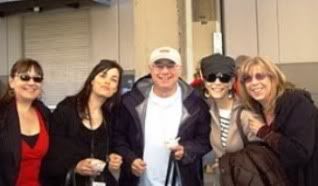
(Photo courtesy of Gail Davis Rahmy)
We were so stuffed after this that we couldn't even think of going out to dinner, so we trudged back across the bridge and sought out a place where we could sit and talk and have tea or coffee. Then we roamed around in Whole Foods, checking out new products, and i couldn't resist taking home two 1 1/2 lb. bags of organic powdered sugar-- only $2.99 a bag! It is so expensive where I live! (And I have several birthdays coming up in the family.)
It was a really fun day and such a pleasure to spend it with "kindred spirits"!
I'll report on my last day in Portland on Saturday!
PS: I found out when I got home that there is a Peruvian food cart in Portland and they serve vegan versions of their dishes!! See this article. Guess where I'm going on my next trip to Portland?
Cheers,
Subscribe to:
Posts (Atom)